
– at All Saints Church Dedworth
Published in Windlesora 15 (1997)
© WLHG
Following the death of Mary Sophie Tudor, her husband Henry and their children decided to build a memorial to her. They chose to build All Saints Church in a field near their home and the first stone was laid in October 1862. The family were patrons of the arts and called in the pre-Raphaelites to build and decorate the church. The pre-Raphaelites were artists belonging to a movement that was reviving the literal and visual arts in England at that time. The family selected G F Bodley as the architect. He built other notable gothic churches, but All Saints was the only example of his work to be found locally.
The church was opened in 1863 and over the next 25 years William Morris and his team produced the stained-glass windows that made All Saints an important stopping place for visitors to Windsor.
Morris was born at Walthamstow which was then a suburban village on the edge of Epping Forest. He was the son of prosperous middle class parents. When he was six the family moved to Woodford Hall, a large mansion with extensive grounds. His father died when Morris was thirteen but five years before that the two of them had visited Canterbury Cathedral. Later, Morris recalled his impression that “the gates of Heaven had opened”. The family moved on to Water House in Walthamstow which has since become the William Morris Gallery.
It is clear that the early memories of his childhood had a particular significance for Morris and were always precious to him. In almost every aspect of his work – poetry and stories, designs for wallpaper, fabrics, tiles and furniture, stained-glass, metalware and jewellery – evidence can be found of the sights which so delighted him as he grew up in the Essex countryside.
In 1861 the firm of Morris, Marshall, Faulkner & Co. was established. In addition to Morris himself, other distinguished artists and craftsmen such as Dante Gabriel Rossetti, Edward Burne-Jones and Ford Madox Brown placed their talents at the firm’s disposal. Morris led by example and had untiring energy. Over 600 of his original designs have survived, their chief characteristics being an absolute mastery of pattern and skilful use of bright colours. “The Firm” supplied the stained-glass windows for Bodley’s original building between 1863 and 1887.
By the mid 1960s it became clear that All Saints Church was suffering from cracks caused by the movement of the Thames Valley clay on which it was built. This caused the brickwork to deteriorate and soon the church had to be closed to avoid injury to the congregation. In June 1970 it was decided to demolish the old building and rebuild on the site. The windows were removed to the premises of the Worshipful Company of Glaziers (Clayton and Bell in Aylesbury) for safe keeping. The Worshipful Company generously restored the windows free of charge before they were placed in the new church.
Two of the windows, showing the Annunciation and designed especially for All Saints by Burne-Jones, could not be incorporated in the new building and the PCC sought to place these elsewhere. One scheme involved selling them to St James Church in Woodley, Reading for £100. However, the Victorian Society and others in Windsor stopped the move and for the next ten years these windows were stored at the Worshipful Company of Glaziers in Aylesbury in a state of disrepair. In 1982 they were restored and loaned to the Royal Holloway College at Egham, for the setting up of a centre for the study of Victorian art where they have been ever since, though they were shown in the Morris Centenary Exhibition at the Victoria and Albert Museum during 1996. All Saints PCC is discussing the future of these windows. Do we sell them and use the money to mend our leaking roof, or should we install them in the new Church?
Three stained-glass panels, which formed the east window of the old church in 1863 have been installed in the foyer of the new building. The centrepiece is Rossetti’s Crucifixion with Burne-Jones’ Nativity on the left and William Morris’ Resurrection on the right.
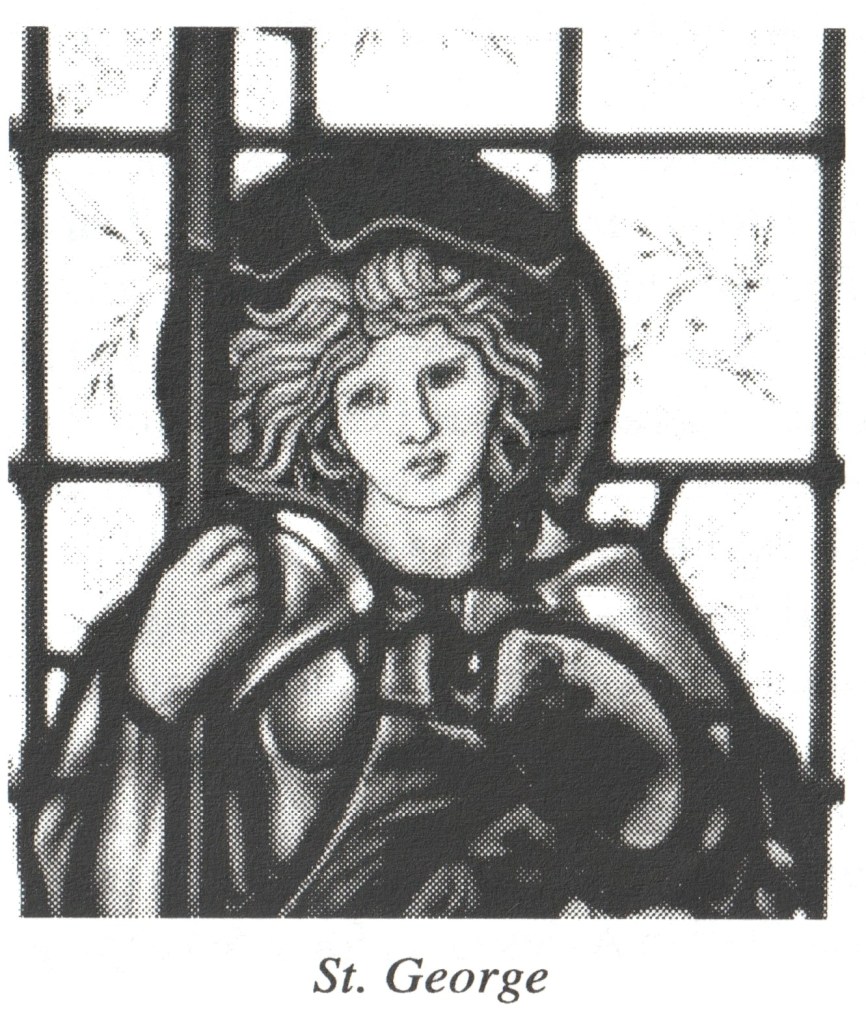
There are ten more windows mounted in a vertical light box behind the altar, – five visible from the inside and five only seen from the outside. On the inside the topmost one, St Elizabeth (1881), is almost impossible to see except from the altar. Below, in descending order, are St Gregory (1881), St Margaret (1887), St John (1887) and St George (1887), all by Burne-Jones and all having a background of clover and hawthorn. The window of St George is noteworthy for its spelling mistake – the ‘r’ is missing from George. It is not known who was responsible.
Outside, and virtually impossible to see except after dark when the windows are illuminated are, in descending order, Morris’ St Catherine (1873), Madox Brown’s St Anne (1873) and Burne-Jones’ Virgin and Child (1877), St Nicholas (1877) and St Ursula (1887).
What Morris would have made of the present building is open to conjecture; one suspects he would not have approved. Surely, though, his heart would have been gladdened to see windows from “the Firm” maintaining the link from his time to our own.
Peter Norris and Trevor Morgan
 Windsor Local History Group