
Published in Windlesora 16 (1998)
© WLHG
There were at least seventeen small independent operators with bus services in and around Windsor during the late 1920s and early 1930s, but only one has survived to the present day. That is the White Bus of Winkfield. Admittedly, a number of others had the misfortune of operating services in what became the London Transport area in 1933, and so were compulsorily acquired. However, that was not the case for all of them, and it is to the credit of the Jeatt family that the operation has survived so long.
The story starts in July 1921 when William Rule Jeatt, the grandfather of the present owner Douglas Jeatt, opened a garage business in North Street Winkfield. These were still early days of the motor car, let alone the motor bus, and his garage stationery proudly proclaimed the fact that his customers’ cars would be ‘overhauled and repaired by genuine engineers’ – obviously the competition was less scrupulous!
Meanwhile, a gentleman by the name of George Francis Ackroyd who lived at Briar Cottage, Ascot, owned a 20-seat Republic Model 10F bus (MO 5816) which had been first registered by him on 2nd July 1925. He kept the bus at the Common Garage, Sunningdale. On 10th January 1929, Ackroyd sold the bus to Frederick George Brown of Dartleigh, Ascot and also the right to operate it on a service between Windsor Castle, Winkfield, Ascot and Sunningdale under the name of the Republic Bus Service. The service had presumably been operated by Ackroyd himself during the previous three and a half years.
Brown took on Mr Jeatt’s son, Cecil Edouard Jeatt as a driver and the idea of bus operation obviously began to appeal to the Jeatt family. So much so, that in December 1930, W R Jeatt entered into an agreement to buy both the rights to operate the service from Mr Ackroyd, who was by now living in Cornwall, and to buy the bus from Mr Brown. The service was christened White Bus and the base of operations, unchanged to this day, was the North Street Garage.
The total consideration for the purchase seems light by today’s values, comprising £50 for the bus and £100 for the right to operate the service. At the end of June 1931, Mr Jeatt did not renew the licence for MO 5816 and was in correspondence with a London-based automobile engineer regarding the purchase of further second-hand vehicles. In July he was at least considering a 14-seat Chevrolet 1927 model; since its second and third gears would apparently need to be replaced, it was being offered at the very low price of £30. This really was remarkably cheap since new 14-seat vehicles were costing some £700 in the 1920s.
By October 1931, Mr Jeatt had bought a 20-seat Reo Pullman Junior (registration number FG 3768). The question of the seating capacity is amusing in that the seller of the vehicle claimed on his invoice that it was a 20-seater; the Traffic Commissioners who licensed the bus would only admit to a capacity of 16, so what happened in practice is a matter for conjecture.
The route of the original service started at Windsor Castle and came out of the town via the King Edward VII hospital and the edge of Clewer Green. It then went along what is now the B3022 via St Leonard’s Hill and past the base of operations in Winkfield. From there it continued through Cranbourne to Lovel Hill and Brookside, down Fernbrook Road before turning sharp left along the A329 to the Royal Ascot Hotel (which has since disappeared) and Ascot itself. Having stopped at both the Horse and Groom and Ascot Station, the route then went down through South Ascot before turning north again to terminate at the New Inn, Sunninghill. The whole route took 48 minutes to complete and alternate journeys terminated at Ascot station; one of the afternoon journeys each way operated via Cranbourne Church.
The problem from Mr. Jeatt’s point of view was that this route was in the middle of services of other operators. There were two of them, one large and one small, and both of them objected in their different ways. The major objector was the Thames Valley Traction Company which had extended its Maidenhead to Windsor service as far as Ascot on 1st July 1919. From then until May 1931 (just a few months after White Bus had acquired the Republic Bus service), Thames Valley was in competition with the Great Western Railway service which had started even earlier, in 1905, and which it acquired at that point. From the start, Thames Valley was clearly irritated by White Bus and by August 1931 it was writing to Mr Jeatt noting his assurance that should his children wish to dispose of ‘their omnibus services’ (the plural is interesting), Thames Valley would have first refusal. It is apparently still waiting, even though that company has gone through several transformations.
The Thames Valley service also came out of Windsor via the Prince Albert at Clewer Green, on past the Squirrel at Winkfield and the Fleur de Lys at Lovel Hill and on to Brookside; thus far it had blazed the same trail as White Bus followed and had already been doing so for some 12 years. After Brookside, its buses apparently took the direct route down what is now the A332 to Ascot Heath cross-roads and thence to the Horse and Groom.
The other objector was a Mr Bruce Argrave, who was also based at Winkfield and operated under the name of the Vimmy Bus Service. In 1931 he was apparently running a service which started at Windsor Hospital and followed the same route as White Bus, but again only as far as the Horse and Groom. In November 1931 Argrave appealed to the Traffic Commissioners to rescind what had apparently been laid down as a co-ordinated timetable between Thames Valley, White Bus, Borough Bus as far as Clewer Green and his own operation, and to restore his old timetable so as to avoid financial loss on his side. Whether or not he succeeded we do not know, but the grounds for his appeal were illuminating. He claimed that he had originated the route (which means that he had probably competed with Republic Bus), that he had excellent vehicles and that, on the basis of his original timetable, he would employ seven people. Furthermore, he claimed that White Bus only had one old vehicle and ran irregularly and that Thames Valley should not be allowed to compete at all. Vimmy went on in 1935 to acquire a second-hand 20-seat Star Flyer to operate the service but on 13th May 1936 both that bus and the service itself were bought up by Thames Valley.
White Bus was relicensed by the Traffic Commissioners during 1933 and the following two years. There were still only four journeys along the whole route, plus a late service on early closing day and at the weekends, plus two extra journeys as far as Ascot Station.
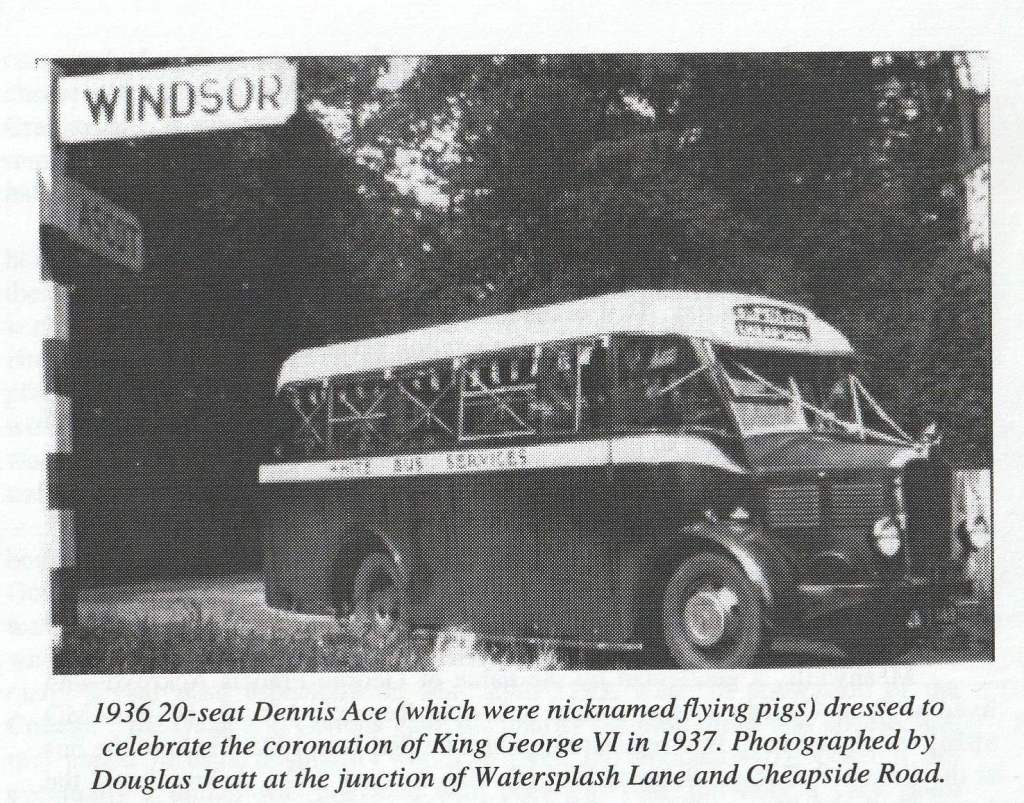
In 1934 Mr Jeatt acquired his first new bus, namely a 20-seat Dennis Ace. This was one of the great classic small buses of the 1930s and proved to be a very successful buy, so much so that a second Ace was added in July 1936.
These two ‘flying pigs’ gave such trouble-free service to the Jeatt enterprise that they and their operation featured in an article in the Dennis Distributor magazine in the spring of 1938. They certainly continued in service for some years and we know that the 1936 Ace (registration number JB 9468) was involved in an accident somewhere between Sunningdale and Bagshot just three days before Christmas 1941.
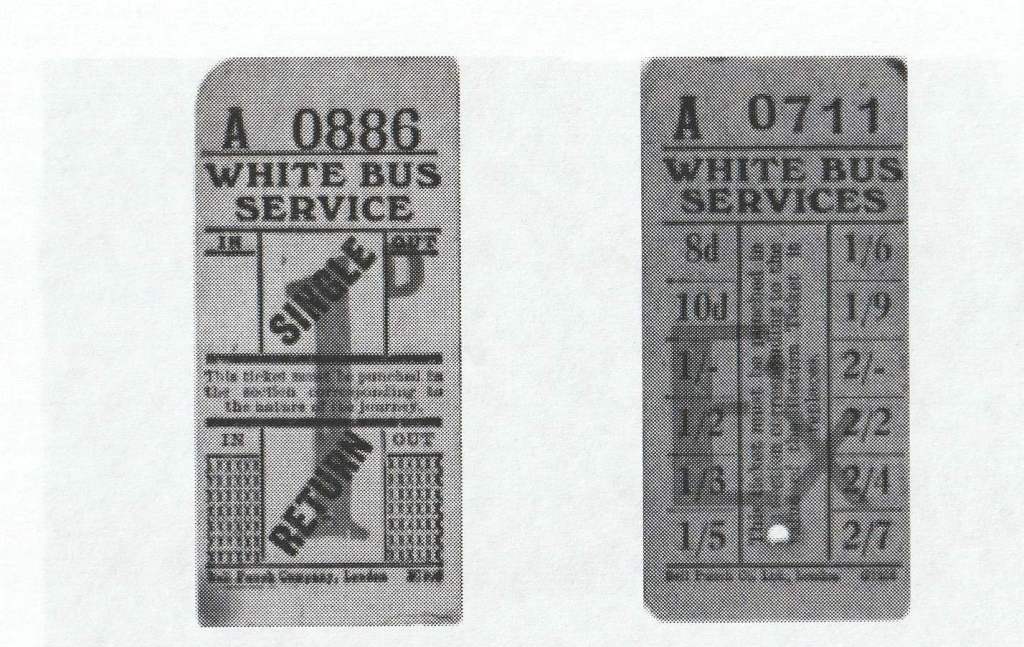
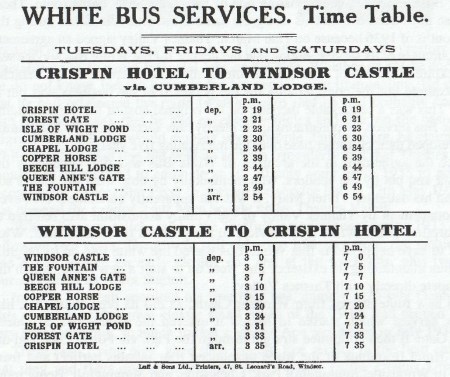
The year 1936 turned out to be a very significant one for the pattern of route operation in that two fundamental changes took place. The first was on 1st March when a second route was added, albeit only two journeys each way on Tuesdays, Fridays, and Saturdays. Like the first, this ran from Windsor Castle but it came out of town and into the Great Park through Queen Anne’s Gate, making a sweep round via the Copper Horse and the various lodges to terminate at the Crispin Hotel between Ascot and Windsor. We know from the application for this route that it was uncharted territory for a bus service, that it would be worked by the relatively new Dennis Ace and that White Bus at that stage owned three vehicles. The fare for a 35 minute ride was 6d single and 10d return. One interesting aspect of this service was that it used roads which were not open to the public, being reserved exclusively for the members of the Great Park Community; this is still the case today.
The second route change occurred on 1st July 1936 when the original service, which was in almost total competition with Thames Valley, was replaced by a new route from Windsor to Sunningdale continuing on from there to Bagshot.
The pressure exerted by Thames Valley on White Bus reached a crescendo in the early months of 1936. The Reading based company succeeded in buying out Vimmy Bus in May, thus eliminating one of the competitors on its route. There must also have been discussions along the same lines with White Bus during the early months of 1936 because on 12th March, Thames Valley signed an agreement for the purchase of its service, noting that the licence for the White Bus service was due to expire at the end of June. The document made no reference to any vehicles being acquired but the consideration for the goodwill of the business was put at £1,250. This was a remarkable increase on the original cost of the corresponding Republic Bus service, demonstrating quite clearly how successfully the Jeatt family had developed their customer base over the intervening five years.
Since the agreement in the archives of White Bus was only signed by the purchaser and not by the vendors, who incidentally by now were Mr Jeatt’s son Cecil and his daughter Vivien Mary, it was not apparently concluded. However, the announcement by Thames Valley of the Vimmy acquisition also referred to the absorption of the White Bus Service, so the position remains unclear. What appears to have happened is that White Bus waved the white flag on its original route, thus maintaining its existence and went on to start a new route, which did not compete directly with Thames Valley.
This new route started from Windsor Castle, as did its predecessor but like the new service which started in March it entered the Great Park at Queen Anne’s Gate. It then continued straight through the Park via Forest Gate and the Crispin Hotel (terminus of the route introduced four months earlier) and from then on to Woodside, Sunninghill Park, Cheapside, and Sunninghill. Being more direct than the original service, Sunninghill was reached in only 40 minutes compared with 48 on the original routing. From there on, the buses went south in the opposite direction from the original route but in this case right down to the Windmill on the A30 at Windlesham, before turning right along that road to terminate at Bagshot. The single fare when the Traffic Commissioners first approved the route was 1/7 and the journey time 54 minutes. This change of route, plus the occasional journeys to the Crispin Hotel service, resulted in a considerable increase in the number of passengers carried. In 1935, the last year of the original service, some 42,000 rode the White Bus paying an average of 4d or 5d (Some £800 in total) whereas by 1937, when both the new services were well established the number of passengers had risen to 70,000; again at the same average fare, some £1,400 was turned over by the business.
The July 1936 edition of the monthly London Transport timetable for the Windsor area carried both the White Bus routes, the main one comprising six through journeys a day (the early morning one did not operate on Sundays) plus a short working in the morning from Windsor Castle to the Crispin Hotel and back. There was also an additional journey at the end of the day on Friday, Saturday and Sunday evenings. The second route continued to operate only on Tuesdays, Fridays and Saturdays twice each way; certainly, Wednesday was early closing day in Windsor and to that extent, it made commercial sense not to choose that day.
Such was the stability of prices in those days that the fare given in the original 1936 route application, namely 1/7 single and 2/4 return, was in force at least into the early 1940s.
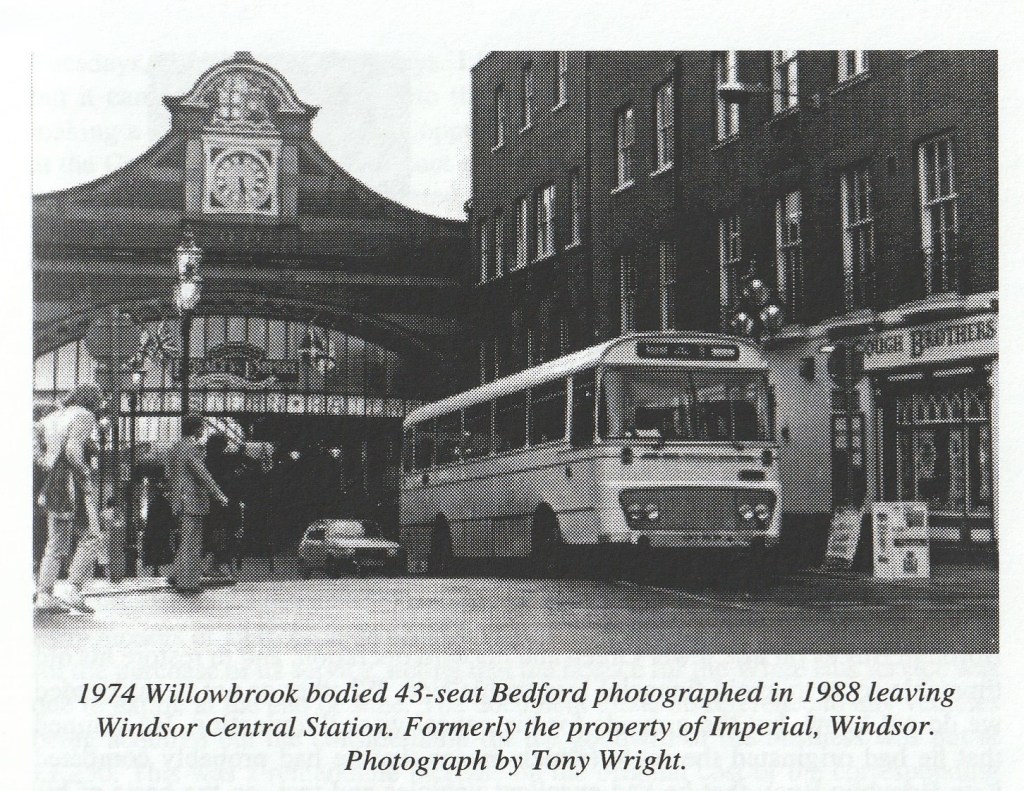
Also in the 1940s, the Windsor terminus moved from outside the castle to the covered forecourt of the GWR’s Windsor Central station. White Bus, along with all the other independent operators and London Transport in its early years, had terminated its route at the bottom of Castle Hill where the relatively wide expanse of road enabled all the buses to layover, without upsetting the virtually non-existent cars. London Transport had moved to its own bus station in Windsor in early 1933 and Thames Valley operated services from both the Windsor railway stations. By 1944, White Bus had also moved into the GWR station, a natural centrally located terminus, where it remained until April 1992 when it was ejected by the Royalty and Railways exhibition. The Windsor terminus is now opposite the Theatre Royal.
By December 1944 when the full effects of World War II would have been felt, the late weekend journey had disappeared. That said, however, the fact that both services came through the war virtually unscathed shows how vital the licensing authorities considered these routes to be. The wartime restrictions on fuel and even on new tyres led to many cutbacks in services over the country as a whole, so White Bus was clearly seen as an essential operator. The late evening journey was restored by the early 1950s and by the middle of 1958 there were six extra journeys along various parts of the route apart from the two-hourly, eight-a-day through workings. Even the infrequent Crispin Hotel service had sprouted a third journey coming out of Windsor, though still only two going in.
The late 1950s and early 1960s proved to be the high water mark for the White Bus because, by the middle of 1968 the Crispin Hotel service had been discontinued and the main route had been cut back to Sunninghill. The journeys too were less frequent; the last bus during the week left Windsor at 6.15 in the evening and there was now no service at all on Sundays. The pattern of operation had become more complex in order to replace the Crispin Hotel service so that certain journeys went different ways on certain days of the week.
In September 1982 the route was extended again, this time to the Heatherwood Hospital in Ascot. This represented a going back in some respects to the early days, since the Horse and Groom in Ascot re-appeared in the company’s timetable after an interval of 46 years. The only difference however, is that the service now approaches the centre of Ascot from the opposite direction to the one the original route took.
In conclusion I should just like to go back to the Jeatt family. W R Jeatt, the founder of White Bus seemed to have remained the power behind the throne until retiring some time in the mid thirties and died in the 1940s. The business was left to his son and daughter (Mrs Mauler), the latter being equally active, even working as a driver. She took over the private hire work in 1955 and ran it under the name of Winkfield Coaches. Both operations continued to share the same garage facilities but in due course Mrs Mauler retired and the whole operation is now run by Mr Douglas Jeatt the grandson of the founder.
Michael Mills
Michael Mills, who has been interested in buses since his schooldays in Tunbridge Wells, is now researching the early years of bus operation around Windsor and Slough.
This is a shortened version of an article which appeared in Classic Bus March 1997 and included more photographs and a partial list of the company’s buses.
 Windsor Local History Group