
Published in Windlesora 33 (2016)
© WLHG 2018
With a growing interest in genealogy, many people set out to explore their family tree armed with family memories and a few birth, marriage and death certificates.
The residential areas of central Windsor consist of many Victorian terraces, and when they were built, they were identified only by a terrace name – numbering came later. Some of the buildings were identified by plaques on the outer walls, but many more were not, so their names survive only in trade directories and censuses. Here was 6 Alexandra Terrace, Clewer, for instance, and does it still exist? This inquiry came from a lady trying to trace her grandmother’s birthplace, and the answer in this instance is that it was in Oxford Road, and yes, it does still exist.
The parish of Clewer included all of the streets to the west of Peascod Street, such as Bexley Street, Albert Street, Arthur Road, Vansittart Road and Oxford Road. Alexandra Terrace was one of the terraces in Oxford Road, to the west of Alma Road, which escaped the wholesale demolition in 1967 to make way for the building of Ward Royal.
Using a combination of trade directories, maps, censuses and visual clues from walking along the pavements, it’s possible to identify the Victorian terraces in streets such as Oxford Road, and match them to their modern house numbers, On the north corner, at number 96 was a shop, A Wallis, grocer and dairyman, and by the 1930s this had become Ernest Hogg, grocer and coal merchant. Some people still refer to this as Hogg’s Corner, and these days the building survives as a dental surgery.
Next to Hogg’s Corner is Oxford Terrace, consisting of twelve houses with the modern numbers 98 – 120. The rest of the north side consisted of:
| 122 to 132 | Ada Terrace 1-6 |
| 134 to 144 | Cranbourne Terrace 1-6 |
| 146 to 158 | York Terrace 1-7 |
| 160 to 166 | Carlton Villas 1-4 |
| 168 to 190 | Elizabeth Terrace 1-12 |
| 192 to 202 | Formerly St Stephen’s Mission House and School, demolished and rebuilt as houses in the late 1930s |
None of the above is identified by plaques. Typical occupations of the residents in the early 20th century were a coal merchant at 12 Oxford Terrace, a cooper at 1 Ada Terrace, a dyer at 4 York Terrace, a wheelwright at 4 Carlton Villas and a dressmaker at 4 Elizabeth Terrace.
Moving to the South side, on the left, going from Alma Road, are:
| 99 | Acacia Cottage |
| 101 | Rose Cottage |
| 103 to 125 | Borough Boundary Terrace 1-11 Note: has a name plaque |
| 125 | Maybank |
| 127 | Ash Villa |
| 129 to 139 | Alexandra Terrace, and hence Grandma’s Birthplace |
| 141 to 143 | Providence Place 1-2 |
| 145 | Augusta House |
On the corner of an alleyway leading to Augusta Place, where there was a greengrocer amongst the cottages.
Between there and The Perseverance Public House at 161 was York Place, of which three still exist at 147-151, however, 153 to 157 are modern houses. An alleyway after The Perseverance led to six Beaumont Cottages, which included a greengrocer, fruiterer, coal and coke merchant, and a butcher.
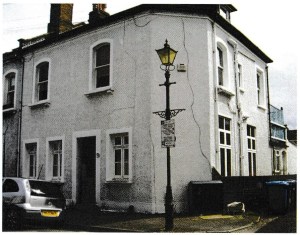
Next came Greenham Place, consisting of 4 cottages, 163-169, then Darville’s grocer, followed by a Post Office at 171-3 which was there for almost 100 years. Between there and The Elephant and Castle Public House at 183, was a row of four shops, including the 1839 bakery which many people remember as Duffey’s. Five houses known as Beasley’s Cottages have long since been demolished, and the site is now the rear entrance to Trinity St Stephen’s First School.
Finally, there was the Ragged School, now St Stephen’s Hall, and The Mitre pub.
The Elephant and Castle closed in the late 1950s, and The Perseverance a few years later, with both of the original buildings converted to homes. The Mitre was demolished and rebuilt as houses just a few years ago.

Sue Ashley
For further information about terraces in other Windsor roads, please contact the author
Addendum (not part of the original article)
The following is an extract of maps from 1957 which show the numbering in Oxford Road. This will add understanding.

Revised: 1956, Published: 1957 for Oxford Road, Windsor.
This image is not part of the original article and has not been, and will not be, used in any commercial way for any form of financial gain.
 Windsor Local History Group