
At Windsor and Waterloo
Published in Windlesora 31 (2015)
© WLHG
In 1804 Royal Regiment of Horse Guards, which included Trooper Thomas Evans among its number, was brought to the new barracks at Windsor by King George II.
As a soldier Tom was paid at a rate of 1s 9d per day and had a 1d a day for beer. Out of this he had to pay for all his clothing, equipment and laundry, and food consisting of beef and bread. His initial uniform was paid from his bounty Troopers of the Blues worked to ‘evening stables’ at 19.00 hours, had to be in quarters by 21.00 hours with all candles and fires to be extinguished by 22.00 hours.
On 10 November 1812 the Regiment sailed from Portsmouth for Portugal and Spain. Their journey was held up by storms and they landed at Tagus on Christmas Eve, 1812. They crossed the Douro on the 4th June 1813, and fought at Vitoria. During his time abroad Tom put on weight, perhaps due to the good food and wine. This was noticed by his girlfriend when he returned to Windsor in July 1814. Tom’s bulk was also noticed by his Commanding Officer, Lieutenant Colonel Sir Robert Chambre Hill, to the effect that when in April 1815 orders were received to ‘March for Foreign Service’, Sir Robert decided that Tom Evans would be left behind in England. Tom was indignant and told his Commanding Officer that if he would not have him as a regular soldier he would go as a volunteer. He was eventually accepted as a regular and joined the troops going abroad. Tom Evans was Sir Robert Hill’s trumpeter.
On Sunday, 18th June, 1815 the regiment arose from a muddy Flanders field after a night of rain and electric storms. At that time the name Waterloo was still no more than a crudely painted name on a Flemish signpost. Towards noon, this was all to change as the familiar sounds of camp life were overtaken by the roar of a French army in attack. By 2 o’clock, the sound of battle was closer to the ridge, a vast ocean of sounds of batteries and small arms, hooves, drums, trumpets and bugles and thousands of human voices screams of hatred, fear and agony.
To this accompaniment, the Household Heavy Brigade trotted forward to the crest of the ridge, and there, the 1st and 2nd Life Guards saw the foe, a broad, straight line of shiny Cuirassiers of the Guard, galloping up the ridge over the mangled remains of British and Hanoverian batteries and infantry.
The Heavy Brigade charged. There followed an almighty clash which halted the French and rolled them back. Their line broken, the Cuirassiers fell into disorder and into headlong flight right and left of the Brussels-Charleroi road, with 1st and 2nd Life Guards in pursuit.
Sir Robert Chambre Hill, who had brought forward the steady line of Blues, saw the victorious Heavy Brigade’s flanks opening out at the gallop and brought the Blues into the breach. Somewhere at this stage, Sir Robert, well out in front, found himself surrounded by a remnant of five Cuirassiers and was wounded in the sword arm by a pistol ball. Tom Evans killed three of the Cuirassiers and broke is sword blade as he killed the fourth. The fifth Cuirassier was knocked out by his sword’s hand guard. He then managed to rescue his commanding Officer and led him safely back to the ridge, leaving a fleeing French army and 50,000 corpses lying on the Plain of Waterloo. His bravery was later acknowledged at Windsor.
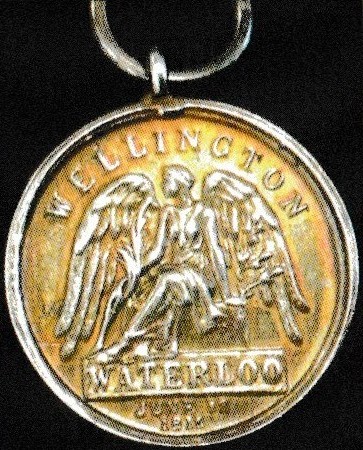
Tom Evans and Jane Broughton, his sweet heart were married in October 1817 and on 4th July, 1820, Tom ended his service with the Blues, and went as Drill Instructor to the Carmarthenshire and Pembrokeshire Cavalry. He continued there for nine years, with this Yeomanry Regiment before later returning to Berkshire.
Elias Kupfermann
Sources:
Medal: Household Cavalry Museum.
Sleek Headed Men By SQMC Frearson.
Royal Horse Guards (The Blues), White-Spunner, MacMillan 2006.
Royal Household Brigade Magazine, Winter 1965/6.
 Windsor Local History Group