
How the Railways came to Town
Published in Windlesora 32 (2016)
© WLHG 2016
In 1829, the young Isambard Kingdom Brunel found himself in want of employment. The Thames Tunnel had been abandoned and he needed a challenge. Hearing of a competition in Bristol to design a bridge across the Clifton gorge he set to work to prepare some typically ambitious plans. Although initially rejected, a modified version was eventually accepted but the bridge was not completed in his lifetime. He did though become well known in the city and when in 1833 it was decided that Bristol needed a railway to compete with Liverpool, Brunel was chosen as chief engineer of the Bristol to London Railroad.
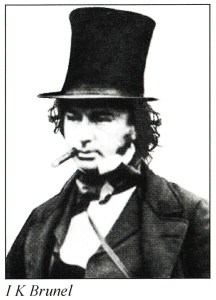
Always one to plan on a grand scale, he soon named it the Great Western Railway, decided on a broad gauge of 7’ 0¼”, and set about surveying the route. He met with much opposition from local landowners and this intensified at the London end of the proposed line where land values were higher and the residents more vocal. He intended to follow the Vale of the White Horse and proceed up the Thames Valley to a terminus at Paddington — then in open fields.
In East Berkshire it was suggested that route might bring the trains through Windsor. Local trades people were strongly in favour of this, but both Eton College and the Crown were implacably opposed. When it was suggested that the line might pass through Maidenhead it was met with horror by those whose livelihood depended on the coach traffic and bridge tolls. The final plans were deposited in November 1833 with the route through Slough and Maidenhead being chosen with the possibility of a branch line to Windsor. The Windsor Express commented:
If the union of Bristol and London be an object of such national importance, how can that object be more directly and effectually promoted than by a railroad through Windsor
When the Great Western Railway bill was thrown out by the House of Lords in August 1834 it was hoped that changes might be made and Windsor would get its railway after all. The revised bill of 1835 however, passed with the only difference being the omission of a branch altogether. Ihe townsfolk complained bitterly but the opposition by Eton was decisive. At a meeting at Salt Hill in 1833, the Provost, Dr Goodall, had made it clear that ‘the College would endeavour to prevent it to the utmost of their abilities and the extent of their purse’. At a subsequent meeting in Windsor Guildhall, Dr Keate, the soon-to-retire headmaster, announced opposition to the railway that
It will be impossible to keep the boys from this railway in their hours of liberty… I cannot help thinking that it will very materially endanger the discipline of the school and may endanger the passengers.
There was some suggestion that the boys would find sport in breaking the windows of the train carriages, maybe attempting to do so on both sides with a single stone. When challenged by Windsor’s town clerk John Secker, himself an old Etonian, Keate replied ‘that they would do so not wilfully or intentionally but in playfulness’ Any thought that the new head, Dr Edward Hawtrey, would be any more sympathetic to the line was soon dispelled as he remained opposed as did Rev Thomas Carter, the bursar, and many masters.
With little interest from the GWR, the Town decided that it would sponsor its own railway to London from Windsor, via the north side of the Home Park and on through Colnbrook. A prospectus was duly issued and shares were offered for sale. In a report prepared by Henry Habberley Price, who was surveying possible routes for the GWR, it was suggested that the London to Windsor Railway form the basis of the main GW line, pointing out that two parallel lines would neither be economic or sanctioned by Parliament.
Early in 1834 as the GW bill progressed through parliament, there was continued objection by Eton College who wanted no railway within 3 miles of the school. In September a public meeting was held in the Merchants’ Hall Bristol to consider the revised route. Representatives from Windsor attended the meeting, hoping for a railway in a tunnel under the castle and passing well south of Eton. Charles Saunders, the GWR Secretary, did not help their case by commenting
‘what good to have a railway through Windsor and pass such an important town as Maidenhead’.

Maybe Saunders was aware of the trouble the Windsor line would cause. Whatever the reason, it did little to placate Windsorians who still argued for their preferred route. Fate however, was against them. The Municipal Reform Bill was going through parliament and this suspended all local council business between December 1834 and September 1835. By the time the council reconvened, the Great Western Bill was on the statute book. Maidenhead Council had been bought off by compensation for loss of bridge tolls, and while Eton still pressed for the line to avoid the Thames Valley by passing through Basing and Farnborough, the route was by now settled. Windsor Council had even sold land at Langley for the station to be built. Eton however had secured a clause to ensure there would be no station at Slough.
By April 1838, as the opening loomed, great pressure was put on the College to allow a station at Slough but in spite of memorials signed by the Mayor of Windsor and other leading citizens including those in the then small town of Slough, the Provost and College claimed it was their paramount duty to support the interests of the college and claimed the protection granted by the clauses in the Act. The Company sought to circumvent this stricture. There may be no station at Slough but that was not to say the trains could not stop there and it was made clear that they would do so. Tickets would be sold at the Crown Inn and arrangements would be made for passengers to board and alight without platforms. Eton sought an injunction to prevent this but it was dismissed. An appeal followed but the Lord Chancellor ruled that the Company was entitled to do anything not expressly forbidden by the act. Oddly, even as the appeal was pending, with the line open from Slough to Paddington, there was a request by the College for the Company to provide a special train to take the boys up to London for the Coronation on June 28th 1838.
The GWR was not happy about the absence of a station nor indeed were Windsorians. The Company wrote to the College as early as 9th July stating:
that were a station permitted at Slough, they would pay for two persons selected by the Provost or headmaster for the purpose of preventing any Eton boys passing to the railway without the sanction of the masters.’
Little progress was made during the remainder of the year however, Eton being of the opinion that the GWR had reneged on the original agreement and the College remained wholly opposed to the railway. With trains running, the Great Western soon received royal patronage when Prince AIbert made a journey on 14th November 1839, travelling from Slough to Paddington. He soon became a regular traveller. The company had already built a sumptuous royal saloon, but there was still no station from which it could travel. Maybe due to royal influence, in 1840 the College attitude began to soften and Slough and Windsor Station finally opened.
When in 1842 Queen Victoria took to the rails and seemingly approved, the Railway gained its seal of approval. There was even suggestions that maybe a branch line to Windsor might after all be permitted, subject to adequate safeguards. The College archives contain a draft agreement between the College and the ‘Windsor and Slough Railway Company’ stating many of these safeguards: fencing along the length of the line, regular policing and NO STATION AT ETON. Nothing came of this venture, and when the GWR finally opened throughout from London to Bristol in 1841, there was no likelihood of a line to Windsor.
The campaign continued with James Bedborough, mayor at the time, speaking to a House of Commons select committee in 1846, said, ‘I think there is no town in the kingdom that is so badly off for the want of a railway….as Windsor’. A traffic survey taken at the Slough Road gate in 1845 showed that a total of 648,611 individuals passed along the route with over half of these being on foot and 140,000 in omnibuses. In addition there was an extra 35,000 during Ascot week. With 17 trains each way daily, there was a constant stream of passengers. This volume of traffic caused much congestion and confusion in Eton High Street and, as it all funnelled over Windsor Bridge where tolls were levied, long traffic jams resulted. This state of affairs led to the obvious argument that a branch line would do much to relieve the situation. Dr Hawtrey’s reply was ‘I should compare it to cutting off my leg instead of my little finger’

Further railway projects were launched in 1844 and 45 against this background with the suggestion that the line might be operated on the atmospheric principal to overcome the objections to noisy, smelly locomotives leaving a trail of smoke in their wake. The atmospheric system relied on a vacuum to pull the train along. Early experiments by Clegg and Samuda held in London showed some success, as did a commercial line built in Dublin. Brunel was very taken with the idea, Prince Albert showed interest, and Charles Vignoles was appointed engineer to the Windsor, Slough and Staines Atmospheric Railway in 1845.

Other engineers, notably Robert Stephenson, were very sceptical but it appealed to the politicians of the day with Sir Robert Peel and Gladstone both lending their support.

The now familiar objections were raised once more. The railway could not encroach on Crown land; there was even an argument about who owned the river bed should a bridge be built. The College was opposed as ever and invoked the 1835 clause prohibiting any railway within 3 miles of Eton. The proposed line was intended pass to the east of the town to a station near Windsor Bridge, well inside the ‘territorial limit’
The link would be difficult too. The GWR was broad gauge whereas the London and South Western at Staines was standard. It was thought that the earthworks would increase the risk if flooding (emphasised by the severe floods of 1846) and could affect the atmospheric pipes — ‘would this not give an asthmatic touch to the pipes?’ The pumping stations would despoil the landscape and would be visible from the castle, the fisheries could be disturbed and, worst of all, the privacy of Prince Albert’s favourite bathing place compromised.
These points were argued over, disputed and denied. Vignoles was firmly committed to the atmospheric system suggesting it could continue right through to Nine Elms but eventually the scheme was defeated due to the Crown, Eton College and the GWR, who wanted nothing to do with the 4’ 8½” lines of the SWR. In any case the atmospheric system was being rapidly discredited on the South Devon line where, after just over a year’s operation, it was abandoned completely. A crushing blow for Brunel.
At a meeting of shareholders held on 16 July 1846, the Atmospheric Railway was dissolved and the people of Windsor were no further forward in gaining their railway. The company decided however, to amalgamate with the Great Western for a proposed branch that would terminate ‘somewhere near George Street’. It seemed that the Provost and Fellows of Eton were prepared to approve this as long as the line was some distance from the town’ although the Head and masters maintained their opposition to the end.
From then on any hope of a line to the town was to rest with one or other of the two major railway companies which by the mid 1840s dominated traflic to the west and south west of London. Once again controversy reigned as two factions, one led by Henry Darvill and the other by James Bedborough, (both colleagues on the Liberal council) argued the relative merits of the GW and LSW proposals. Both had their shortcomings as the GW would necessarily pass close to Eton’s grounds whilst the SW would approach by way of the Home Park – on Crown land.
A public meeting, chaired by Bedborough, was held at 9.00 am on 7th December 1846 with the rival merits being discussed by the local populace. Several MPs were present as was Charles Saunders representing the GW and Joseph Locke, the Chief Engineer of the LSWR. To the annoyance of many locals the hall was packed with GW employees ‘trained in’ from London and Reading and throughout the day, matters became increasingly unruly, culminating in pandemonium when a vote was taken by a show of hands ‘of those resident in Windsor Eton and Clewer’. Not surprisingly the vote favoured the GW but when Captain Bulkeley and Rev McRea proposed the adoption of a Petition supporting the vote, the Eton contingent took to their feet to oppose it. This was seconded by the Windsor solicitor and a second vote proposed. However Bedborough had had enough by this time. He declined to sign the petition, proposed a poll and declared the meeting closed. The crowd dispersed to the local public houses where numerous ‘treats’ had been laid on by the GWR to strengethen their case.
The poll took place on the following five days, supposedly only by those residents who attended the Monday meeting with decisive results. 14 for the Great Western 238 against, seemingly leaving the way open for the SW line. There was then something of a lull while both companies promoted bills. At a council meeting on Ist March 1847 speeches were made by the Tory leader, Robert Blunt, favouring the SW line and by Henry Darvill who favoured the GW branch. Many of the previous arguments were again used, but now the central location of the GW station was emphasised as it would Sweep away George Street, one of the most disreputable in Windsor. The drawback of the SW route, only — reaching as far as Black Potts at Datchet, was outweighed by the more convenient London terminus and onwards travel to Kent, Sussex and other South Coast resorts.

A parliamentary battle was then to ensue. The Crown and Provost and Fellows of Eton College, though not the masters, were prepared to sanction a suitably routed GW line from Slough and there was no problem with a SW line which ended at Black Potts (even if it did break Eton’s three mile rule) Wrangling continued often about trivial details. The SW wanted to call it Black Potts Station, the College insisted on Black Potts Terminus A change of name later apparently did not occur to them. Finally, in the hope of resolving the matter, the House of Commons set up a committee to examine both GW and SW bills. They quickly found in favour of the SW (there were many old Etonians in the house) and by the end of June the Windsor, Staines and South Western Railway Bill received Royal Assent. The Great Western however, looked upon this defeat as a mere temporary set back and it was quick to exploit a providential plan by Crown and Council to improve the environs of the castle.

There had already been a public outcry about the enormous sums spent on the reconstruction of the castle over the previous decades and now it was now felt necessary to improve the surroundings. Thames Street, High Street, and Castle Hill were lined with squalid run down houses including the notorious George Street directly opposite the Curfew Tower. Furthermore, the public highways to Datchet and Staines ran through the park which was felt to encroach on the privacy of the Royal family when in Windsor. The Crown was reluctant to approach parliament for additional funds for such work but saw a great opportunity in the shape of the railway companies. If they wanted to come to Windsor they could pay for the privilege, which indeed they did.
The Crown had secured the sum of £85,000 to help fund The ’ Windsor Castle and Town Approaches’ act passed in 1848. This paid for slum clearance, the demolition of George Street, the deviation of the two roads through the park and two new bridges to replace the old Datchet Bridge. Squabbles continued but the Crown had been won over and by August 1848 the GW bill became law having received the support of Lord Morpeth, Commissioner of Works and Forests for the Crown, by which time SWR had reached Black Potts. Less than a year later the SW Windsor Extension Bill was passed and Windsor was at last set fair to receive its railway — and not just one but two lines with two different stations and of course two different gauges.
The race was now on with both companies considering it a matter of pride to reach Windsor first. The SW was ahead of the game, having already reached Datchet, but the river had to be bridged and a route into town found. It had commenced work on this even before Royal assent was given with an opening date set for August 15th 1849.
Meanwhile the GW wasted no time. Within days of the GW bill being passed in September, construction of the line began and continued for much of the time both day and night. Under such pressure of work there were numerous accidents with one unfortunate, Joseph Moyser, a riveter working on the Thames bridge by moonlight, falling into the water and drowning. The bridge was noteworthy as being a novel design by Brunel. Originally he had proposed a central pier in the middle of the stream, but Eton had objected as it would impede rowing on the river. Brunel produced the single span bowstring bridge instead, which is still in use to day and is the oldest wrought iron structure in commercial service in the world. It was also to form something of a prototype for the Royal Albert Bridge carrying the main line over the Tamar at Saltash. Much of the rest of the line was built on a wooden viaduct (another Brunel speciality) to ensure there was no impediment to flood waters on the Brocas. The present brick structure dates from the 1880s.
By August 1849, the SW line was virtually complete with the opening on target, Locke’s bridge was also of a novel design but used cast iron – a material soon found to be treacherous for railway bridges. On 14th August, the day before the Government Inspector was to visit the line, one of the columns resting on the river bed moved and a supporting girder cracked. The Directors recorded that they ‘cannot too strongly express their regret’ and one suspects Locke had some explaining to do.
By September, the GW bridge was complete and on the 20th, only a day after Joseph Moyser lost his life, the first engine travelled over the line arriving in the new station at 8.00 am, with Brunel on the footplate and Daniel Gooch at the controls. In its edition of the following week the Express recorded that ‘the new station, erected as if by magic, in the room of squalid tenements, and opening a smiling scene of wooded uplands in perspective, bids fair to be an ornamental to the town.’ This was not of course the present station but one to Brunel’s design.

Following a successful inspection, the line was opened to the public on 8th October 1849. The first train left Windsor at 8.05 on its six minute journey to Slough. The first down train was the 7.05 from Paddington arriving at 8.30. At Slough the lines were arranged so that Royal and Express trains could run straight to Windsor without being detained at Windsor and Eton Riverside Station Slough Junction, the so-called Queen’s Fork. The West curve allowed departing trains onto the mainline towards Maidenhead and Reading.
The GWR had won the race but the SW worked fast to repair their bridge, the line opening to traffic with little fanfare on Ist December 1849. The first Waterloo bound train departed at 08.10 hours from what the Express reported as ‘a makeshift station with very poor access to Datchet Lane – a wretchedly narrow street’.
However, the railways had arrived and Windsor was now on the national network. The years of argument, controversy and wrangling were at an end and like it or not steam trains clanked into the town from both north and east. Eton College had ensured the GW line swept in a wide loop around their land, that there were no intermediate stations whilst the Crown had dictated there was to be no engine shed at the Windsor end. The SW line slid through the Home Park, hidden by a screen of trees, and ended very close to the walls of the Castle. By 1851 it boasted Sir William Tite’s elegant station, still in use today albeit somewhat contracted.

The Crown was quick to spend its railway windfall and by 1850 new roads had been built to Datchet and Old Windsor with the routes through the park being closed. Old Datchet bridge was demolished and two new ones, the Victoria and Albert bridges were opened between Datchet and Old Windsor. Other works were also undertaken to enhance the appearance of the town and its surroundings. When Victoria bridge was found to be in need of repair in 1963, it came as something of a shock to British Rail to find out they were responsible for its upkeep thanks to the negotiations of 1848.

What changes the railways wrought in the town would be the subject of another article, but I hope I have given an insight into why so small a town as Windsor should boast two stations. The battles of 170 years ago have left their legacy.
 Windsor Local History Group