
Published in Windlesora 15 (1997)
© WLHG
The publication Properties of the National Trust includes:
The Goswells, Windsor
“Land lying between Thames Street and the River, purchased for about £3000 in order to secure the beauty of the view of Windsor Castle from the river. The purchase money was raised by public subscription, King Edward VII giving £500 and King George (then Prince of Wales) £250.”
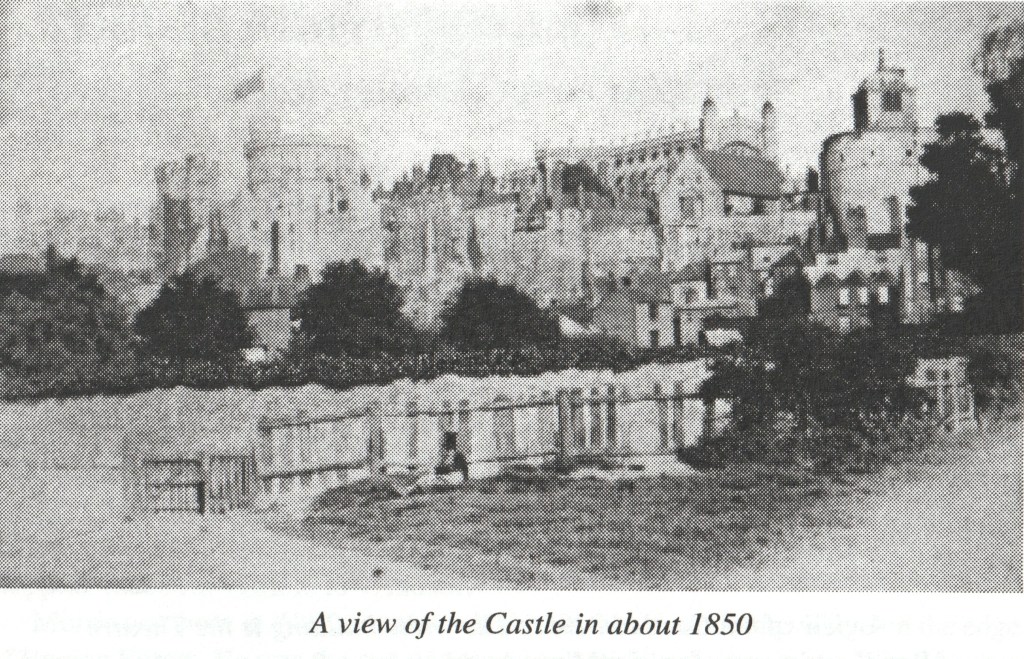
The area was about three acres, and old photographs and paintings show that there was indeed a fine view of the castle from the river and the Goswells at that time. This is no longer the case. So what is the explanation?
Research at the National Trust offices in London and at Hughenden Manor and also reports in the Windsor Express of 1910 have provided the answer. Mistakes were made by the Royal Borough Council when the relevant committee approved the plans for the present Theatre Royal after the old, smaller building had burned down in 1908.
Until the middle of the 19th century there had been little change in Windsor’s medieval streets. These contained buildings which were generally of only two stories, and the view of the castle across the gardens of the shop premises in Thames Street was famous, and very popular with painters and early photographers. The area known as the Goswells, once a common field, had been offered for sale for development, and the construction of one row of terrace houses (Bridgewater Terrace) had already been commenced parallel with the Central Station of the Great Western Railway terminus.
Early in 1909 the attention of the National Trust for Places of Historical Interest or Natural Beauty was called to the importance of “keeping open and free from buildings the area lying immediately to the east of Alexandra Gardens between the river and Thames Street, and almost beneath the Curfew Tower of the Castle”. Princess Louise, Duchess of Argyle, third child of King Edward VII was President of the National Trust, which had been formed in 1895. She persuaded her father and brother to head a subscription list to buy the land. There was powerful support from other members of the Royal family and the nobility, the Mayor of the Royal Borough, Eton College and local residents. Their cause was aided by national publicity. A pamphlet states that the Trust intended to “Safeguard the view from the River Thames, Brocas Clump and the Great Western Railway bridge”. Councillor Luff kept examples of the publicity papers and these have survived in the Luff Library at the Royal Free School. The National Trust report for 1909-10 announced the purchase and acclaimed the view preserved.
The old theatre, which burned down in 1908, was owned by the Shipley brothers. One of them, Sir William Shipley, was the wealthy owner of Burges Brewery which then stood at the Junction of Victoria Street and Alexandra Road. He was not only wealthy but generous and public spirited. He wanted the replacement theatre to be as good as a London one, and employed eminent architects from outside Windsor, a decision that irked some local worthies. The old theatre had been built in 1815, and had a comparatively low proscenium arch over the stage. The new theatre was to have a bigger stage, with a higher proscenium arch. This and other improvements were approved by the Public Works Committee who noted the “magnificent plans” – 9 or 10 of them in all. This was the committee that dealt with building plans in those days as there was no Building Inspector or Town Planning Officer. The committee was notified by the Lord Chamberlain that the theatre must have a safety curtain, and this was approved without discussion and without realising that a safety curtain had to have a tall fly tower. It was not until this two storey tower was being built in brick above the new theatre that the mistake became obvious. Letters to the Editor appeared in the Windsor Express and a letter of protest was sent to the Council by the Secretary of the National Trust, as follows:
29th November 1910
“To the Town Clerk, Windsor
Dear Sir, – I am directed by the National Trust to address to the Town Council of Windsor an expression of the great regret which the National Trust feels at the disfigurement of the district which has been caused by the erection of the new Theatre.
The building completely blocks the view of the Castle as seen from the High-street of Eton; it forms an ugly intervening feature in the view of the Castle from the river; and it entirely spoils the beauty of the view from the Terrace near the Horse Shoe Cloisters. It is hardly too much to say that its construction is a disastrous tragedy.
Your Council have given such conspicuous help to the National Trust in its recent successful effort to secure the Goswell Meadow from unsightly and disfiguring buildings that my Committee had looked with confidence to them to respond to the support and aid given by many members of the public to the preservation of the beauty of Windsor by carefully safeguarding those interests from attack in other directions.
It is a source of great disappointment to my Committee, as it will be to the general public to find that within a few months of the purchase of the Meadow by the Trust, the erection of such a building has been allowed. The Committee conclude that your Council did not fully realise what the effect of the theatre would be when they passed the plans but they venture most respectfully to urge that no plans should be passed in future by your Council without careful consideration being given to the effect of the proposed new building upon its surroundings.
So far as their powers extend your Council occupy an honourable position as guardians of the amenities of Windsor; to that extent they have in their safe keeping the setting of one of the chief of our national jewels; and the friendly co-operation which they have given to the National Trust convinces us that they appreciate the position, and will not resent the representations which my Committee now respectfully make, and will endeavour to prevent the repetition of so unfortunate a calamity.
I am, yours faithfully,
Nigel Bond, Secretary.”
Alderman Mitchell proposed that no action be taken. He thought the members of the National Trust rather dictated to the Council what their duties were. The Mayor said it seemed that they were all wise after the fact. He thought that the theatre themselves would admit that it was rather an eyesore, and no-one was more angry than the owners, but they had to remember that it was the Lord Chamberlain’s department which required the safety curtain to be in a particular position.

The matter became past praying for, and was swept under the carpet. It was to be a quarter of a century before the National Trust was to allow the Council to take over the management of the Goswells Open Space, in an agreement dated October 1934. They control the bowling green tenancy to this day.
The National Trust made only the briefest reference to the Goswells in later publications, and the Council, when relating the good works of Sir William Shipley, never mentioned the lost view.
Gordon Cullingham
 Windsor Local History Group