
Published in Windlesora 28 (2012)
©2012, WLHG

On Saturday 1 August 1812 father and son, Charles Knight Senior and Charles Knight Junior, published the first newspaper in Windsor. It carried the grand title of:
Windsor and Eton Express and General Advertiser of the counties of Berks, Bucks, Middlesex, Surry, Harts, Oxon, Hants, and Wilts.
A somewhat ambitious undertaking you might say, given the limitations on the transport of the day and the fact that the flatbed, hand printing presses could only deal with some 200-250 news sheets per hour. Nevertheless, the Knights managed to print an average of 500 papers each week. The paper was taken out by Pony and Trap to subscribers who paid 6d for four pages of newsprint. The paper had to be stamped before it could be used for printing. The first page of every newspaper carried a red stamp to show that duty had been paid. There was an additional duty for every advertisement published.
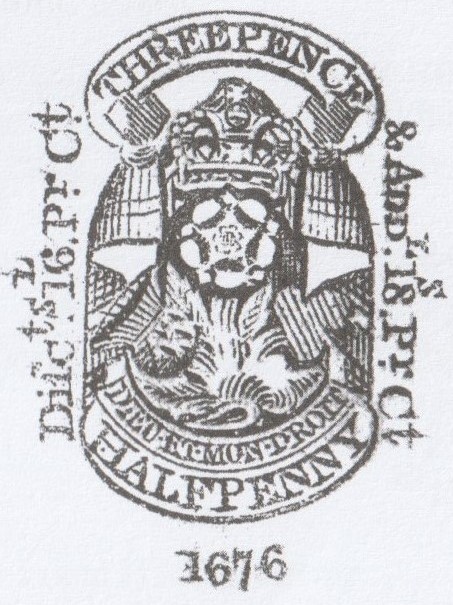
The front page of the paper carried advertisements from houses and house contents (but no prices), to fire insurance, lost pets, to stallions who will cover for one guinea and a crown every Saturday at the Turk’s Head PH Eton. [WEE 11—18 April 1813]. Charles Knight himself advertised his books, theatre tickets and the medication he sold from his office. The second page had political news, reports from the Houses of Parliament and foreign news. On the third page, you would find reviews of books, theatre etc, news from around the country, crime reporting and reports from the Old Bailey. The back page carried local news, commodity prices and notices of birth, marriages and deaths, often from all over the country, and also stories left over from other pages, There was always a column of news about the royal family, and reports of the movement of regiments in and out of the town. Many of the articles and features were copied from other newspapers around the country and abroad. News items followed each other in a random fashion, mostly without headlines. The print was very small to get the maximum of news onto the minimum of pages, as each printed page carried a stamp duty of 1d.
The paper was published in the heart of Windsor, right opposite the Castle in Castle Street. The house now carries a plaque to Charles Knight junior, but not his father, whose bookshop and print room this was. Right from the start there were at least two editions, for Windsor and for Slough.
In 1818 the size of the pages was enlarged to carry more news. This meant that a new, improved press would have been installed in Windsor.
Charles Knight Senior retired in 1819 and his son took Richard Dredge 48 partner into the business.
Three years after the death of his father in 1824, Charles Knight Junior sold the paper to William Reynell. He then moved to London to take on the work he is most famous for, that of publishing popular literature such as the Plain Englishman, Library of Entertaining Knowledge, Penny Magazine and Penny Cyclopedia.
William Reynell changed the title of the paper to: Windsor and Eton Express and Reading Journal. It was then printed at 42 Thames Street.
William Reynell sold the paper to his partner Richard Oxley in 1833, and he took John Burgiss Brown into the business. The paper was printed at 10 Church Street. It now carried the title: Windsor and Eton Express, Bucks Chronicle and Reading Journal. But Weekly Advertiser for Berkshire, Buckinghamshire Hertfordshire, Middlesex, Oxfordshire and Surrey, was soon added, however; small details of the title changed constantly. The price remained at 7d, until 1840 when it went down to 5d because of a reduction in the stamp duty.
In 1854 a new cylinder printing machine called the Napier Press was installed by Richard Oxley, which probably coincided with his move to 4 High Street, where the Oxley family continued to publish and print the paper for the next 140 years. In 1861 stamp duty was finally abolished. This enabled a much speedier and cheaper method of printing and the introduction of a continuous roll of paper.
By 1870 the price of the paper was reduced to 2d, with a further reduction to 1d ten years later. It was now owned and published by another father and son, Richard and Frederick William Oxley. By 1890 they increased the paper to 8 pages and it now had clearer headlines. The first photographs appeared in the paper in June 1897 on the occasion of the Diamond Jubilee of Queen Victoria with pictures of jubilee arches and two photographs of the Queen. Previously the only illustrations were the coat of arms, in the centre of the heading of the Windsor Express and some small woodcut illustrations with a number of the advertisements.

The new century also saw a new name: Windsor and Eton and Slough Express, Berks, Bucks, Surrey and Middlesex Journal, Ascot and District Advertiser. The Oxley family was still in charge, with Stanley Frederick Oxley. 1920 saw a price rise to 2d.
On 8 September 1939 the paper experienced a radical change. For the first time advertising disappeared from the front page, and was replaced with news of the Second World War. The price also went up to 3d, and the paper was printed on Bachelor’s Acre, with offices at 4 High Street Windsor and 12 High Street Slough.
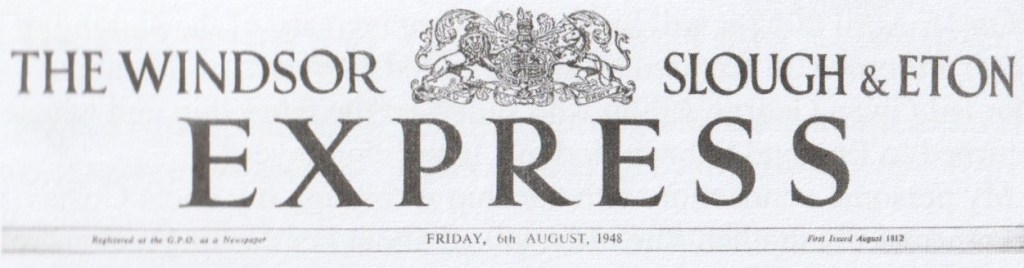
In 1950 the price was still 3d, and the paper published its sales figures of 15,708. In 1952 they had risen to 26,708.
The next price rise to 4d did not come till 1960. There were now two separate papers, the Windsor and Eton Express, and the Slough Express with is own office at 57 High Street Slough. Another novelty: the paper carried coloured pictures for the first time.
The 1980s saw the end of the family newspaper. The Oxley family sold the Windsor & Eton Express series to the Windsor News Group who still printed it in Madeira Walk, Bachelor’s Acre, Windsor. There were 52 pages lor the price of 28 new pence in a new tabloid format. A very young Francis Hult reported on the latest film with: ‘At the movies’.
In 1987 the paper changed owners once again and moved out of Windsor. It was published by Trinity Newspaper at 256 and 487 Ipswich Road on the Slough Trading Estate. The price went down to 25p, although it was larger than ever with 96 pages. Much of this was advertising.
In April 2008 the Maidenhead Advertiser bought the paper and today it is part of Baylis Media Ltd which employs 85 people. It is printed in Maidenhead and delivered free to many households in the area and also sold for 60p. The circulation for both Windsor and Slough editions stands at 44,000. Francis Batt is still on board with a feature called Watch Out – Batt’s About, besides other reports.
Maidenhead Advertiser is unique among regional papers in that it is owned by a charitable trust established by former editor and proprietor Louis Baylis in the 1960s to safeguard the paper’s independence and tradition of public service.
Brigitte Mitchell
Sources
Windsor and Eton Express archives
The Early Newspaper Press in Berkshire, K F Burton, Reading 1954.
 Windsor Local History Group