
Published in Windlesora 33 (2016)
© WLHG 2018
In the summer of 2016, I visited the town of Windsor, Ontario in Canada. Having previously made contact with their museum, I received an invitation not only for a guided tour of Windsor’s two museums, but also to meet the Mayor, Mr Drew Dilkens in his office as he was keen to show me his door!

The door turned out to carry the coat of arms of the Royal Borough of Windsor, and in his storeroom, he had found another coat of arms in colour which had been presented to the town in recognition of the help given to the Royal Borough of Windsor during the disastrous floods of 1947.

This was not the first time Windsor, Ontario had stretched out a helping hand across the Atlantic, to Windsor Berkshire; in 1940 they had sent 500 Canadian Dollars to help Windsor’s efforts to raise money for their Hurricane Fund.

In 1951 during a refurbishment of the Guildhall after the war years, when the building had been used for work connected with the war, a window was installed in the Ascot Room celebrating the close association between the two Windsors, and paid for by the people of Windsor, Ontario. Their mayor was expected to come over for the unveiling, but was unable to do so, thus Princess Elizabeth reopened the renovated Guildhall and unveiled the window with the help of Dr Armstrong, Agent-General for Ontario.
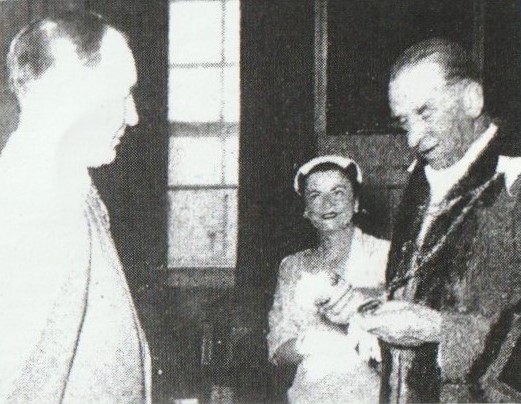
A year later, Mayor Arthur John Reaume and his wife, were finally able to get over the big pond. They met Windsor’s Mayor Cyril Dyson under the window in the Guildhall. Mayor Reaume timed his visit well, because he was invited to attend Queen Elizabeth’s coronation on 2 June.
Curator Madelyn DellaValle then took me to visit the first of Windsor’s museums, the Francois Baby House, a charming building which once connected to the Detroit river, but is now dwarfed by skyscrapers. It was the home of Mr Baby, a French Canadian and local politician, and houses as its main exhibition the history of the Anglo-American War, and the battle of Windsor 1812, along with exhibits of the family that lived there, and the early days of settlers in the area. The building is a National Historic Site of Canada.

The next surprise was the Chimezuk Museum, a few minutes walk away by the river. Named after Joseph Chimezuk, who left his estate to the city of Windsor in 1990, it is a large modern museum with four galleries: a permanent exhibition of the history and development of Windsor and the story of the First Nation, two galleries for changing exhibitions, and a very exciting Children’s Gallery and learning space.
One item caught my attention, an interactive map viewer. The city’s three historic maps could be called up individually and viewed in detail. This is what we need in our small museum in Windsor, Berkshire to display our many wonderful historic maps, going back to 1607, in one small place. It is something we are working towards at the moment.
Dr Brigitte Mitchell
Notes
Photographs are copyright of Dr B Mitchell.
 Windsor Local History Group