
Published in Windlesora 30 (2014)
© WLHG
For anyone with an interest in aeronautical history, a trip to Brooklands Museum is a must. Not only do its exhibits represent the history of flight from the very beginning to the end of purely British aircraft design and manufacture, but it also houses a wealth of other detail about flying and its development in the UK. Furthermore, there is a chance to see the remains of the old banked racing circuit which gave way to aeroplane manufacture prior to the Second World War. If buses are your bag, it is also home to a wonderful collection of ex-London Transport vehicles from the London Bus Museum.
For Windsorians, there is the special appeal due to the involvement of one of their own. Sydney Camm spent much of his working life with Hawkers and was instrumental in the production of some of the finest planes which ever flew under the RAF banner. At one time in the 1930s, over 80% of their aircraft were of Camm design. On loan to the museum by the Royal Borough of Windsor and Maidenhead is the original engine bought by Camm and his friends in the Windsor Model Aircraft Club in 1913 to power their first full-size plane. Sadly the Great War intervened and the plane never flew.
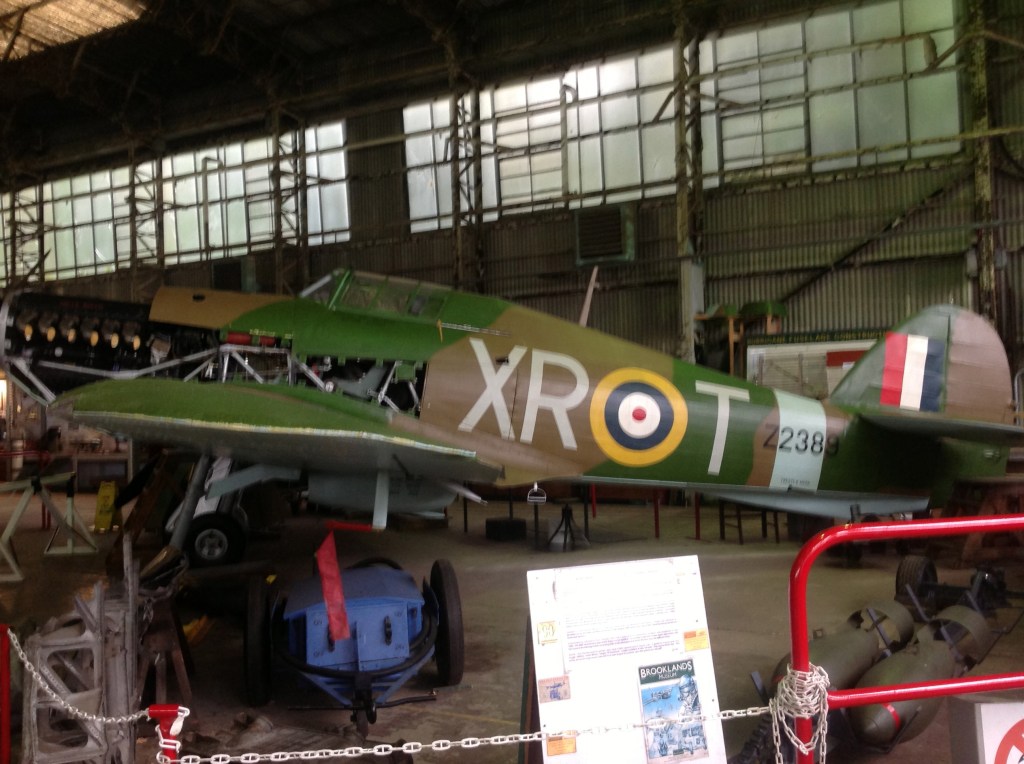
A much more recent exhibit represents what was probably Sydney Camm’s ‘magnum opus’: a Hawker Hurricane. These planes were crucial to the RAF successes in the Battle of Britain and served in all theatres of the war until replaced by newer marques such as the Typhoon, Tempest and of course Reginald Mitchell’s iconic Supermarine Spitfire.
Of the 14,000 Hurricanes built, very few survive and when it was heard that the well-preserved wreck of one had been found in Russia in 1992, there was considerable interest here. The remains had been transferred to St Petersburg, where partial restoration had been undertaken but after some negotiation, it was agreed that the plane should be repatriated to Britain for the task to be completed. This began in 1999, and work has continued on it ever since. I had the opportunity to see the plane when I accompanied Brigitte Mitchell and Geoff Goodey on a visit last October. We were met by John Pulford, a volunteer steward, who gave us a good look around and explained the aircraft’s short but interesting history — built in 1940 and shot down in 1942. It made one realise just how transitory an existence many of these planes had.
Z2389 was one of the fifth batch of 1000 Hurricanes produced at Hawker’s Kingston factory between August 1940 and July 1941 and would have been assembled at either Brooklands or Langley. During 1941, it served with four RAF squadrons and subsequently with the American Volunteer 71 ‘Eagle’ Squadron based at Martlesham Heath.
By 1942 Hurricanes were being superseded in the Western arena of war, and Z2389 was crated up and sent as aid to the Russians, traveling on the SS ‘S85’ to Murmansk in May of that year. Here it was quickly reassembled and entered service with 767 Regiment of the Red Air Force based in the Kola peninsular.

On 20th June, when being flown by one F/Lt Ivan Kalashnikov, it engaged with two Messerschmitt BF109Fs and five BF110s over remote country near Murmansk and was downed along with two more Hurricanes. Kalashnikov apparently survived the crash, but the plane did not and lay where it fell for fifty years until found by Russian historians who removed it from the site in 1996 for restoration. In 1997, it was first seen by WW2 recovery specialist, Jim Pearce and later inspected by a Brooklands Museum team. With the help of an HLF grant, the plane was purchased and brought to Brooklands in 1997, where it is now nearing the end of the renovation process. At present fitted with a non-standard engine, it is intended that the correct version of the Rolls Royce Merlin will eventually be installed.
Z2389 is unlikely to ever fly again, but it is hoped that it will be able to taxi around the runway at Brooklands for all to see.
Our visit ended with a look at one of the early Harriers, another successful design which owed much to Camm. Far longer-lasting than the Hurricane, it was in RAF squadron service for 41 years. The author was able to sit in the cockpit and gain a sense of what it was like to fly such a craft, though without several thousand horsepower roaring away behind! A very interesting visit.
Malcolm Lock
Acknowledgements
Photographs courtesy of Brigitte Mitchell
Further Information
See also the Brookland’s Museum website [accessed 03/06/2025].
 Windsor Local History Group