
Official Borough Celebrations
Published in Windlesora 19 (2002)
© WLHG
When, having been secretary of the 1977 Silver Jubilee Celebrations Council of the Royal Borough, the author was invited to contribute a reminiscent article for this magazine, the conundrum arose as to where to start. Inspiration, as so often, came from Alice: ‘Where shall I begin, please Your Majesty?’ enquired the White Rabbit. ‘Begin at the beginning,’ the King said gravely, ‘and go on till you come to the end and then stop.’
The beginning in one sense, of course, occurred on 6th February 1952 when the Princess Elizabeth acceded to the throne on the premature death of King George VI. This event signalled that in the normal order of things the Queen would celebrate her Silver Jubilee in 1977, and so it came about.
Above all, the celebrations were designed to avoid expense from the public purse and to provide fun for everyone in the Royal Borough.
From first to last the driving force was that of Kit Aston, (subsequently Sir Christopher Aston) first Mayor of the Royal Borough of Windsor and Maidenhead, Under his leadership was formed a small executive committee consisting of himself, as chairman, the author as secretary, Major Michael Parker (now Sir Michael Parker) organiser of the Royal Tournaments, Bill Jacques as treasurer and David Coulson as publicity manager.
For many months this committee met regularly on Sunday mornings at Kit Aston’s home in Wraysbury together with the chairmen of twelve sub-committees, each charged with some aspect of the Jubilee plans. From these gatherings flowered the vast collective enterprise which became the 1977 Jubilee celebrations.
Rolls Royce Rally – 7th and 8th May
Of all the Silver Jubilee events, the first, and undoubtedly the most grandiose, was the Historic Vehicle Silver Jubilee Tribute. Conceived at a meeting in November 1975 between Kit Aston, who was a director of Rolls-Royce Motors, George Birrell, then Chairman of the Rolls Royce Enthusiasts’ Club and John Schroder, Birrell’s successor in Jubilee year, the seeds of the idea germinated in spectacular fashion up to the memorable moment on 7th May when some 600 Rolls-Royces processed through Windsor to the Grand Quadrangle to be reviewed by The Queen. Some of these cars were of fabulous provenance: the first of three to be inspected by Her Majesty was a 1924 Cabriolet with a body by Barker. This was the most original car in the parade, and was owned by Mr Edward Harris, the president of the club. The second car, which led the parade, was a 1901 2-cylinder Decauville, similar to the one that inspired Henry Royce to build his own cars. The third car described in detail to the Queen was a 1905 open 4-seater Tourist Trophy style car similar to the one in which the Hon. CS Rolls won the 1906 TT Race on the Isle of Man. The car was known as the Light Twenty, and only one other model exists.
Many of the Rolls-Royces travelled from overseas, including cars from Australia, South Africa, the USA, South Americas, France, Germany, Holland, Belgium, Sweden and Eire. They represented every single model made by the company since 1904. Cars with a remarkable history included that of Field Marshal Montgomery, which landed on Juno Beach after D-Day and was used by him in Normandy, the original Silver Ghost AX 201, a 40-50 hp model built by Rolls-Royce in 1907 and a 1920 Pettern Armoured Car, which between 1921 and 1943 served in Northern Ireland, Shanghai and Egypt. Several had featured in popular films such as The Forsyte Saga, Upstairs Downstairs, The Dam Busters and Goodbye Mr Chips.
During the parade a World War II Spitfire circled the Grand Quadrangle and then swooped low over the Long Walk in a dramatic fly past.
From the Castle the cars drove down the Long Walk via the Ascot Gate to Ascot Racecourse where they were joined the following day by 100 more historic vehicles from the Transport Trust, the Veteran Car Club, Historic Commercial Vehicle Club and a score of other groups representing steam traction engines, buses, motorcycles, and bicycles.
It was estimated that over the two days 40,000 enthusiasts, including the Duke of Gloucester, viewed this incredible vehicular pageantry, underlining the enormous success of a fantastically ambitious venture.
It may here be added that although at the time it was suggested the event could never be repeated, a committee comprising members of the Rolls-Royce Enthusiasts’ Club, the two Windsor Rotary Clubs and the Crown Estates Office, has since the beginning of 2001, been working on a similar project for the Queen’s Golden Jubilee. As King Leopold I of the Belgians used to say: ‘The great thing is success’ and as is well known, nothing succeeds like it!‘
The Sealed Knot May – July
If, as was more than likely few Windsor folk had heard of the Sealed Knot before 1977, this would certainly not have been the case afterwards. In theory, the Sealed Knot comprises both Cavaliers and Roundheads, but it is arguable that in those memorable summer weeks of 1977 it was Cavalier spirit which impinged upon the citizenry of Windsor.
The Sealed Knot Society is the most well known of a number of groups throughout Great Britain which recreate historic events — in this instance the battles of the Civil War. The Society was formed in 1968 to promote a greater awareness of the struggle between King and Parliament. By 1977 the membership exceeded 3,000. The sealed knot is the emblem in the Garter collar worn by Charles I on his way to the scaffold and was subsequently adapted by a Royalist secret society as its name and badge. Every aspect of the Society’s presentations from the names of regiments to words of command is painstakingly accurate. The Captain General of the Sealed Knot at the time of the Silver Jubilee was Brigadier Peter Young, DSO, MS, MA, FCA, a distinguished soldier, military historian, author and broadcaster and one of the six founder members of the Society.
At Windsor, some 2,000 Cavaliers and Roundheads camped in 17th century style in the Home Park, their campfires at night highlighting plumes, sword hilts, bright uniforms, banners, pikes and muskets and trumpets and drums.
On 6th May was re-enacted in the Home Park a pageant of the trial and execution of Charles I and the restoration of the monarchy 11 years later. The author, having earlier been made an honorary commandant of the Society, was invited together with the Mayor to join Brigadier Young in taking the salute at the March Past. Acceptance did not envisage the Captain General being mounted and the hooves of his somewhat frisky horse showering the Mayor and the newly promoted Commandant with generous amounts of mud generated by the recent heavy rain!
During the three weeks of the encampment at Windsor the Battle of Caversham Bridge and Prince Rupert’s unsuccessful assault on the Puritan-held Castle were on 4th and 5th June re-enacted with great credibility, noise, panache and vigour.
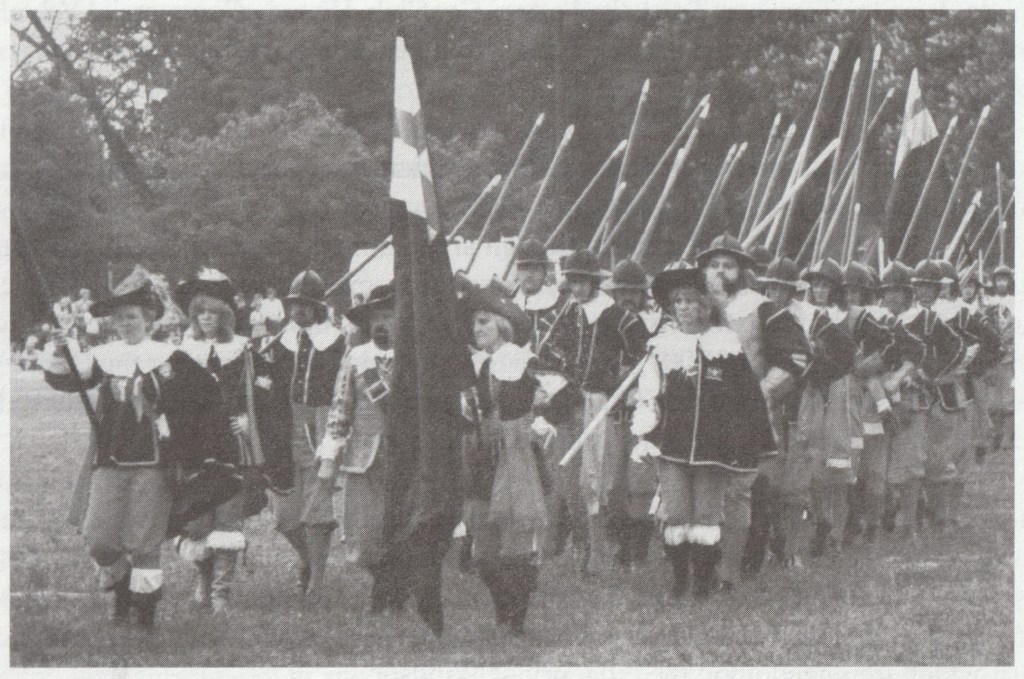
The Society, moreover, took full part in the bonfire festivities, the Septcentenary Procession and the Night of Atrocities on Bachelors’ Acre.
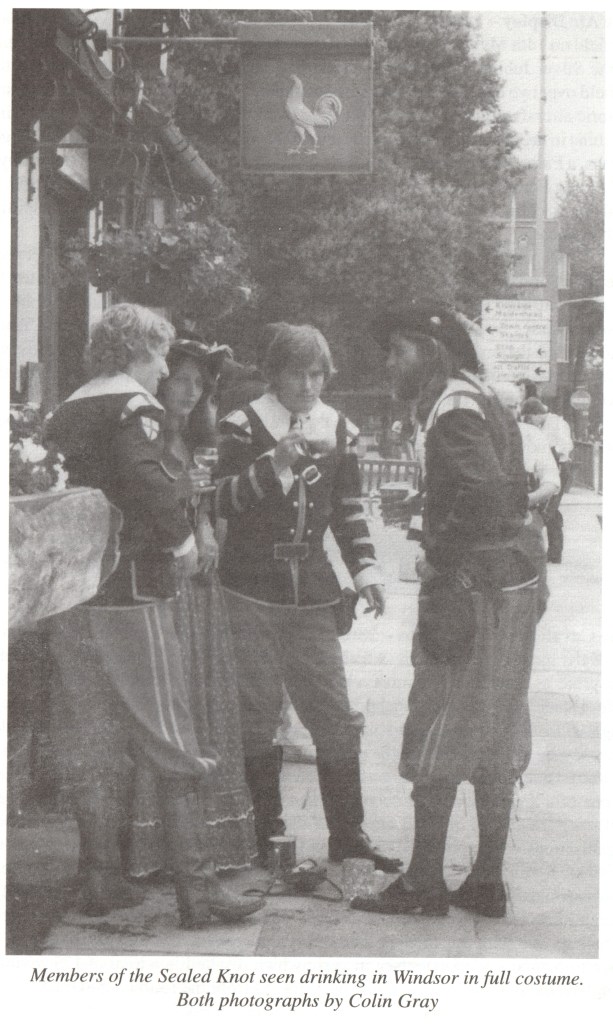
It is probable that in the taverns of the town many soldiers of the Sealed Knot made the greatest impression. In full costume they swaggered through Windsor’s streets for three weeks renewing with gusto the drinking, wenching and the general rumbustuous behaviour redolent of their 17th century predecessors. Not every member of the public was enamoured at this licentious soldiery in their midst but overall the atmosphere thus created was convivial, not to say joyous. After all, as Harrison Ainsworth wrote in his novel Ovingdean Grange: ‘It being a principle with the Cavaliers to banish care and to make the most of the passing moment, they all appeared in good spirits!’
The Air Display – 14th May
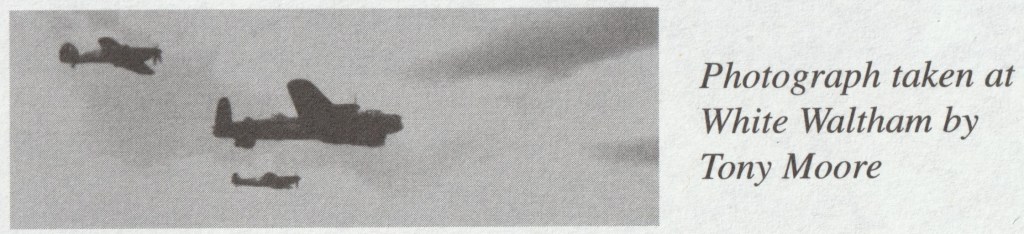
A maroon fired by Prince Charles at White Waltham Airfield on 14th May as a Vickers DC10 flew by in a Royal Salute heralded the start of the Silver Jubilee White Waltham Air Pageant. 60,000 spectators thronged the airfield over two days to watch a display of aviation from 1912 to 1977. Participating historic aircraft included an all wood 1912 Blackburn monoplane, the oldest flying machine in the country, from the Shuttleworth Collection. A Gloster Gladiator, Tiger Moths, a Fairey Fly, a Fairey Swordfish, a Rapide twin bi-plane were followed by a US Flying Fortress and a Yak 11, the only Russian fighter in the Western World. A further attraction was the Battle of Britain Flight, consisting of a Hurricane, a Spitfire and a Lancaster Bomber.
During the afternoon there was a mock First World War Dog-fight between a replica Sopwith Camel and a Fokker Dreidecker Triplane ostensibly piloted by the notorious Red Baron. One of the many highlights was a breathtaking display of solo aerobatics by 23-year-old David Perrin of the Rothmans’ Aerobatic Team, who thrilled the crowd with a series of stomach-churning twists, rolls, stalls and near suicidal vertical dives. The Pageant concluded with the appearances by the RAF with a Hawker Harris Jump Jet, a Meteor and a Vampire.
This was the first air display at White Waltham since the Air Transport Authority moved out in 1945.
The Cavalcade of Monarchs – 28th May onwards
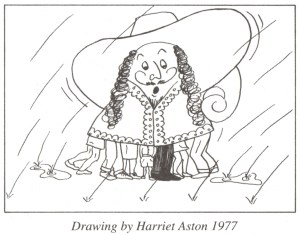
Perhaps the most imaginative of all the many ideas brought to fruition in 1977 was the Cavalcade of Monarchs. The project — a mammoth in more sense than one — was the brainchild of Kit Aston’s wife, Eileen. Huge papier maché heads of no less than 40 Kings and Queens of England from King Arthur to King George V were created with the most detailed accuracy by Pat Laws, formerly props manager at the Theatre Royal. Each head measured over four feet in circumference and was designed to rest on the shoulders of one of a regiment of volunteers, the remainder of whose limbs and torsos were brilliantly costumed in royal apparel of the appropriate period. Among the local organisations which provided dresses and actors were twenty Berkshire Women’s Institutes, nine drama groups, twelve schools, Windsor and Maidenhead Townswomen’s Guilds, four operatic societies and the Windsor Theatre Guild. The Cavalcade was first staged in Windsor on 28th May and subsequently on several occasions at towns and villages in the Royal Borough. The author was prevailed upon to compose a commentary in verse which resulted in a total of 125 rhyming couplets, the flavour of which may be retrieved from the following extract:
Edward the Third next occupied the throne
As Edward of Windsor he was widely known
Born in the Castle, something of a tartar
First King to grant great honour with a garter
(The Countess of Salisbury’s) — all men saw it slide
‘Honi Soit Qui Mal y Pense’, resourceful Edward cried
William Shakespeare told the tale in customary words —
‘When first this Order was ordained my Lords
Knights of the Garter were of noble birth’
We trust today they are of similar worth.
The Royal Windsor Big Top Show – 28th May
At the Mayor’s Annual Dinner in 1976, attended by the Duke of Edinburgh, and at which David Smart of the circus family was a guest, the notion of a top class circus performance for the Silver Jubilee was first floated. Bill Cotton, the Head of Light Entertainment at the BBC, became involved and from these discussions emerged the Royal Windsor Big Top Show.
One considerable problem was to find a sufficiently large venue. Smarts at that time were planning a new Big Top and they agreed to bring these plans forward with the result that the event took place in the Jubilee Big Top — then the largest tent in Europe.
The glittering performance, attended by The Queen and the Duke of Edinburgh, on 28th May, featured amongst many others and beside some stupendous circus acts, Ronnie Barker, Ronnie Corbett, Mike Yarwood, Bruce Forsythe, Eric Sykes, Les Dawson, Olivia Newton-John, Mollie Sugden and David Frost. The show, with an audience of 4,000, was the biggest circus to be staged in the Home Park since Messrs Barnum and Bailey brought their circus to Windsor with Buffalo Bill and his Wild West Show to perform before Queen Victoria.
The Jubilee Beacon – 6th June
Far on the deep the Spaniard saw, along each southern shire Cape beyond cape in endless range, those twinkling points of fire.
Lord Macaulay: The Armada
Windsor’s place as the national pivot of Jubilee day was assured thatevening, with the lighting of the Queen’s Silver Jubilee bonfire by Her Majesty on Snow Hill, within a torch beam from the Copper Horse. At 9.00pm two processions started up the Long Walk, one consisting of several thousand school children carrying lighted torches, the other of rank upon rank of members of the Sealed Knot. The Queen and the Duke of Edinburgh, standing in an open Range Rover, drove through the young torch bearers to the foot of Snow Hill, thence to the bonfire more that 35 feet high and 35 feet in diameter, which the Queen, with a little technical assistance, lit at 10.00pm. This episode, however, was not just Windsor’s show: for months past, as in the days of the Armada, 102 similar beacons had been constructed in eight continuous chains extending to the Shetland Isles in the North, St Kilda in the West, Dover in the East and Jersey inthe South. As the flames on Snow Hill rose into the night sky, so across the British Isles these eight chains were er successively fired by their vigilant attendants.
Immediately thereafter the Queen lit a torch which was carried by a runner to Heathrow where two miners’ lamps were ignited and carried by a Qantas jumbo to Sydney and from which 3,000 bonfires were lit throughout Australia.
It is estimated that between 100,000 and 300,000 people witnessed the Snow Hill spectacle which had been planned two years previously at a meeting between Kit Aston, David Coulson and Sir Martin Charteris, the then Private Secretary to the Queen, at which it was said the latter quoted from Lord Macaulay’s poem The Armada. Prominent in the implementation of this national project were the Royal Institution of Chartered Surveyors and Roland Wiseman, then Deputy Ranger of Windsor Great Park.
Among this huge assembly in the Great Park were 11 other members of the Royal Family, including Queen Elizabeth, the Queen Mother, Prince Charles, Princess Anne, Captain Mark Phillips, Prince Andrew, Prince Edward and Princess Margaret and her children. But there was one notable absentee who, since the days of Richard II, claims Windsor Park and Forest as his domain. Possibly Herne the Hunter, ‘sometime keeper of Windsor Forest’ felt his ghostly blue flame to be outclassed by the Jubilee conflagration or perhaps the spectre with its ‘rusty chain hanging from its left arm and an antlered helm upon its head’ was in truth lurking nearby on Spring Hill, or in Hawks Wood to witness with ghoulish fascination the flammabilities of the 20th century.
The evening concluded with an ox roast and a gigantic firework display.
The Grand Silver Jubilee Ball – 11th June
The Grand Silver Jubilee Ball, one of several balls throughout the Borough, was held in the Smart’s Big Top. Organised by a committee, headed by the late Stanley Brown, then General Manager of Caleys, the entertainment included the Pipes and Drums of the Gurkha Rifles, and many guests responded to the exhortation to appear in historic costume.
The Boat Rally 11th – 12th June
On 11th and 12th June the Silver Jubilee River Pageant and Carnival took place. A convoy of some ninety craft assembled at Boulters Lock, Maidenhead, under the control of the Pageant Marshall, Peter Bowles, of the Thames Valley Water Authority.
The vessels included some twenty-five steam boats, working boats, punts, canoes, river cruisers, sailing boats, Royal Naval craft, decorated floats some with bands, and most impressively some of the boats of the Association of Dunkirk Little Ships, whose qualification was to have participated in Operation Dynamo at the Dunkirk evacuation in 1940. As they headed downstream the salute was taken by Admiral Graham on the High Stewards’ Barge, then moored just above Maidenhead Bridge. From Bray the aquatic precession returned to their Boulters Lock moorings from whence the following day they progressed down river to the Brocas at Windsor. The thousands of people who lined the riverbanks were privileged to enjoy a commentary on these boats, historic or otherwise, by John Snagge and Brian Johnston.
The Trees
The Queen’s Trees constituted another imaginative initiative in Silver Jubilee Year. At that time the ravages of Dutch Elm Disease had caused a disastrous loss of trees in the Great Park and throughout the Royal Borough. Work had already begun in Queen Anne’s Ride where the Duke of Edinburgh had planted the first replacement on 5th November 1976. This ambitious project envisaged a planting of one thousand yards of oak trees in Queen Anne’s Ride followed by the planting of interesting and unusual trees along the twenty five miles of the River Thames, within the Royal Borough.
The Borough Council set an example by presenting to the Queen a number of trees at the beginning of Jubilee Year and a public appeal was launched entitled The Queen’s Trees which was registered as a charity. Subscribers were invited to give £10 for a ‘tree for the Queen‘ receiving in return a tree print of a specially commissioned painting by Mr Graham Rust. Over one thousand contributors responded to the invitation, their names being recorded in The Royal Tree Record, which was ultimately presented to the Queen by Mr George Waldram,
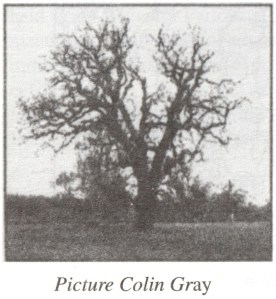
Royal Lodge – 23rd November 1980.
No less than 41 of the presentation oak trees were a Jubilee gift from the Plowden family, whose ancestor, Edmund Plowden, was Treasurer of the Middle Temple in the reign of Elizabeth I, and who gave to the Inn the Benchers’ Table made from a single great oak floated down the Thames from Windsor to London. Mr Anthony Plowden said ‘I thought it would be a good idea to commemorate the Silver Jubilee of Elizabeth II by replacing this oak as part of The Queen’s Trees Project.’
The Commemorative Items
There was one ‘sub-committee’, which consisted of one member only, who became his own chairman, secretary and treasurer. Councillor Richard Shaw, a former Mayor, of both the old and the new Royal Borough, masterminded the very successful production of a variety of souvenirs, independently of the national output. Amongst these was a limited edition of 50 engraved crystal decanters commemorating the grant of Windsor’s first charter by Edward I on 28th May 1277, together with the Jubilee Silver Medallion, embossed with the Jubilee emblem and the arms of the Royal Borough, and white appropriately decorated porcelain tiles. All these items were of high quality and sold with great rapidity.
Et Alios
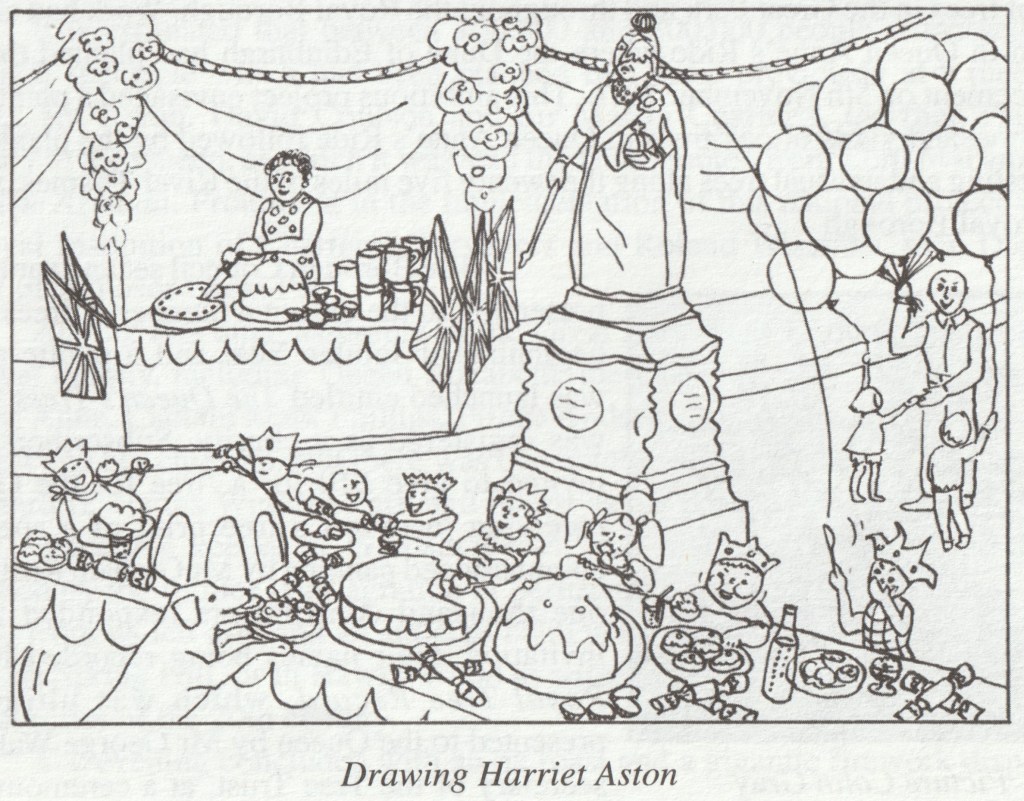
Throughout the Royal Borough in that faraway summer of 1977 there were many, many more events and attractions in celebration of the Silver Jubilee. In towns and villages there were street parties, concerts, dances, fairs, flower festivals, barbecues, carnivals, processions and fireworks. An impressive Thanksgiving Service took place at St Georges’s Chapel where also a concert of Handel’s Coronation Anthems was performed on 21st June.
On Ist May the Windsor Festival Society presented a Silver Jubilee inaugural concert at the Theatre Royal in the presence of The Prince of Wales, High Steward of Windsor, and in recognition of the Jubilee, the finals of the nationally popular /t’s a Knockout competition were held in the Great Park under the titles Jeux Sans Frontiéres, as one of the last Jubilee extravaganzas on 27th July. Veritably 1977 was a year of a thousand memories.
Postscript: The Prince Philip Trust
As Secretary of the Prince Philip Trust for the Royal Borough of Windsor and Maidenhead since its creation, the author is often asked how the Trust began.
In 1976 Kit Aston, then Mayor of the Royal Borough, had a meeting with the author, who was then Clerk to the Trustees of the Royal Albert Institute Trust. Mr Aston, during his term of office was an ex-officio trustee of the RAI Trust and had conferred with the Duke of Edinburgh as to the possibility of setting up a new trust in Prince Philip’s name upon similar lines. In the case of the new trust, however, the objects were to be widened and the area of benefit expanded from Windsor and Eton to the entire Royal Borough of Windsor and Maidenhead.
The author prepared a draft of the new constitution, using the RAI constitution as a precedent, and the final version was completed in consultation with Councillor Arthur Jacobs, subsequently Mayor of the Royal Borough, who was then a member of the Charity Commission.
A number of donations to the new trust were received during Jubilee Year, but the bulk of the initial funding derived from the somewhat unexpectedly large profits received from some of the Jubilee events, notably the Rolls-Royce Rally.
The original nine trustees in addition to Prince Philip, Kit Aston and the author, were Mr Jack Crump, then Director of Education for Windsor, Cllr Ian Harris, Mayor in Jubilee Year, Mr Michael McCrum, Headmaster of Eton College, The Hon Gordon Palmer, Lord Lieutenant for Berkshire, Mrs J Schroder, wife of the Chairman of Rolls-Royce Enthusiasts’ Club, and Mr LC Reynolds, Headmaster of Desborough School at Maidenhead. Mr Eric Carr became the first treasurer.
The inaugural meeting of the trustees, chaired by His Royal Highness, was held in the Mayor’s Parlour at the Guildhall, Windsor on 24th April 1978. This meeting was followed by a banquet in the Guildhall Chamber, attended by 70 or more of the most active organisers of and participants in the Silver Jubilee celebrations – a function that suitably marked on the one hand the end of the Jubilee festivities and on the other the beginning of the Prince Philip Trust for the Royal Borough; but that, as Rudyard Kipling observed, is another story.
John Handcock
Acknowledgements
The author is grateful to Lady Aston and Mr Richard Shaw for their willing provision
of information and documents.
 Windsor Local History Group