
The Evolution of a Vision
Published in Windlesora 33 (2016)
© WLHG 2018
I have never felt comfortable as a spectator
HRH The Prince Philip, Duke of Edinburgh: Thirty Years on and off the Box Seat
In the author’s garden stands a massive oak tree. It has been growing there for over six hundred years; ever since, indeed, the reign of Henry VIII. When last recorded, the circumference of the tree’s huge trunk measured twenty-one feet, and the spread of its vast branches from one side to the other equated to eighty-two feet. It is well-nigh impossible to credit that this Herculean creation of nature evolved from a tiny acorn seed barely an inch long.
In like vein, forty-one years ago in 1976 there germinated in the fertile mind of one Kit Aston, first Mayor of the Royal Borough of Windsor & Maidenhead (subsequently honoured with a well-deserved knighthood by the Queen), a small seed of an idea. This emergent embryo escalated rapidly into a brand new charitable trust – The Prince Philip Trust for the Royal Borough of Windsor & Maidenhead – to ascribe to it the full name by which it became formally known.
The raison d’étre of the new charity was twofold: first, to celebrate the Queen’s Silver Jubilee and secondly to express to the Duke of Edinburgh the appreciation of the Royal Borough for His Royal Highness’s great contribution over many years to the life of the nation and his active interest in the welfare of the citizens of the Royal Borough. Aston, a man of considerable stature with an impressive war record, was Chairman of a number of public companies and knew his way around the City and the world of big money. He could not have been bettered in the task of propelling forward his infant project. The implant of Aston’s idea originated in his Trusteeship of another well-established local charity, the Royal Albert Institute Trust, which supported cultural causes in Windsor and Eton and of which, whilst Mayor, he was an ex-officio.
In a master stroke, Aston persuaded the Duke of Edinburgh to lend his name to the fledgling Trust and his next coup consisted in his careful selection of the first Trustees who, including the Duke, were to number nine, five ex-officio and four nominated. The former group comprised His Royal Highness, the Lord Lieutenant of the County (Mr John Smith), the Mayor (Mr Christopher Aston), the Headmaster of Eton College (Mr Michael McCrum) and the Director of Education for Windsor (Mr Jack Crump). The four nominated Trustees were Leonard Reynolds, a magistrate who also possessed a commendable war record and was a former Headmaster of Desborough School in Maidenhead, Mrs Joan Schroder, wife of John Schroder, Chairman of the Rolls-Royce Enthusiasts’ Club, Kit Aston himself (who had by the time of the first Trustees’ meeting ceded the Mayoralty to Cllr Iain Harris) and the author who had served as Aston’s secretary during the aforesaid Royal Jubilee celebrations. As Treasurer Eric Carr, Manager of Barclays Bank in Windsor, attended meetings and later became a Trustee himself.
The requisite preliminaries having been completed and the Trust Deed prepared and signed, a successful application was made to the Charity Commission for registration, giving charitable status and enabling the Trust income to be free of income and capital gains tax. A large debt should here be acknowledged to Arthur Jacob, a Wraysbury Borough Councillor who worked for the Charity Commission and who smoothed the path to the necessary charitable footing. Jacob became Mayor in 1981 and as such, served his year as an ex-officio Trustee.
The objectives of the new Trust, enshrined in the Trust Deed, were as follows
- In the interests of social welfare and with a view to improving the conditions of life of persons within the area of benefit to provide or assist in the provision of facilities for recreation or other leisure time occupations.
- To train young people within the area of benefit so that they may learn to serve others by encouraging and enabling them to undertake voluntary work in education, social services, and similar charitable activities.
- To advance and promote for the benefit of the public within the area of benefit the improvement of artistic taste, knowledge and understanding in literature, science and the fine arts.
The area of benefit was defined as ‘The Royal Borough of Windsor & Maidenhead as constituted from time to time’.
It may be noted that these provisions were considerably wider both as to Objects and Area of Benefit than those which governed the Royal Albert Institute Trust which, as has been seen, provided Aston’s inspiration and whose historic objects and area of benefit are defined as ‘The promotion in Windsor and Eton of the study of literature, science and the fine arts and the delivery of lectures on subjects of general interest’.
As for the initiatory finance, apart from the initial injection of one thousand pounds ‘from charitably disposed persons’, the Trust received an unexpected surplus from the Silver Jubilee events, notably the Rolls-Royce Rally. In fact, the dozen or more events which constituted the 1977 Silver Jubilee celebrations in Windsor (vide Windlesora Jubilee edition number 19) had not been intended to do other than break even in response to the Queen’s wish that the expenses of the nationwide celebrations should in no way fall upon public funds. This unforeseen largesse, amounting to thirty thousand one hundred and sixteen pounds, could not have materialised at a more crucial time and into the coffers of the new Trust it was duly directed.

It may be reasonably asked how it was that the original capital of thirty thousand one hundred and sixteen pounds expanded to its 2017 figure of over two million pounds. It certainly didn’t emanate from a Midas-like phenomenon whereby everything touched changed effortlessly into gold. Rather, it derived almost entirely from the enthusiasm of the Duke of Edinburgh. By the end of 1977 the Trust was in business, and on 24 April 1978 the first Trustees’ meeting took place in the Mayor’s Parlour in Windsor’s Guildhall preceding a magnificent dinner (see photograph below) at which the efforts of those closely involved with the Jubilee Celebrations were recognised. Clustered round the table were all nine of the founding Trustees and the Treasurer. The meeting began with an unexpected and encouraging directness. Aston was about to sit at the head of the table when Prince Philip enquired, ‘Why are you sitting up there?’
‘Er, well, Sir‘ responded Aston, ‘I was sitting here as Chairman.’ The Royal reply was swift and decisive, ‘This is my Trust and I shall be Chairman‘. It was thus entirely in character that Prince Philip announced that he was to be no distant figurehead – nor was he. In the first thirty years of the Trust, out of sixty meetings, His Royal Highness missed only five.
Prince Philip’s horizons were on a grand scale. At meeting after meeting suggestions flowed with fundraising ideas. Huge car rallies were organised in connection with the Rotary Club of Windsor and Eton; a total of seven Koyal Charity Galas were held at the Theatre Royal, organised by the legendary Davy Kaye and after his death by his son Kaplan Kaye, raising ome one hundred thousand pounds between them.
Charity cricket matches involving the Lords Taverners, of which Prince Philip was Twelfth Man, yielded further nuggets. There were two magnificent concerts in St George’s Hall, both performed by Windsor and Eton Choral Society and the Windsor & Maidenhead Symphony Orchestra. One of these, in 2007, was in the presence of both the Queen and Prince Philip, and celebrated not only the thirtieth anniversary of the Trust, but also the Diamond Anniversary of the betrothal of the then Princess Elizabeth to the then Lieutenant Philip Mountbatten. Windsor & Eton Operatic Society mounted several Royal Galas in aid of the Trust.

In 2015 and in the two following years, three charity Race Days were orchestrated in conjunction with Ascot Race Course and the Rotary Club. Practically all of these many events, raising tens of thousands of pounds, were attended by His Royal Highness. A further source of income which deserves a mention is the succession of annual Windsor Half Marathons in Windsor Great Park, which have also raised significant funds for the Trust over many years.
This cornucopia has come about through the good offices of Prince Philip as Ranger of the Great Park and the much-appreciated co-operation of successive Deputy Rangers, the late Roland Wiseman, Philip Everett, and Paul Sedgewick, the present incumbent.
The Roland Grange, Snowdon, and Castle Trusts, together with St James’s Place have all swelled the treasure chest. Furthermore, in most years, a cheque arrived from Prince Philip’s personal funds.
Many were the presentation ceremonies at which Prince Philip, on behalf of the Trust, received cheques from the organisers of various events. One of these took place on 28 November 2005 at a Dinner in the Officers’ Mess in Combermere Barracks in Windsor following an earlier meeting of the Trustees.
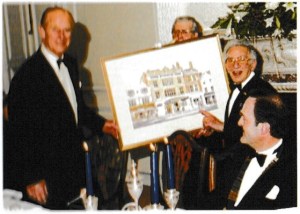
Another meeting and dinner was held at Legoland’s Mansion Suite, on St Leonard’s Hill, after one of the Royal Gala Charity shows at the Theatre Royal after receiving a substantial cheque from Davy Kaye, presented the latter with a painting of the Theatre where so many bountiful variety shows had expanded the Trust coffers.
It must not be thought that the Royal interest has been purely financial. On 14 March 1858, a nineteen-year-old sailor at the Siege of Lucknow performed an act of outstanding bravery, for which he was awarded the Victoria Cross, His name was Edward Robinson and he is buried in the Church Road cemetery at Old Windsor. Over succeeding decades, the inscription on his gravestone became almost indecipherable. In 2000, Mr George Murray, a World War II veteran living in the village, decided with the backing of the Royal British Legion, to do something about it. Refurbishment would cost twelve hundred pounds and it was suggested to Mr Murray that he might apply to the Prince Philip Trust. The Trustees felt that the application was worthy of a grant of the full amount, and so the gravestone was restored. George Murray organised a re-dedication ceremony, and Prince Philip was invited to perform the unveiling. There was an immediate acceptance, and on 15 May of that year, with some of Edward Robinson’s descendants present, and a Sea Cadet band, the unveiling by Prince Philip and re-dedication took place to the great joy of a large number of people. Such episodes as this exemplify the Duke’s abiding interest in his Trust.

Over the years there have been marginal changes designed to widen the Trust Objects. Moreover, the number of Trustees has been raised from nine to twelve. The ex-officio Trustees no longer include the Headmaster or the Windsor Director of Education, the latter position having disappeared. There are four new ex-officio Trustees, they being the Secretary and the Treasurer, the Governor and Constable of Windsor Castle, and the Deputy Ranger of Windsor Great Park.
Trustees’ meetings are held twice a year, sometimes at Windsor Castle, sometimes at the Guildhall or Maidenhead Town Hall, and on occasion in Trustees’ homes. Each meeting is followed by a dinner hosted either at the Castle or by the Mayor, otherwise by whichever of the other Trustees provides the venue for the meeting.
In 2011, on obtaining the not insignificant age of ninety, Prince Philip decided to surrender the Chairmanship, which was then assumed by the Prince Edward, Earl of Wessex. At the same time, the Duke of Edinburgh was appointed the Patron of the Trust in recognition of his unique contribution to its extraordinary success. This is highlighted by the fact that at the latest Trustees’ meeting in April 2017, the remarkable sum of thirty-eight thousand pounds was distributed between twenty three applicants, That is eight thousand pounds more than the original capital sum. Even more remarkable is the fact that over the last forty years, the Trust has given over 1.6 million pounds to some five hundred and eighty deserving organisations and individuals. At that same meeting, a notable example of the Trust’s bounty followed an application on behalf of a little girl suffering from a disorder entitled ‘Rett’s Syndrome’ which deprives the sufferer of all the muscles in the body except the eyes. A modern device called the Tobil Eye Gaze Computer enables the patient to communicate by movement of the eyes alone. It is very expensive. The Trust came to the rescue with a very substantial grant, and the new life given to that little girl exemplifies the vision of Kit Aston and Prince Philip all those years ago.
The Earl of Wessex has already shown himself as a worthy Chairman in succession to his father.
AIl the various Trustees have, in the last forty years, played their part but it would be a serious omission not to pay a particular tribute to five of their number, First, to the late Eric Carr, who held the Treasurer’s position with great efficiency for twenty two years, and was succeeded by the present Treasurer, Ross Wilson. Secondly to Ross who had been the trust Auditor from the start and thus is the only Trustee to have been actively involved with the Trust for the whole forty years. Thirdly an immense contribution to the Trust finances has been made through

Andrew Panter, who has chaired with efficiency and drive no less than five of the Car Rally Committees which have produced such enormous sums for the Trust. Fourthly Kevin McGarry, and fifthly Chris Aitken, who successively since 2002, have served as Secretaries to the Trust with outstanding devotion and efficiency.
On 11 April 2017 at a glittering fortieth anniversary dinner in the Guildhall, some seventy guests, including the Duke of Edinburgh and the Earl of Wessex, paid tribute to the work of the Trust in a Toast ‘To the Prince Philip Trust for the Royal Borough of Windsor & Maidenhead, coupled with the names of Their Royal Highnesses, Prince Philip Duke of Edinburgh and Prince Edward, Earl of Wessex’.
Prince Philip published a book entitled ‘A Windsor Correspondence’ containing letters between himself and Bishop Mann, Dean of Windsor relating to moral issues of the day. In a tribute to those former Trustees departed this — world, notably Kit Aston, the author who proposed the Toast at the anniversary dinner concluded with a quotation from one of Bishop Mann’s letters:
We are what we are by virtue of those who have gone before us. We live our lives in gratitude for their good endeavours and so that we in our turn may add those endeavours to those to come’.
The Prince Philip Trust is well established in its bounteous existence to flourish into the next century and beyond.
John E Handcock
The author was a Trustee of the Prince Philip Trust from its inception until 2007 and the Secretary from the beginning until 2002.
Acknowledgements
All photographs in this article are used courtesy of the author
 Windsor Local History Group