
1216, 1217 and 1225
Published in Windlesora 32 (2016)
© WLHG 2016
If King John had not done the decent thing and died on 18 October 1216, Magna Carta would today just be a cipher of history. True, many copies of the Charter had been made and distributed throughout the country, and the 25 barons had been chosen to enforce John’s oath, but legally it was worthless. The Pope had annulled it.
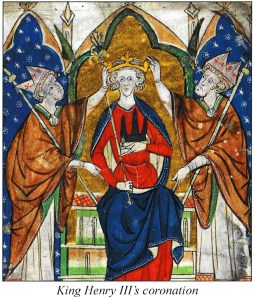
Most of the barons rallied round young King Henry, and as Prince Louis was in control of London, Henry III was crowned at Gloucester Cathedral on 28 October 1216. The crown was too large, so the bracelet of Isabella of Angouleme (Henry’s mother) was used for the purpose.
William Marshal, Earl of Pembroke acted as regent. He had been a loyal supporter of King John who had appointed him regent in his will, although his son was one of the 25 rebellious barons. Marshall was one of the greatest knights of the age, still jousting and fighting battles into his 70s.
It was mainly due to William Marshal that Magna Carta survived, as he lost no time in issuing a revised version of the Charter on 12 November 1216. Most significantly he left out clause 61, the security clause which compelled the 25 barons to reinforce the Charter. This time the new Pope made no objections. Only one original copy of the 1216 Charter survives in Durham cathedral.
Magna Carta 1217
Meanwhile Prince Louis still tried to fight for the crown of England, but his supporters were defeated by William Marshal at the battle of Lincoln on 20 May 1217, and his power-base drained away after the great fleet sending reinforcement from France was destroyed by Hubert de Burgh on 24 August 1217. Louis signed the treaty at Lambeth on 12 September 1217 giving up his claim to the English crown.

On 6 November 1217, another revised version of the Charter was issued along with the Forest Charter, dealing with the royal forests. A copy of this is preserved at Durham Cathedral as well. This is where Magna Carta first acquired its name, the Great Charter, to distinguish it from the smaller Charter of the Forest.
Magna Carta 1225
In 1225 Henry III made a significant issue of Magna Carta under his own seal, in return for a grant of taxation. This transformed the charter from a document wrung from a king by his rebellious barons into a royal declaration of the law of the country.
It was this Great Charter that was copied onto the first statute roll.
 Windsor Local History Group