
Published in Windlesora 22 (2006)
© WLHG

Windsor’s Racecourse on the island between the River Thames and the Mill Stream was opened on Tuesday 5th June 1866. There had been steeplechasing in the town for several centuries, but the course would have been across farmland and the stands would have been temporary. In this town there was the added interest of the military races. In March 1863 for example, in the Military Sweepstake the horses had to be ‘bone fide and unconditionally the property of officers on full pay from the army for one month before the day of the race’. Sometimes the rider had to be an officer on full pay also. Civilian races on the same day might have the condition “The horse must have been hunted during the current season with a pack of hounds within 25 miles of Windsor.’ or it had to be owned by a gentleman living within 25 miles of Windsor. The riders were sometimes the owners, and in at least one case this was a woman. There were also open races. The course was around the area where the Boltons are now and the distance varied but was given most often as ‘approx. three miles’ Entries had to be made at the Bull Inn in Peascod Street, or to an office in Northampton.
John Frail had been one of the organisers of these steeplechases and it was at his initiative that the new permanent course was established on the Rays, which was part of the farm of Thomas Gristwood and owned by the Vansittart family. Frail seemed to have been known in Windsor as a brilliant organiser and clerk of the course at his home town, Shrewsbury, but he had a very interesting past.
Frail was born in 1804 and after starting out as a hairdresser he became an election agent for the Conservative party. He was very well organised and good at the art of bribery. It is considered that Disraeli might never have become Prime Minister if it was not for Frail’s skill. He managed elections in London and the south of England, but in 1852 his agent in Derby was arrested for bribery with a letter addressed to Frail in his possession. There was a select committee hearing at which both men were exonerated but they were both removed from party management. He had at least two sons. The racing world gives the names of these sons as Charles and Cecil and the ODNB gives them as Charles and John. Charles ran Windsor Racecourse and was followed by his son, also Charles, who died in Windsor in 1954. It is possible that some confusion has occurred and Cecil was in fact the grandson of John senior. Cecil was clerk of the course at Haydock and the Cecil Frail Stakes is still run at the course each June.
Despite his reputation for bribery, John Frail senior was elected Mayor of Shrewsbury in 1879 but died that same year.
Work on Windsor race course began over a year before it opened and the substantial grandstand was designed by Mr JF Clark of Newmarket. A winding lane round the Clewer Park estate of Daniel Gooch MP had been widened and two new bridges had been built across the mill stream, one for carriages and one for pedestrians, who were admitted free. There was a problem here as carriages trying to get out were trying to use the same bridge as those trying to get in and a request was made that there should be a third bridge. All the other facilities were rated as very good. Most of the officials came from Newmarket and there were a large number of entries for all the races. Two days before the first meeting there was rain and then fine weather, so the course was in fine condition for the start. The opening day was a great success.
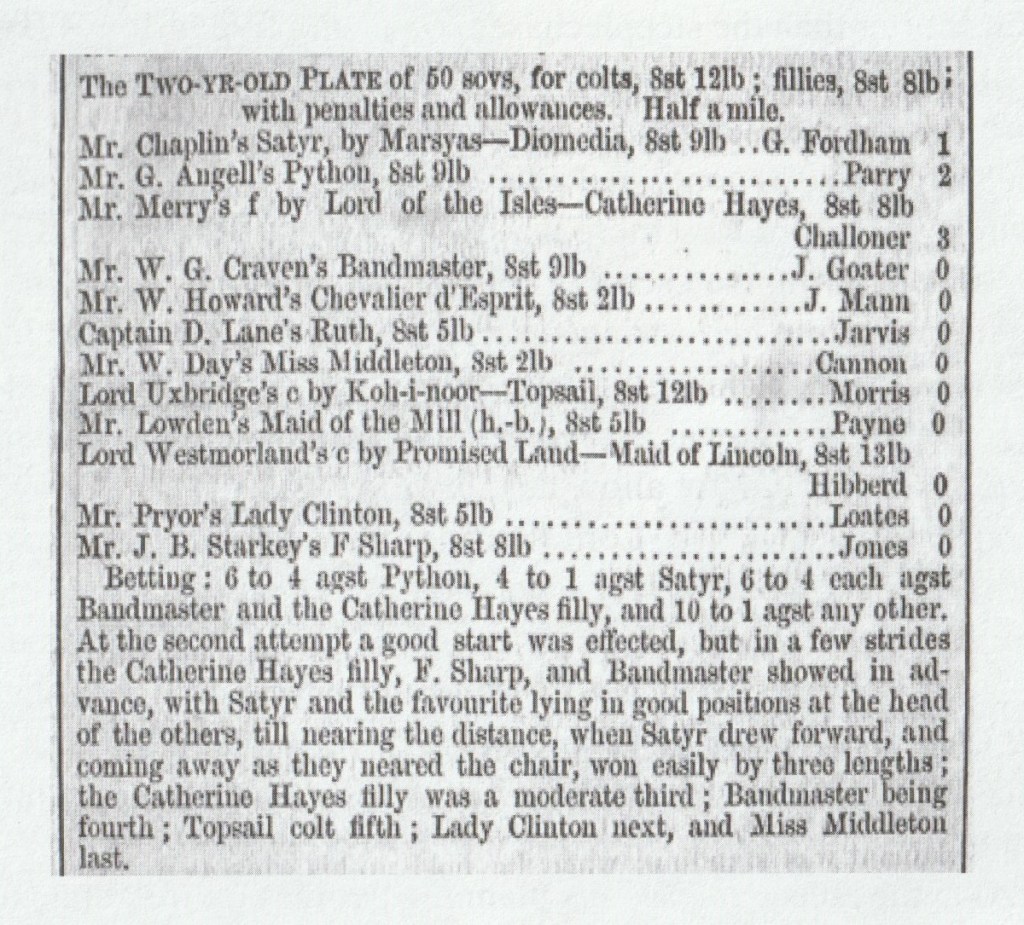
The first race was the Two-year-old Plate and it was won by Mr Chaplin’s Satyr ridden by George Fordham who was champion jockey thirteen times between 1855 and 1869, so the quality of the jockeys was the very best. Incidentally Fordham had his last ride at the Windsor course in August 1884 and then retired to Slough.
The race that had the most interest was the Royal Stakes on the second day. This was won by Count F de Lagrange’s Dragon ridden by Harry Grimshaw. He had won the Derby, the St Leger and the Two Thousand Guineas as well as races in France on the same owner’s Gladiateur in 1865 and looked set to take Fordham’s crown. Gladiateur was reckoned to be one of the best horses of the nineteenth century. However, Grimshaw was killed a few weeks later in an accident in a trap he was driving home from Newmarket. The last race of the first meeting was the Dedworth Handicap, won by Mr J Wood’s Rose, by a length and a half. (The racecourse was in Dedworth at that time, but with boundary changes, is now in the Parish of Clewer.) The races were very much shorter than the steeplechases some only five furlongs. Two, two-day meetings a year were planned though the winter meeting was sometimes disrupted by floods.
The steeplechases continued after the opening of the new course but in March 1874 Lord Rossmore was thrown from his horse and fatally wounded during the Guards Cup race. Queen Victoria was watching the race from her carriage in Kings Road and saw the incident. She asked if the races planned for the following day could be cancelled. After some persuasion, it was agreed that the civilian races should be run but the Queen would not allow her soldiers to ride and so the military races were cancelled. Lord Rossmore was taken to the Guards barracks where he lingered on for several days. The Queen made repeated enquiries as to his health and went off to visit him but news of his death reached the castle just after she left and she was told when she arrived at the barracks. No more races were run on that course, but steeplechasing, including military races continued at Old Windsor on Ham Island.
In 2005 the racecourse awaits planning permission for a transformation which includes a new hotel on the site. Much more than racing takes place there now. The Institute of Groundsmen holds its annual show there each September and this takes about three weeks to set up and dismantle. There are craft fairs and caravan shows at the course and several local events. Racing is held every Monday in summer and there is an annual festival.
Pamela Marson
Sources
Several Racing Websites
Oxford Dictionary of National Biography
Windsor Express – various dates in 1863, 1865, 1866, 1874.
 Windsor Local History Group