
How Windsor became a town without cinemas
Published in Windlesora 22 (2006)
© WLHG
It is ironic that Windsor, home to many actors, in close proximity to famous film studios like Pinewood, Bray and Shepperton, and so often used as a location for films, should have been without a cinema for more than 20 years. The first picture house in the town opened in 1910, and at its peak in the 1930s boasted four cinemas, but on 16th January 1983, the last remaining one closed its doors as audiences dwindled away. While Slough and Maidenhead, which also lost their original cinemas by the 1980s, have had new multi-screen cinemas built in their place, Windsor remains without a screen to its name.
It was not always so. Windsor was among the first towns in the area to open a cinema in the first flood of new picture houses which followed the Cinematograph Act of 1909. This was the first English Act of Parliament which dealt specifically with the cinema and was chiefly concerned with safety in theatres. Celluloid film was extremely inflammable and there was a constant danger of fires. The new Act banned cinematograph exhibitions except in licensed premises and these licences were granted for up to a year to local authorities who had the power to set their own conditions (a power which eventually led to film censorship as well as theatre safety). Even after the Act, there was a grave risk of fire. In the Windsor area, film which was due to be delivered to the People’s Electric Theatre in May 1911 was destroyed in a fire, and the following February a blaze broke out among the films in the rewinding room at the Empire Cinema Palace in Chalvey.
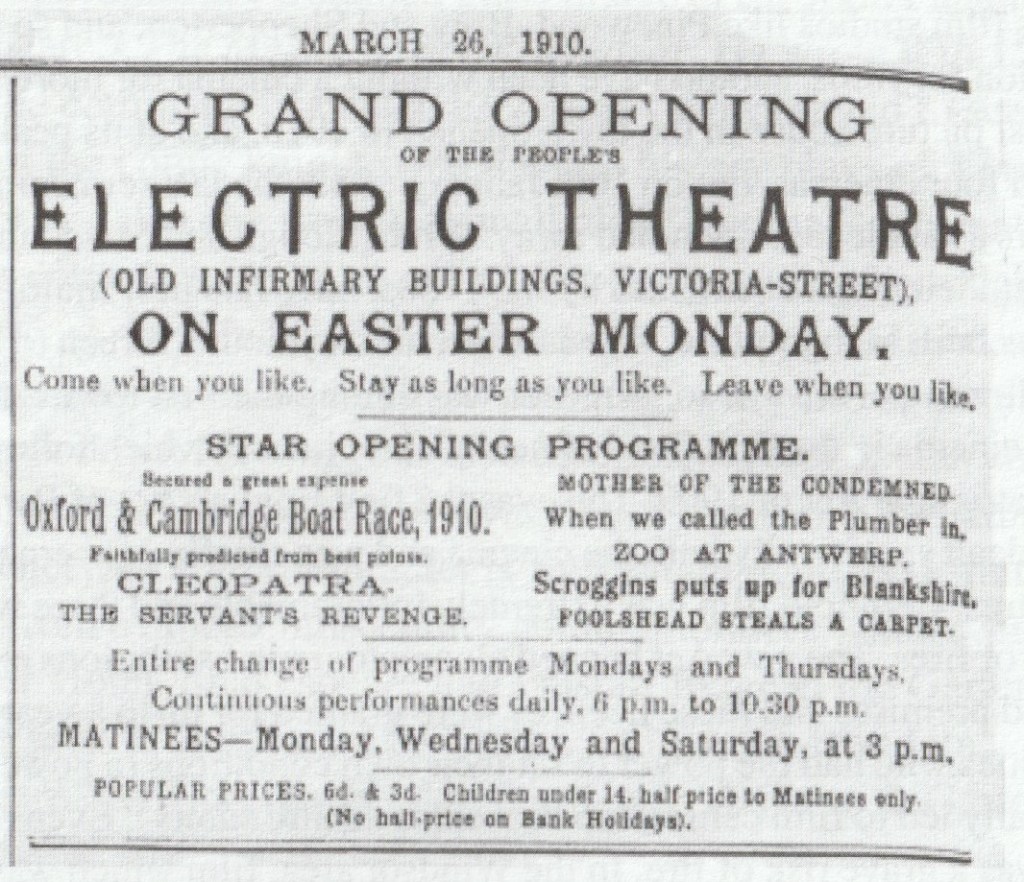
The new Act, which came into force in January 1910, was the cue for new purpose-built cinemas to spring up all over the country which complied with the new regulations. In March the same year, an enterprising man called Mr Champion opened the first cinema in Windsor, The People’s Electric Theatre, in Victoria Street. He had adapted part of the old infirmary buildings into a little theatre and had obviously taken the safety strictures of the new act seriously. As the Windsor, Eton & Slough Express (2nd April 1910) reported: “There are numerous exits, and the cinematograph and operator are enclosed in a room, so that there is not the least danger.”
Mr Champion promised “Farce. Drama. Tragedy. Travel. The pick of the world’s pictures.” It must have been irresistible, and at the opening on Easter Monday, 1910, crowds assembled long before the pictures started and hundreds waited patiently for the next performance later that evening. The ‘Star Opening Programme’ included the Oxford and Cambridge Boat Race for1910 — ‘secured at great expense’ and considered ‘very realistic’, Cleopatra, When We Called the Plumber In, and The Servant’s Revenge. Programmes were changed on Mondays and Thursdays, there were continuous programmes from 6pm to 10.30pm, matinees on Wednesdays and Saturdays, and all for 3d or 6d.
The new electric theatre did have competition. The week after it opened,the Royal Albert Institute showed Royal Canadian Bio-venues’ latest moving pictures, proclaimed to be the first time ‘singing, talking and laughing pictures’ (were seen) in Windsor. A year later, The Electric Empire in Peascod Street, opened on Ist May 1911. The Empire had previously been the venue for the short-lived craze of roller-skating but the new proprietor, Mr RE Saul of Aldershot, announced there would no longer be skating.
It was not until February 1913 that the town’s first purpose-built cinema, The Windsor cinema, was opened also in Peascod Street, on the site of a grocer’s shop. The growing popularity of films in people’s lives was obvious and the new cinema, which was built at great speed and completed in 10 weeks, showed all the signs of the lavish picture palaces which were to come. The Windsor Express (1st February 1913) reported breathlessly: ‘Without doubt it is one of the prettiest, if not the finest, cinemas in the county.’
It was a source of pride that the cinema was designed, built and furnished by Windsor men and had employed a large number of Windsor workmen during the winter. The 22ft high picture hall had seats upholstered in green velvet for 500 people, a sloping floor, and was lit by electroliers. Much emphasis was paid to the safety of the new building with emergency exits, fire-proof doors and a wide paved space at the back “which hundreds could gain in a few seconds if ever panic occurred”. The frontage of the cinema in Peascod Street was still more extravagant with a glass verandah lit by 40 electric lights and the vestibule floor laid by Italians. The last word in convenience for the patrons was provided by a special novelty — two hundred numbered slots for four hundred umbrellas with their own uniformed attendant.
The grand opening on Monday, 3rd February, by the Mayor of Windsor, Councillor TE Luff, was slightly marred by the smell of fresh paint (the Windsor workmen only just hit their deadline) but it did not spoil the occasion. Mr Luff praised this enterprise of Windsor people, which would provide ‘infinite instruction, pleasure and profit to people, young and old, in this district’. A portrait of King George V was thrown on to the screen and the audience rose to its feet as the cinema’s own orchestra played the National Anthem before settling down to a film show which included The Woman in White, parts 1 and 11, and Nora’s Debt of Honour.
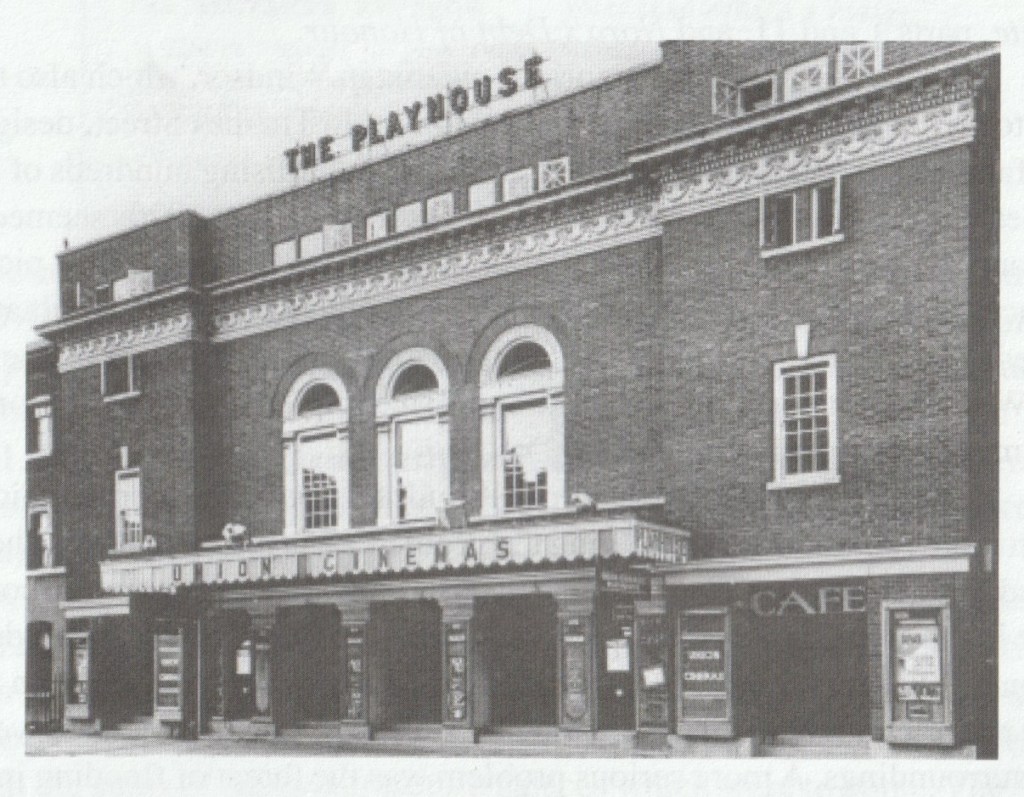
The biggest and most luxurious cinema in Windsor, which also turned out to be the last, was The Windsor Playhouse, in Thames Street, designed by the famous cinema architect Robert Cromie, and utilising hundreds of local tradesmen and workmen. The demand for cinemas in the 1920s seemed insatiable and the new buildings aspired to be as grand as the huge ornate picture palaces in America. Like the Windsor, The Playhouse had been built at top speed. Work started in July 1928, the foundation stone was laid by the Mayor, Sir William Carter, on 29th August, and was completed within six months just in time for the opening on Boxing Day.
It was claimed to be the quickest-built theatre in the world, which was even more remarkable considering the problems caused by the site. The cinema faced Sir Christopher Wren’s fine house and it was felt that ‘any discordant note in the architecture of Thames Street should scrupulously be avoided’ (Windsor Express, 21st December 1928). Cromie adopted a Georgian style in dull red brick for the frontage, varied by stone piers, which blended well with the surroundings. A more serious problem was the threat of flooding in the basement. To prevent this, the whole of the sub-structure was ‘tanked’ and the houses either side were underpinned.
The imposing theatre, which seated 1,500, left the Windsor Express reporter groping for adjectives. “In its design, the geometrics of sight lines, the science of acoustics, and the arts of decoration have been combined to produce a theatre which is the acme of comfort and as near perfection as is possible in the present day, whatever developments the future may have in store.” The auditorium was decorated in silver, jade green and apricot, and the theatre was heated by radiators. Most important of all a ‘sound chamber’ had been built behind the screen ‘to enhance the tonal value of speaking films, which will doubtless be in a greater and greater degree a leading feature in the cinema programmes of the future’. How prophetic.
The opening ceremony matched the splendour of the new cinema. The Mayor, Lieut-Colonel Stephen Wright, and various local dignitaries were greeted with a fanfare by two trumpeters of the Royal Horse Guards. The drawing attraction of a superbly equipped cinema was not lost on the Mayor. He was confident that the ‘thousands of motorists on the road’ would say, ‘Let us go to the Playhouse at Windsor.’ Guests watched a mixed programme of live cabaret and films, including the British picture, Madame de Pompadour, starring Dorothy Gish, which, the Express reporter critically remarked, failed to make the most of the splendours of the French court.
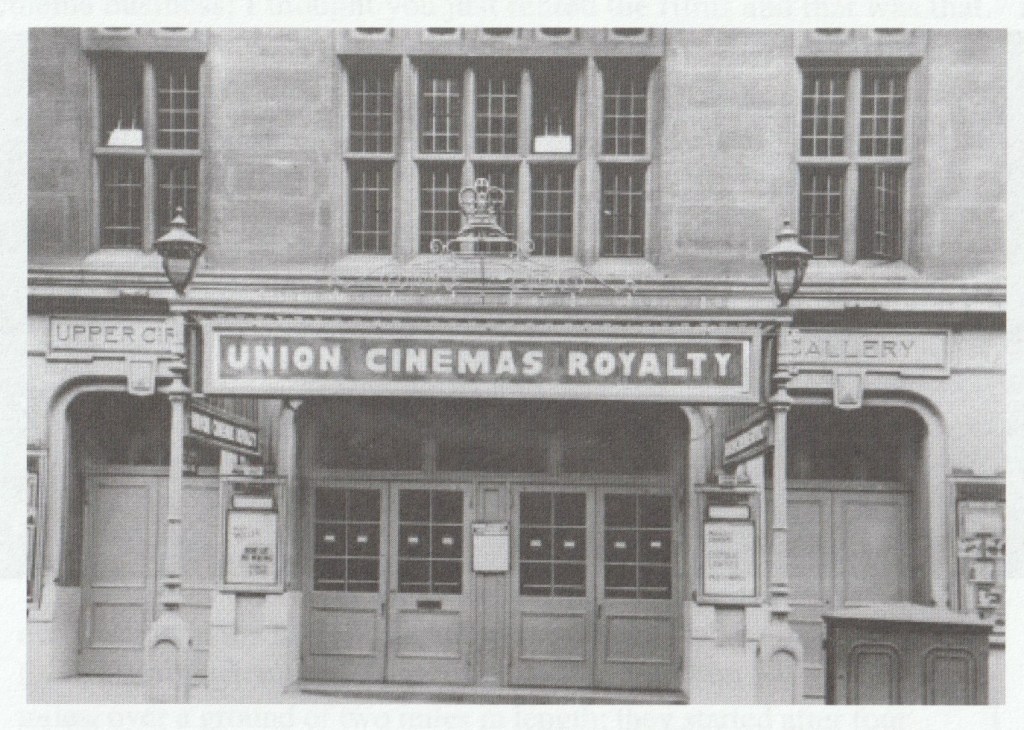
In the 1930s a fourth cinema joined The Empire, The Windsor (which was renamed The Regal in 1931), and The Playhouse. The Theatre Royal, Windsor, had been badly hit by the talkies and Jack Gladwin converted the theatre into a cinema and subleased it to The Windsor Playhouse Ltd. The
managing director, Southan Morris, had also acquired the Regal and the Adelphi in Slough, and he renamed the theatre The Royalty. According to John Counsell, who later ran the theatre for many years, the building was not really suitable to be a cinema, did consistently badly and was the lame duck of the group. For eight months between September 1933 and May 1934, Counsell leased it as a theatre again but he ran out of money and it reverted to being The Royalty. It remained as an unsuccessful cinema until 1938 when Counsell triumphantly took over the lease again and changed it back to the Theatre Royal which it remains to this day.
The glory days of cinema continued and admissions to cinemas peaked in 1946 to about 1.6bn. More than 10,000 people went to The Empire to see the film of the royal wedding in 1947, and its second biggest audience was for the coronation film, A Queen is Crowned, in 1953. But it was the coronation which prompted thousands of people to buy their first television set and that was the beginning of the end for cinemas. As well as television, there was bingo which greedily took over many of the cinema buildings. People were more prosperous and had a far wider range of leisure pursuits on which to spend their money. Cinema audiences slumped from the fifties onwards, reaching their lowest point in 1984 when figures were down 53.8 million. Cinemas began to close as rapidly as they had been opened and Windsor was no exception.
The first to succumb was The Empire. The cinema’s valuable site in Peascod Street was bought by the Post Office and it closed its doors on 25th May 1957. Mr SJC Watsham, who had taken over The Empire in 1936 and also owned The Rex in High Wycombe and The Picture House in Beaconsfield, told the Express (25th May 1957) that the cinema was still doing good business (the popular British comedy, Doctor at Large, was the last film shown) but obviously the ‘five-figure sum’ paid by the GPO was too good to refuse.

showing the position of both the Regal and the Empire
The Regal had been reconstructed and reopened in 1935. It had been part of Southan Morris’s Windsor Playhouse group which was taken over the same year by Union Cinemas, which in its turn was bought by Associated British Cinemas in October 1937. The cinema limped on until 4th January 1969, when it closed and became a bingo hall.
The last to survive was The Playhouse, which has also been taken over by Associated British Cinemas and renamed the ABC. For the last short months of its life, it had another name, the Carousel, when, in a bizarre twist, it was bought by the Smart circus family from EMI in November 1982. It was not a good move. Ronnie Smart, who had set up Windsor Safari Park, knew a great deal about circuses but not much about cinemas and the way distributors worked, taking a large lump of the profits and barring independents from showing the most popular films. He bought the Carousel for his children, Christine and Lord, to run, but after only two months the experiment failed. Even showing the current blockbuster, ET, did not work and audiences seldom reached more than 20. The cinema closed, supposedly temporarily, on 16th January 1983, but never reopened.
Ronnie Smart admitted he had been naive. “I did not realise that cinemas did such bad business. The trouble with me is I just got carried away,” he told the Express (14th January 1983). “I had no idea about cinema business; I thought you just rented the films and that was that.” His last words on the subject — “I do not think the people of Windsor want a cinema” — proved to be prophetic. Although new multi-screen cinemas have been built elsewhere in the area, and film clubs like that at Windsor Arts Centre show some of the current releases, Windsor has never had another cinema of its own.
Alison Haymonds
References
The advertisement for the opening of the Electric Theatre is from the Windsor Express, March 26th 1910. The Windsor Union Cinema images are from the archives of the late Tony Moss of the Cinema Theatre Association
 Windsor Local History Group