
The Memoirs of the Marquis d’Harcourt (1771-1831)
Our Emigré General
Published in Windlesora 15 (1997)
© WLHG
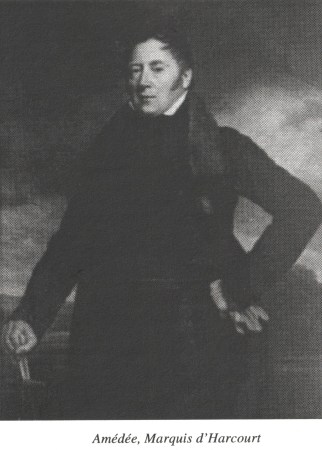
Amédée d’Harcourt, the eldest son of the Marquis d’Harcourt, was staying with his uncle who was the Governor of Normandy, as the French Revolution began its relentless, chaotic slide into anarchy. He was the eighteen-year-old son of nobility, torn by desire to fight for his King, protect his family, or go to England with his uncle, the Duc d’Harcourt, and there take up arms on behalf of his King. Although he sought his father’s advice it was his uncle who helped him make up his mind. They both took their horses and sold them in Amsterdam and then sailed to England, arriving with few resources. Amédée’s journal, Souvenirs, was written when he was a middle-aged man and it recounts his career as an officer in the British Army. It begins in Douai where he was staying at the home of his grandparents, just as the Terror was starting:
“the present was painful, the future frightening and the cry of War! which followed the arrest of Louis XVI caused me to leave the estate. It was not ambition nor fear, but the voice of honour which decided my departure. My father resolved to remain on his land but did not disapprove of my departure, and putting 100 louis in my hand he wished me ‘Bon Voyage’.”
Amédée’s uncle, the Duc d’Harcourt, had already decided to leave France for England where a branch of the Harcourt family, established since the Norman Conquest, was wealthy and had influential connections at court. So the Duc and his nephew travelled together, the first of the many emigrés who crossed the channel to safety, during the dangerous part of the Revolution. They were rescued by their English cousins, General William Harcourt and his brother the 2nd Earl Harcourt, who treated them with great kindness, renting a home for them, first at Sunninghill and then at Staines.
General William Harcourt lived on the lovely estate of St Leonard’s Hill with its seventy-five acres of parkland. He was later to become 3rd Earl, Field-Marshal Harcourt and with his wife the Countess, become intimate friends with George III and the Royal family. He held some of the most important military posts and she was well known as a benefactress in the Parish of Clewer.
Amédée became the aide-de-camp to the General and his memoirs follow the many battles which took place on the continent at that time. It was not the most glorious period in British military history, defeat following defeat, as the underestimated army of Republican France chased the allies out of the Low Countries. The battles are described by a coolly observant Amédée who must have had mixed feelings about the ‘Patriots’ who, although having destroyed his whole way of life, were still French soldiers. More poignant is the arrival of his young brother Emmanuel who, having been conscripted into the French Patriotic Army as a boy soldier, was taken prisoner by the allies.
“October 1793 . … we were half quartered in front of Tournai when I was informed by some spies of the arrival of my brother with the enemy army . . . . A detachment had surprised the French corps, which had been left imprudently near our forward posts. It had cut into shreds 300 children, very young and hardly used to firearms and there I was on foot trying to recognise, amongst the dead, the face of my poor Emmanuel. After a fruitless search I learned that the previous day, two companies had been despatched, which gave me a little hope but did not dissipate completely my unrest. Finally, one day when the Duke of York was dining with my General, I was sent for and the Duke gave a sign; the door opened and a young man in grey jacket and trousers of rough material was introduced into the room. It was my brother, who after a long time waiting for a favourable opportunity had managed to escape bringing his company with him, even his captain.”
Emmanuel was able to give his brother news of the imprisonment of his mother and sisters in Amiens. There was no news, however, about the whereabouts of their father. The memoirs continue with Amédée’s career as a soldier and it is in effect a history of the British Army, for in his position as aide-de-camp to the Field Marshal Harcourt, he was able to observe the results of political policy. Many famous names pepper the pages of his journal and the insight into the characters of such people add an extra dimension to our understanding of this complex period.
It was after his return from an adventurous journey to St Petersburg that he married his distant cousin Sophie Elizabeth Bard Harcourt of Pendley, and became a captain in the British army. He served in Ireland under General Harwicke and was there when the uprising led by Emmet began. He even had a solution to the problems of Ireland! He went on to serve in South Africa, Malta, Sicily and Gibraltar.
In 1809 Amédée returned home to St. Leonard’s Hill.
“This was a wonderful place, a delicious spot, where I spent too many happy days for it not to occupy a special place in my memoirs. St Leonard’s is situated on the summit of one of the hills that dominate the Thames Valley, having Windsor on the one side and the beautiful forest on the other. The first looked after with care, graced with magnificent views and covered with shrubs from every country and flowers from every climate; the second without any decoration but a few grassy paths where one drives in the carriage to the midst of the most beautiful trees in the world. There is nothing more cheerful than the front of the Castle, and nothing more majestic than the sight of the forest, and this in my eyes is the greatest charm of St Leonard’s Hill.”
The journal is written in French and was in two parts which were put together as a typed manuscript by Amédée’s descendent, Comte Emmanuel d’Harcourt, in 1968. Emmanuel suggests in his introduction that there may be another part which has not yet been discovered. But the possibility that there may be another section does not detract from our enjoyment of Amédée’s Souvenirs.

By 1831 Amédée and his wife Sophie were living at St Leonard’s Dale which was the Dower house of St Leonard’s. He was then sixty years old and a General in the British army, having survived many vicissitudes in his adopted land, but his character and charm shine through the words in his journal. That year his life ended tragically when he was killed in a fall from his horse in Winkfield Road. The Windsor and Eton Express of Saturday 17th September 1831 reported:
DREADFUL ACCIDENT –
DEATH OF GENERAL HARCOURTWE have this week to record the occurrence of a fatal and most painful accident in the vicinity of Windsor. On Wednesday last, a lad excited much attention by riding into the town at so furious a rate as to endanger the lives of the passengers, two or three of whom were knocked down in his career, but fortunately they were not seriously hurt. It was soon ascertained that the object of the lad in riding at this desperate pace was to obtain medical assistance, which he had been despatched in quest of, for his Master, Le Marquis D’Harcourt (better known in this neighbourhood as General Harcourt), who it appeared had just been thrown from his horse near his residence at St Leonard’s Dale. The lad stopped at Mr O’Reilly’s (the surgeon’s) and that gentleman, on receiving the message, proceeded with all possible expedition to the residence of the Noble Marquis; but his services were no longer required, for on his arrival he at once perceived that life was extinct.
CORONER’S INQUEST
On the following day (Thursday) an inquest was held on the body before Mr Slade, Coroner.
A Jury, composed of the inhabitants of the neighbourhood, assembled at the house of Mr Stevens, of Clewer green, and having been sworn, proceeded to St Leonard’s Dale for the purpose of taking evidence of the deceased’s lady – La Marquise d’ Harcourt – who was accompanying her husband when the frightful accident occurred. The Jury humanely considering that it would be an unnecessary and a painful trial to the feelings of Lady Harcourt; if she were required to appear before them to give her testimony, agreed that E. Foster, Esq. a County Magistrate, accompanied by the Coroner and the Foreman of the Jury (Mr Baylis), should proceed to her Ladyship’s residence, and take down in writing her account of the unhappy catastrophe which so suddenly bereaved her of her husband. The party having returned to the Jury room, Mr Foster read to the Jury the deposition, on oath. It was in substance this:-
Sophia La Marquise d’Harcourt – 1 am the wife of the deceased Marquis; I was returning home from Mr. Riley’s yesterday, about two o’clock and the Marquis was riding by my side; I saw him take of his hat which startled the horse, and upon his attempting to put it on again, the horse plunged and threw him off; directly afterwards I ran up to him and found him quite insensible, and blood flowing from his ear.
Sheila Rooney
The portraits of Sophia and Amédée are published with the permission of the Harcourt family.
 Windsor Local History Group