
Published in Windlesora 08 (1989)
© WLHG
Windsor has only a minimum of memorials, thankfully. All too often they are erected with much pomp and pageantry, then allowed to deteriorate by the local authorities. The few memorials Windsor has are interesting and worthy of a study.
Two of the oldest in the Royal Borough are the statues of Queen Anne and her Consort, Prince George of Denmark. The Queen was held in high esteem by the Corporation and in 1701 they erected a statue of her in a niche at the north end of the exterior of the Guildhall. Wearing her royal robes, the Queen is holding an orb and sceptre in her hands and a Latin inscription underneath may be translated:
Sculptor, thy art is in vain, it cannot trace The semblance of the matchless Anne’s grace;
Thou may’ st soon to high Olympus fly
And carve the model of some Deity.
In a niche on the south side is the statue of the Queen’s consort, dressed in Roman military uniform. Underneath is the following inscription, translated thus:
To the most serene Prince George, Prince of Denmark, an hero
to be revered in every age. CHRISTOPHER WREN, Esq., erected
this statue, 1713.
No doubt this inscription has led many to believe, erroneously, that Wren was the architect of the Guildhall.
A memorial seeming to be of much interest to those visiting the town, is that of Prince Christian Victor, situated at the foot of Thames Street, between Old Bank House and the Hundred Steps. It was originally intended by the Mayor and Corporation, with the approval of Queen Victoria, to erect a Drill Hall as a memorial to the Prince, but this seems to have received little support in other quarters. A group of his friends decided to erect a statue and engaged Mr Onslow Ford, A.R.A. as the sculptor. Unfortunately he died ten days after the contract was signed so Mr. Goscombe John, A.R.A, whose signature appears on the statue, was chosen to complete the work. The bronze statue was cast at the Thames Ditton Foundry of Messrs Hollinshead and Burton. It represents the Prince in campaign uniform, bareheaded, standing on a boulder, his sword by his side and a pair of field glasses in his right hand. One day whilst examining the statue, an elderly lady approached the writer to ask if one of the puttees was fastered the wrong way, as it was a story that she had heard. The inscription is as follows:
CHRISTIAN VICTOR
Captain Brevet Major, King’s Royal Rifle Corps;
Elder son of Prince and Princess Christian of Scheslwig-Holstein
Grandson of Victoria
Queen of Great Britain and Ireland and Empress of India
Born at Windsor Castle, April 14, 1867, Died at Pretoria, October 29, 1900
Erected by his Friends in admiration of his qualities as a Man and a Soldier
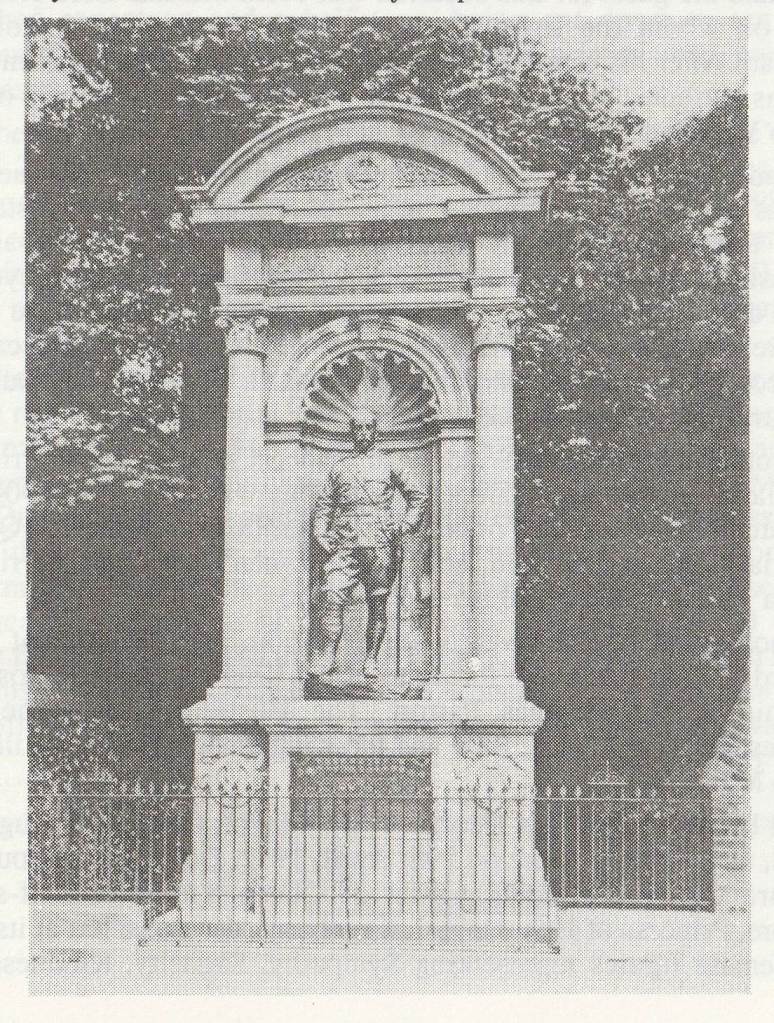
Above the inscription the Prince’s orders and medals are sculpted. These have always been difficult to interpret but Windsor Heritage have now thoughtfully affixed a board on the adjacent wall, with the nomenclature.
No less imposing is the canopy, designed by Mr A. Y. Nutt, assistant architect at Windsor Castle. It is of the Italian Renaissance period, the work being carried out by Messrs Bannister of Ascot and Messrs Goddard of Eton. The wrought iron railings were forged by Messrs Brown of Windsor.
The unveiling of the memorial took place on Friday, 6th November 1903, and the guest for this occasion was Field Marshal Lord Roberts, V.C., on whom the Royal Borough had bestowed the honour of Freeman. After his return home, Lord Roberts developed pneumonia, this was attributed to the inclement weather he had had to endure on his visit to Windsor.
Gradually, over the years, the area deteriorated and the question arose as to who was responsible for its upkeep. as in so many instances in the town, memories are short. Records showed that it was the responsibility of the Town Council, to whom the site was conveyed by a legal deed of conveyance; the Mayor accepting on behalf of the town the care of the site. In 1984, the Windsor Heritage Committee carried out a complete work of restoration and H.R.H. Prince Philip, Duke of Edinburgh inspected the finished work.
Another memorial in Windsor to Prince Christian is the Princess Christian’s Hospital in Clarence Road. This was opened in 1904 and dedicated to her son by Princess Christian, third daughter of Queen Victoria. Princess Christian died in 1923 when her daughter, Princess Helena Victoria, succeeded her as President. (1)
Another memorial given scant attention, is the statue of King Edward VII situated in the forecourt of the King Edward VII Hospital, of which the King was Patron. The Hospital was opened on Wednesday, 17th March, 1909 and the King died, after a short illness, on 6th May 1910.
On behalf of the King George V, the Mayor, Councillor Augustus Harris, unveiled the statue on 29th April, 1912. Designed by Countess Feodora Gleichen (granddaughter of Queen Victoria’s half-sister, Feodore, Princess of Hohenlohe-Langenburg), the statue has at its base four female figures representing Sympathy, Sagacity, Kindness and Cheerfulness. No doubt these were incorporated, not as a tribute to the Monarch, but as the attributes of the nursing staff.
Finally, there is what is considered to be the most attractive memorial in the town, the King George V Memorial, at the junction of Thames Street and the Datchet Road. Under the direction of the Mayor, Lieutenant Colonel Sir Arthur Churcher, a subscription was opened for its erection. Sir Edwin Lutyens was chosen as architect — the Cenotaph in Whitehall is another example of his work.
Buildings on the site were demolished and work commenced in January 1937. Portland stone was used for the memorial, said at the time to be the finest ever extracted from the quarries. The blocks weighed seventeen and a half tons, being cut down to ten tons. Surrounding the memorial, seventeen oak trees were planted, presented by Messrs Sutton & Sons Ltd of Reading.
The unveiling by King George VI took place on St George’s Day, April 23rd, 1937, the ceremony lasting only fifteen minutes. ‘The Memorial was the precious possession of the people of Windsor’ — these words spoken at the unveiling, like so many uttered on such occasions, were not honoured. Over the years the memorial fell into a state of disrepair. The writer was the instigator of a complete refurbishment. A letter to the Windsor Heritage Committee caused them to take action. It is recorded that the door of the pumping station at the rear of the memorial was found unlocked and a tramp was using the interior for his habitation. In 1983, the memorial and its surrounding area was fully restored at a cost of £7, 000. Her Majesty The Queen Mother inspected the completed work and expressed the hope that it would be kept in its present restored condition. The Chairman of the Windsor Heritage Committee, Mr Freddie Shenston, pledged that as long as his Committee existed, the memorial would never fail to be a credit to the Royal Family, the Royal Borough and its citizens. This promise has been kept. A plaque at the site records the contribution of Marks and Spencer in providing the garden frontage.
Fred Fuzzens
(1) (Web Editor note July 2023: There is a blue plaque on the private house, now known as the Residence, that was the Princess Christian Hospital. This was unveiled in May 2018 with the support of the Windsor and Eton Society, the Windsor & Royal Borough Museum.)
 Windsor Local History Group