
(1825-1907)
A Forgotten Windsor Philanthropist
Published in Windlesora 30 (2014)
© WLHG
Advantages of Commerce
I am wonderfully delighted to see a body of men thriving in their own fortunes, if at the same time promoting the public stock; or, in other words, raising estates for their own families, by bringing into their country whatever is wanting, and carrying out of it whatever is superfluous.
Joseph Addison (1672-1719) Essayist, Whig, Creator of The Spectator and The Tatler (Many thoughts of many minds. 1868 Henry Southgate)
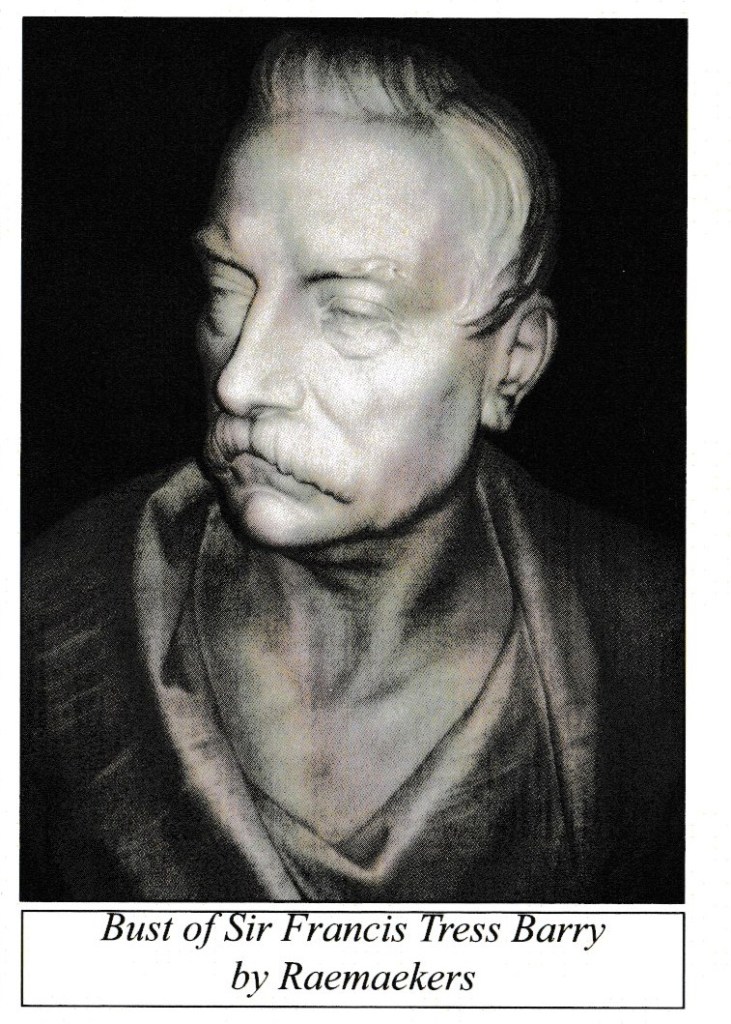
Francis Tress Barry was just such a man. At 16 years old he joined a merchant company in Bilbao as ‘A Purveyor of Machinery’ and at 22 years old was Consul of the Biscay Region of Spain. As a partner in a successful copper mine in Portugal, with his brother-in-law James Mason, he gained a fortune with which to purchase and improve a prestigious estate in Windsor. His philanthropy gained him a Baronetcy from Queen Victoria, and he was MP for Windsor from 1890 to 1907. Yet this most important late Victorian entrepreneur is not remembered, and his name has very little significance in the town.
James Mason studied mining engineering in Paris, probably at the School of Mines, and with his degree went to Bilbao as Manager of copper and lead mines for three English mining companies in the region. There is no doubt that James met Francis through the machinery company which employed this brilliant young man.
Their two lives became considerably entwined when James married Francis’s sister. The two men went into business together, purchasing a run-down copper mine in Northern Portugal, which was to create great wealth for the two men so that each could purchase prestigious estates in England.
In 1856, Francis and his brother-in-law became partners in the firm of F.T. Barry and Co, importing British mining machinery into Spain and from 1859, developed the San Domingos Copper Mine in Portugal, which closed in 1964. He built a 15-kilometre railway to Pomirao (Pomarao) Harbour on the Guardiana river, by which the ore was transported downstream to the Mediterranean port of Vila Real de San Antonio and thence to London where Francis had his headquarters. For the building of an autonomous settlement village for the mining families, both men were honoured by the King of Portugal. Francis became Baron de Barry. (1)
James was the mastermind and manager of the mine with 70% of the shares. Francis borrowed the other 30% from the family. Three-thirteenths was taken by Maria Herron, his wife’s aunt, and which was eventually gifted to him in ‘recognition of the great love she had for him’. Francis returned to England to manage the shipping and accounting for the business. In 1862 James left Portugal and ran the mine through his manager, only visiting once a year until he purchased Eynsham Hall in 1866 when James’ son took over the mine.
With his wealth, Francis purchased the St Leonards Estate in Windsor in 1869. He partially demolished the house known as Gloucester Lodge, rebuilding it as a prestigious mansion resembling a French chateau, and which dominated the skyline. As the result of this, he became a trustee of Clewer Green School which had been established by the Harcourts, the previous owners of the estate, and received a Baronetcy from Queen Victoria in 1889 with the Jubilee Medal with Bar for his philanthropic work.
He paid £1,225 to Middlesex Hospital to pay off the mortgage on a piece of land beside the Thames at Windsor, and £1,985 to the Vansittart Estate to enlarge it. Francis then gave the land to the Windsor Council as a public park to celebrate the Coronation of Edward VII and Queen Alexandra. The park was named Alexandra Gardens. Barry also endowed the Windsor Infirmary. His election as MP for Windsor was reported in the Clewer Parish Magazine for May 1890.
‘F.T.Barry, conservative candidate, returned at a recent general election by a large majority. Mr Barry our new MP is a parishioner of Clewer, and resides part of the year at St Leonards Hill.‘
ln 1890, Francis also bought Keiss Castle, Caithness, from the Duke of Portland, some eight miles south of John O’ Groats, where he spent his summers indulging in his love of Archaeology. He discovered a Broch, previously unknown, and the painted stones and other artifacts are in a special museum dedicated to his finds as part of the Museum of Scottish Monuments in Edinburgh. (2)

While in England, Francis became a member of the auspicious Antiquaries Society whose logo is the mediaeval lamp which had been found on St Leonards Hill. He mounted two exhibitions of local artifacts dredged from the River Thames at Windsor Bridge and Boveney Lock, one in 1895, the other in 1898, and to complete the exhibitions he borrowed the collections of several local archaeologists. An example is the Mesolithic flint scraper currently on display in the Windsor & Royal Borough Museum collection. He was, in fact, known more as an amateur archeologist of note, than as an MP. He was Deputy Lieutenant and Justice of the Peace for Caithness.
Not content with this, Francis developed the St Leonards Hill Estate which he planted with full-size camellia bushes to prove that they were hardy enough to grow outdoors in the northern hemisphere. There is a legend in Reg Try’s family, that they came on the deck of a ship, which may well be true. The company of Mason and Barry owned three ships which could have brought the bushes from Portugal, where they grew prolifically, The originals came to Europe with a family of sixteenth-century merchants travelling to China, India, and Brazil. The Manor House in northern Portugal is still owned by the same family and the descendants of these bushes are still in existence. Portuguese camellias are not named only known by colour, and Sir Giles Loder, a competitor of Reg Try at the RHS Camellia Exhibitions, wrote in the RHS Year book of 1960 that he had visited Portuguese gardens and purchased bushes, noting that the oldest Portuguese camellias were not named. The early plantings at St Leonards Hill are not named either.
The name of St Leonards Hill lives on, but what of the memory of this commercial genius? The drive up to the mansion used to be known as Barry’s Drive but is now St Leonards Hill, Windsor Forest. How many visitors, or residents for that matter, know that the road along the river front from the railway arch to Goswell Lane is known as Barry Avenue, or that the park which is alongside it, known as Alexandra Gardens, owes its existence to Sir Francis?
A millionaire, landowner, and amateur archaeologist, Francis held appointments to the Crown and was honoured by monarchs in Portugal and England. He was created a Baronet in Queen Victoria’s New Year’s honours list in 1899. He made Windsor his own and is buried in Clewer Churchyard, yet so little is known of him in the town. It is for this reason that this article hopes to address this oversight of a man who, for his philanthropy, should be top of Windsor’s Who’s Who.
Valerie Batt-Rawden
Updates
(1) Web Editor comment February 2025. The Portguese river port of Pomarao is near the border with Spain but 40km from the coast and the mouth of the River Guardiana. It was specially built to serve the ‘Mina de Sao Domingos’ by Sir Francis and James Mason’s company, as well as a model village for the workers for which Sir Francis was honoured by the King of Portugal.
(2) Web Editor comment February 2025. Nybster Broch – an Iron Age drystone structure in the Highlands.
 Windsor Local History Group