
The Story of the Windsor Advisory Centre 1969 — 2011
Published in Windlesora 32 (2016)
© WLHG 2016
We have learned a lot. The basic Christian principles had led people to want to help people and not just push them around. These principles are still very good ones
H R H The Princess Royal, Interview with the Illustrated London News
One of the clues to the vitality of a community is evidence of communal pride and the willingness of its members to support local initiatives
HRH The Prince Philip, Duke of Edinburgh; Foreword to The Institute That Became an Institution by J E Handcock
The Windsor Advisory Centre emanated from the vision and compassion of one man. His name was Stuart Kitching. In 1967 he experienced the first stirring of inspiration which two years later would give rise to the fulfilment of his dream. Kitching was a research chemist at Glaxo’s laboratories and an active member of Windsor Parish Church. Subsequent to his years in Windsor, he relocated to Herefordshire and thereafter to the village of Escomb in Durham. In both Dioceses he left his mark. At his funeral service in Escomb Church on 12th January 1984, the Bishop of Durham said of Stuart, “As our diocesan stewardship advisor in 1976 to 1986 …. he lived what he taught in service to the church both before his retirement and afterwards”. He saw active service during the war with Durham Light Infantry in France, Sicily, and at Dunkirk.
Stuart Kitching was blessed with an insight which suggested to him that since Windsor possessed neither a Citizens Advice Bureau nor a branch of the Samaritans, there were clear needs for this lacuna to be filled. He first consulted the Parish Church Council, which was very enthusiastic , but realised that the demands of the proposed advice service would need more volunteers than the Parish Church alone could supply. Accordingly, invitations were sent to each of the other Windsor Churches — Anglican, Roman Catholic, and the Free Churches — to participate in a new venture, invitations which were promptly and constructively accepted.

ln consequence, on 6th December 1967, a working party met in Clewer St Stephens Hall. The group were enthused by a talk from Tessa Stanworth, a representative of the recently opened Beaconsfield Advice Centre. It should not be thought that Stuart Kitching and his wonderfully supportive wife, Elsie, were the only figures displaying leadership qualities. Ron Bull, son of Alfred W Bull, sometime Mayor of Windsor, whose family owned the well-known grocers in Kings Road, was also a member of Windsor Parish Church and harboured similar altruistic ambitions to those of Stuart Kitching. In addition, he worked tirelessly and effectively to bring the dream to fruition.
From the outset, and throughout its existence, the Windsor Advisory Centre was run and staffed by Windsor church-goers. Initially some forty volunteers from the Windsor congregations came forward. It was a truly ecumenical body, working as a first class team. A series of meetings in the latter part of 1967 culminated in a decision to “go ahead with the setting up of the Centre”.
The objectives of the new centre were clear and straight-forward: “to give friendship, help and information to anyone who comes to it”. As regard to people, it was decided that all Centre members should be practising Christians and that all the volunteers should undergo training. A programme was therefore instituted for the winter of 1968/9, consisting of a series of talks on such subjects as advising and counselling, health and welfare services, benefits, the Probation Service, marriage, family fostering and adoption, legal aid, old people and mental welfare, police, housing and the Centre’s Good Neighbour Scheme. This last betokened a subsidiary service which manifested itself in the following terms:
Do you want someone to visit you? If blind, read to you. Give essential household help. Emergency baby-sit. Look after children. Exercise and feed your pet. Shop and collect medicines. Do gardening or decorating. Meet or deliver children from school and take you to and from hospital.
This subsidiary initiative was for many years spearheaded by Joan Hewitt.
Premises were a decided conditio sine qua non. To fulfil the requirements of the clients they needed to be located as near as possible to the town centre. They would require an independent entrance and consist of at least two rooms. Initial enquiries produced offices more interesting than practicable. These sometimes verged on the bizarre and included part of the old Sydney Place laundry, basement space in the Victoria Street multi-storey car park, a condemned house in William Street, and Courage Brewery’s old store in Thames Street. The clock was ticking since the Centre was due to open in the Spring of 1969 and December of 1968 had already arrived.
At a meeting that month, somebody suddenly exclaimed “Portakabins!”, a suggestion which was quickly adopted. Hearing of reconditioned cabins for sale in Yorkshire, Stuart Kitching with characteristic zeal and two or
three others, journeyed north and were able to purchase two portakabins, out of the hundreds for sale, for a total of £425. These were transported to Windsor where they were set up with the co-operation of the Revd Donald Norwood at a peppercorn rent in the Manse Garden of Windsor Congregational Church in William Street. The Windsor, Slough & Eton Express reported in its issue of 7th March 1969, that planning permission had been granted but limited to two years. “This will help them to get off the ground”, said Cllr lan Keeler, chairman of the Planning Committee and a later Mayor of the Royal Borough. Initial costs relating to the installation of electricity and telephone and office furniture had to be found.

The first sums were donated by the members themselves. Everyone contributed half a crown (12½ p) and a few contributed ten shillings (50p). Patricia Brownsey, who became the first Secretary, was energetic and effective. At her instigation, regular Whist Drives, coffee mornings and jumble sales began to boost the coffers. Most of the local churches devoted collections to the Centre, helped by the Windsor Castle State Apartments Fund and the Charities Loan Fund. In later years two local trusts, The Royal Albert Institute Trust and The Prince Philip Trust for the Royal Borough of Windsor and Maidenhead, made significant contributions. A couple of anonymous gifts, each of £100, were thankfully received. In such circumstances the Bishop of Oxford intimated “God will provide” – and as it turned out He did.
In the run up to the opening, the Centre received fulsome reportage and commendation from the local press. Heralded by a Dedication Service at the Congregational Church on the previous day, the Centre opened its doors to the public on Monday 14th April 1969 with a rotating staff numbering some forty five volunteers. On 4th July a welcome infusion into the funds was provided by Colonel and Mrs Philip Ward, who opened their magnificent gardens at Upton Court, Windlesham in aid of the Centre, a fund raiser repeated once or twice in after years. The following week, under the headline “Great Start for Advisory Centre“, the local paper commenced a glowing report:
At the end of its first two months the Windsor Advisory Centre aimed at providing help for those who do not know which way to turn for it, is proving a great success …
A full page report appeared two months later in the same newspaper.
Under the Chairmanship of Stuart Kitching, with Ron Bull as his Vice Chairman, Windsor Advisory Centre was well and truly launched on its voyage of compassionate assistance to the needy of Windsor. “We are here, ready and waiting for anyone with any sort of problem”, said Ron Bull. This was no idle claim. By the 1970 Annual General Meeting, three hundred and thirty five requests for help and information had been handled; the Good Neighbour Scheme and the twenty four hour telephone service were in full swing and the bank overdraft had not only been cleared but there was a healthy balance in the account. As the Kitchings had retired from Windsor, Ron Bull became the second Chairman. In April 1970, the Centre took a major slot in the BBC Women’s Hour. As reported in the local press, “This we believe to be the first time that a Windsor organisation has appeared on a BBC radio programme.”
Training programmes were efficiently organised and conscientiously attended. The 1970 – 71 programme included Counselling, Consumer Protection, Psychiatric Cases for Non Professional Workers, and “How I Answer Problems”. Weekly case discussions were introduced in St Stephen’s hall and whole day courses began with a programme at St John’s Convent in Clewer. The Centre very soon became a feature on the Windsor map and there was seldom, if ever, a year without a visit by the Mayor and Mayoress and occasionally by the town’s MP.
Ever since the local Planning Authority had imposed the two year limit for the cabins on the William Street site, the Centre’s base had been at risk. The cloud on the horizon was that the United Reform Church, into which the Congregational Church had merged, had long been in negotiation with the Planning Authorities anent their intention to demolish the Church and related buildings, and redevelop a new church on the site. This dilemma resulted in a lengthy quest for an alternative site in the town.
The problem evaporated when the Catholic Church offered a location for the portakabins at the St Edward’s old school site in Dorset Road. Much organisation and activity saw the cabins positioned on their new site by the time the Centre re-opened, after the Christmas break, on Ist January 1979, Here, day by day and week by week, the philanthropic work of the Centre continued unobtrusively and unabated. The Dorset Road lifeline was, in fact, needed for little less than a year. In November 1980 the Centre was able to move into its permanent home within the very modern re-developed church in William Street, where it was able to continue its ministration to the poor and needy, strengthened by regular services, training sessions and day courses. In a supportive and sympathetic article on 14th November 1980, under the headline “Where Comfort can come from a Stranger” the local paper reported that the membership stood at fifty one and that nearly ten thousand cries for help had been dealt with since the opening a decade earlier.
The 1981 Annual Report recorded that the opening hours had been extended to 10.00 to 4.00 each week day. That year there had been nineteen hundred and six enquiries, a substantial increase on the twelve hundred and five the previous year, thus highlighting the continuing need for the Centre’s services. The Windsor churches continued to provide financial support and the one thousand pounds rent for the new premises was defrayed for years ahead by the local authority.
There were, of course, setbacks. In 1975 the twenty four hour telephone service was regretfully terminated when the GPO raised the cost of redirected calls to members’ homes, from 4p to an unsupportable 30p; moreover, in 1990 the Good Neighbour Service was ended. The majority of the requests for drivers were frequently to hospitals or medical centres and a progressive diminution of available drivers brought this twenty year service to an end. As if in compensation, the debt counselling service was added in the same year to the Centre’s work. 1990 also marked the Centre’s twentieth birthday and a well-attended party celebrated this significant milestone. It should be added that the family atmosphere which pervaded the Centre throughout its existence was exemplified each year with a summer garden party and a wine and cheese winter evening. At the 1999 AGM, the members stood in remembrance of Ron Bull, who after years of devoted service to the Centre died at the age of ninety four.
The second millennium annual report noted that “The problems dealt with have tended to become multiplex and increasingly complicated and have taken up more time“. It was fortunate that three firms of local solicitors had for some time been available to give a period of free advice, often at short notice.
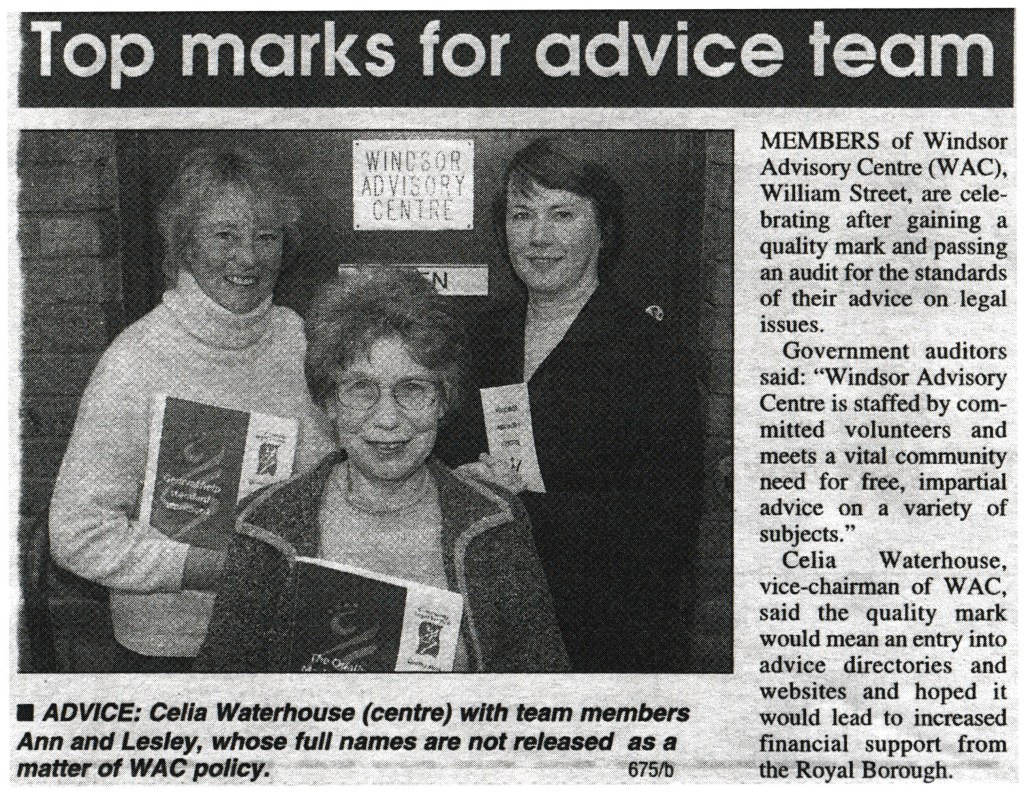
In 2001 the Centre was of sufficient stature to apply to the Community Legal Service for their prestigious Quality Mark Award. Celia Waterhouse volunteered as Co-ordinator for this accolade, which involved considerable expenditure of time and effort to grapple with the CLS’s forty two pages of detailed questions and requirements. Her dedication to this far-from-easy task met with total success when, after the CLS recognised that “Windsor Advisory Centre was staffed by committed volunteers and meets a vital community need”, the full Quality Mark was accorded. It was about this time that the Slough CAB closed, resulting in a surge of enquiries, however the number of volunteers was beginning to slide as older members retired or died or moved away from Windsor. Moreover, the recruitment of new members was slackening, a malaise which was increasingly draining the life blood of many volunteering organisations. June 2009 marked the fortieth anniversary of the Centre and a convivial, well-attended celebratory dinner was held at the Bexley Arms on 26th June. Ironically, at the same time, the clouds were beginning to gather.

Both the 2010 and 2011 Annual Reports revealed significant drops in both volunteers and clients. The former were reduced to thirteen, rendering staffing sessions increasingly difficult while the latter was attributed to the arrival of “technology in the home and its availability in public libraries, etc, which had enabled the self-solving of many straightforward problems”. The Maidenhead Citizens Advice Bureau had moreover opened a rival outreach clinic in Dedworth.
As John Major famously said “When the curtain comes down it is time to leave the stage”. After intensive and heart-searching debate, a notice of a resolution was despatched to the membership, advising of a special General Meeting on 31st March 2011 at which the motion would be put “That Windsor Advisory Centre be dissolved“. All absent members had signified their consent and the nine members attending the meeting regretfully passed the resolution. The date of closure was fixed for 11th June.
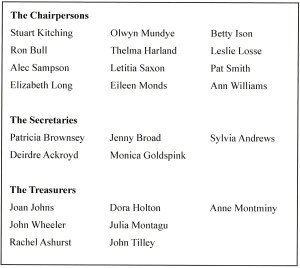
For some years, the members had enjoyed a summer party at the Wentworth home of Ann Williams, the last Chairman and the final such gathering was held on Ist July. It may be added that of all the Chairmen and Secretaries of the Centre, none were more devoted than Ann Williams and the last Secretary, Sylvia Andrews. As the former said of the closure at the final AGM:
This is sad in many ways but the Centre has operated on a totally voluntary basis for forty two years so we should be proud of the achievements of which we have been part and should congratulate ourselves about the many people that we have been able to help in all that time.
It was with sorrow that former members learned of the death of Ann Williams some five years after the Centre put up tts shutters.
Thus, a little over four decades later, the dream of Stuart Kitching came to an end. It is, perhaps, apposite in concluding the story of the Windsor Advisory Centre, to quote from the final paragraph of Hugo Vickers’ biography of Princess Alice, mother of the Duke of Edinburgh:
Above all, she saw hers as a life of service in which she did her best to help those less fortunate than herself.
The Princess would have made a worthy member of the Windsor Advisory Centre.
John Handcock
Thanks
The author would particularly like to record his thanks to Sylvia Andrews for her willing assistance in tracking down the Centres archives, and to acknowledge the help he derived from the summary of a talk given by Ron Bull at the 1982 AGM.
The author was President of the Windsor Advisory Centre from its opening in 1969 to its closure in 2011.
 Windsor Local History Group