
– The Forgotten Rector
Published in Windlesora 05 (1986)
© WLHG
Victorian Clewer is synonymous with the name of Thomas Thellusson Carter who became Rector in 1844. Space does not permit an account of the persecution which led to his resignation as Rector in 1880, and subsequent retirement to the Religious Community which he had founded at Clewer and to whose members he ministered as Warden until his death in 1901. To follow a great man in any walk of life is difficult; to follow a man like Canon Carter, whose sanctity and humility was attested by the majority of his parishioners, might have seemed well nigh impossible. Such a task was allotted to Roland Errington, whose name, but for the greatness of his predecessor, would be written large in Clewer’s history.
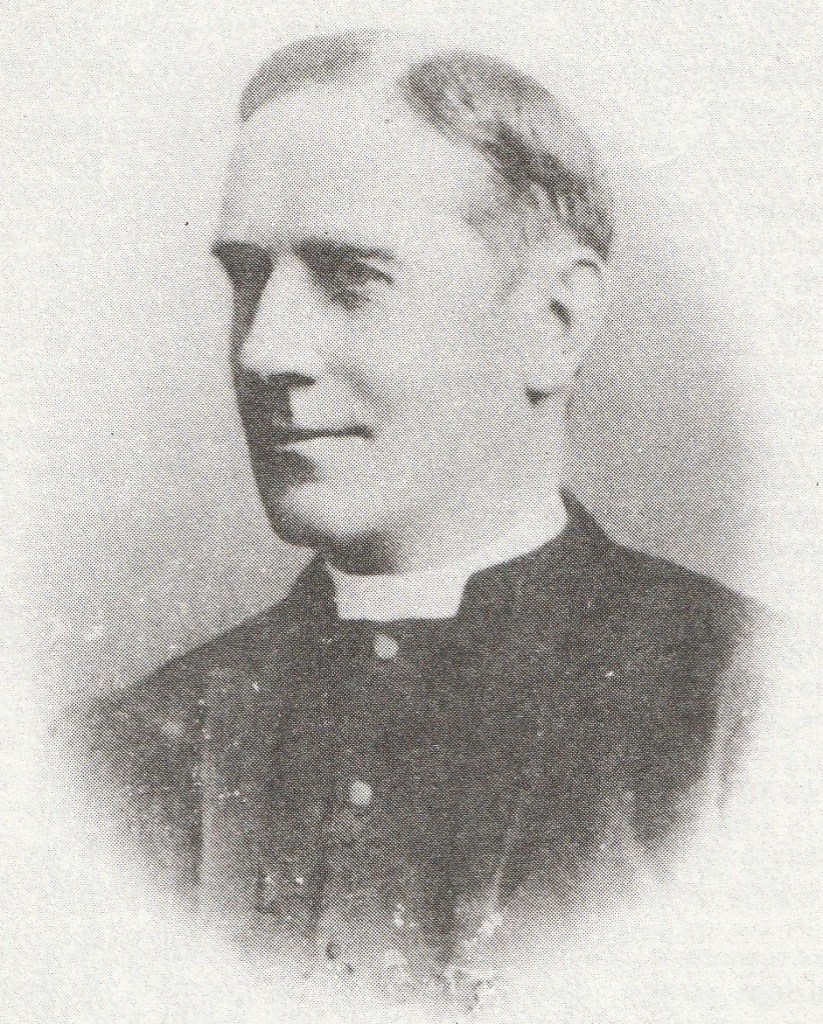
Roland Errington was 34 years old when he became Rector of Clewer, but he was no stranger to the district having served his first curacy at Stoke Poges (1870-75), after which he became Conduct of Eton College (1875-80). The living of Clewer was, and still is, in the gift of Eton College, and the authorities were no doubt anxious to appoint a man who would unify the parish and avoid further controversy, yet maintain a tradition of dignified worship. At Errington’s institution Bishop Mackarness of Oxford expressed the wish that the people should be of “one heart and one mind… no disputings, no strife… that they should be willing to bear and forbear.” He charged the new Rector to be careful of the peoples’ feelings, their interests and even their prejudices. Most of the local clergy had grave misgivings about the new appointment and demonstrated their feelings by staying away from the institution. Despite this rather uncharitable reception (an attitude which would have displeased Canon Carter), Errington’s appointment proved a wise one and he slowly won the approbation of his clerical colleagues.
Errington soon settled into the parish. A mild Tractarian, he maintained the tradition of worship centred on the Eucharist, yet throughout his nineteen-year incumbency he managed to steer clear of ritualistic controversy. The wealthy landowners such as Mr. Frances Tress Barry, Mr. E.B. Foster, and Sir Daniel Gooch once more occupied their pews in St. Andrew’s Clewer. Most important of all to Errington was the friendship which he won from Canon Carter and from the Clewer Sisters.
The parish was large and diverse, consisting of the scattered villages and hamlets of Clewer, Dedworth Green, Clewer Green and part of Spital. As well as the parish church of St. Andrew there were the district churches of All Saints Dedworth, and St. Agnes’ Spital. The latter, though in its infancy, was beginning to flourish under the care of its devoted curate the Revd. Henry Ley, but Dedworth was to be a constant source of anxiety not least because of the apathy of the people. “We should be glad to discover what will interest the people of Dedworth“, Errington wrote despairingly in the parish magazine of January 1838.
Roland Errington was a typical Victorian parson and the parish magazines provide plentiful evidence of the stern pastor calling his people to order, but sometimes one can sympathise with him as when a parish concert was very poorly attended. “As an illustration of the apathy and indifference of the Clewer people… no single relative of the boys who took part… was sufficiently interested in its kith and kin to attend and hear them perform.“
A further solemn warning was issued in June 1887, “We are sorry to hear that there is a great deal of Sunday traffic going on in the parish. The children come to Sunday school with their pockets full of sweets… Those who sell ought to know better. Those who buy will hear something more about it when the summer treat comes off. Sweets today will have changed into bitters then.” Let us hope the warning was heeded for the summer and Christmas treats were the highlight of the year for these poor village children, but they had to be earned by good attendance and conduct during the year.
Though a stern man, Roland Errington was not without a sense of humour which helped him survive many a painful parish concert! He describes such a concert in the magazine of June 1886 thus, “Mr. Hunt’s solo was a marvellous piece of execution, a Fantasia on one string for the violin by Paginini… Gymnastics on any instrument are wonderful to behold, but personally we prefer something quieter… “. One can almost see the pained expression on Errington’s face as he recalled that performance. In fact Errington was himself an accomplished musician not just in a serious vein either, but on a lighter note was a frequent performer at parish concerts when he and his wife sang duets. He was also the proud owner of a magic lantern and needed no second bidding to brighten up many a parish treat. This was especially popular at the House of Mercy run by the Clewer Sisters when the girls would have their Christmas treat consisting of a tea party, tree with presents and the Rector’s lantern show.
There is one incident in particular which above all others shows Errington to be a man of his time, and though we may recoil from it, it speaks volumes about the attitude of the Victorian Church to its neighbour. November 10 1890 was to witness a great novelty in the parish. There was to be a missionary meeting at which “the great attraction will be the presence of a native priest, the Revd. H.M. Joseph, who will give an address“. But alas, much to everyone’s disappointment he failed to appear. Later all became clear. “The mistake arose,” wrote the Rector, “from his imagining that Clewer was in the Salisbury Diocese (it used to be). As he was engaged to travel through that Diocese…” he expected to find himself in due course at Clewer. Mr. Joseph expressed himself as deeply grieved for having disappointed us, and suggests coming to us some other time. We feel inclined to accept his offer. But is he sure to turn up? The warning seems to haunt us ‘Nimium ne crede colori’ which freely translated means “Do not put too much faith in a Black man“. We can only give thanks that we live in a more enlightened age!
It is when we examine the needs of the people within Clewer parish that we really appreciate Errington’s true worth. He may have been stern and somewhat intolerant but when his people were in real need he was always there to champion their cause. A number of issues reflect the humanitarian side of Roland Errington.
The growing need for a parish hall became more urgent towards the end of the 1880’s. Concerts, lectures, penny readings, and Christmas treats all needed somewhere with ample accommodation for the audiences who, despite their initial apathy now flocked to them. Both Spital and Dedworth had halls but Clewer was frequently forced to use the inadequate facilities of St. Katherine’s Infant School. So it was that in February 1889 the Rector first mooted the idea of a parish room and asked for donations. A year later the initial target of £400 had been reached. “But will £400 suffice for a really suitable Hall? We must not only think of the present… As the building is for the benefit of the people of Clewer, all classes should contribute. The poor man’s pence will be no less welcome than the rich man’s gold.” The land for the building was given by Sir Henry Gooch in 1890 but raising the extra money presented untold problems and it was another three years before building commenced. By this time Errington was feeling very disheartened, “Is all public spirit gone out of the place?” he asked. In spite of such slow progress the building was opened on October 12 1893 with a concert by the Royal Handbell Ringers. The Clewer Hall, as it came to be called, consisted of a large hall to seat 300, with a stage at one end. Behind the stage there was a retiring room and a caretaker’s room. The cost had been around £800, and later, when more funds were raised, a library and reading room were added. A Trust was set up for the administration of the Hall and therein lay the seeds of doom for in later years, as the result of an unforeseen loophole, the Hall slipped out of parish hands and is now virtually a private concern.
The plight of the poor was never closer to Errington’s heart than when it concerned matters of public health and safety. The years of his incumbency saw a growing awareness of the connection between bad water and drainage and the spread of disease, and there were a number of epidemics of scarlet fever, diphtheria, whooping cough, and worst of all, small-pox. Errington was an ardent campaigner for a decent drainage and water system for Clewer, and was appalled that as late as the 1890’s there were foul ditches and open sewers running along some of the main thoroughfares of the parish.
In April 1893 a severe epidemic of small-pox broke out in Clewer parish. April 21st saw a case at St. Andrew’s Hospital and the Clewer Sisters decided to remove all uninfected patients to safety. Two days later the man died but no other cases developed and by April 29 the Hospital was declared out of quarantine by the Sanitary Authority. However, no workman could be persuaded to go in to disinfect it. By this time other cases had developed within the parish and in the neighbouring parish of Clewer St. Stephen, and they were being treated in their homes because there was no isolation hospital. (The local authority had been trying for years to erect such a place but no one would agree to having it in their vicinity). Meanwhile, St. Augustine’s Home for Boys, run by the Clewer Sisters, had become infected, so Sister Emma evacuated the boys who were well and gave the Home over temporarily for infected cases who were placed under the care of three experienced nurses. Now the lack of an isolation hospital was felt more keenly than ever as more cases were reported every day. Finally it was decided to erect marquees in the glebe field at the back of Clewer Rectory, and these were occupied until the end of August when the epidemic abated.

In 1978 Michael and Nicholas Shaw, sons of the present Rector of Clewer, excavated part of the present day Rectory garden and discovered crockery marked with an X and a number of bottles amongst many other items. The crockery had belonged to St. Andrew’s Hospital, hence the X symbol, and had been loaned for use in the marquees during the epidemic, but had afterwards been broken up and buried for fear of spreading infection. The bottles still contained quantities of coal tar and had been used to treat patients sores. These artefacts are on display in the Clewer History Museum together with a photograph of some of the helpers. (see Fig. 2). One helper who is not portrayed is Roland Errington who, we are told showed “great courage and pluck… in doing what no one else was forthcoming to do” by going amongst the sick and assisting with the nursing. This example made a lasting impression on Errington’s parishioners and they presented him with an illuminated address and a set of silver dessert dishes in recognition of his “self-sacrifice and courage, and prompt and noble action“.
Roland Errington left Clewer in November 1899 after nineteen fruitful years. If his arrival had been met with suspicion and resentment, then his departure was met with universal regret. He became Vicar of Warden in Northumberland until 1905 when he moved to East Tisted, Hants. In 1919 his wife, whom he had married in 1883, died. Errington retired in 1921 and lived in Winchester until his death five years later at the age of 80.
Perhaps Canon Carter summed up Errington’s ministry best of all on the evening of the presentation after the small-pox epidemic. “Canon Carter… said a few words referring especially to the Rector’s work in the parish, and to the pleasure it gave him to see that work carried on in the way which he had always so much at heart; namely in the true spirit of Church teaching, and in unity among the parishioners“.
Valerie Bonham
Acknowledgements
The Revd. Denis Shaw, Rector of Clewer; Revd. Mother, C.S.J.B.; Mrs. A. Steward of Vale Rd. who has loaned the photograph of the group outside the marquees, to the Clewer Museum.
Further reading:
“In the Midst of the People‘ by Valerie Bonham. 1983. Now out of print but copies for loan may be obtained through Berkshire County Libraries.
 Windsor Local History Group