
Published in Windlesora 19 (2002)
© WLHG
These two days will ever remain indelibly impressed on my mind, with great gratitude to that all-merciful Providence, who has protected me so long, and to my devoted and loyal people.
Queen Victoria’s Journal.
At the time of the Golden Jubilee of Queen Victoria Great Britain was at the height of its prosperity. The Empire was the largest the world had ever known and the Queen numbered her subjects in hundreds of millions. Her Majesty, having been made Empress of India, had emerged from the seclusion of her widowhood and graciously accepted the adoration of the people whose excitement over the preparations for the Queen’s Jubilee was rising to fever pitch.
A great many events centred on London and were copiously reported in the national newspapers. Even the local newspaper, the Windsor Express saw fit to devote most of that week’s publication on events happening in London and we have to look in the court Circular of The Times and the Morning Post to find out what happened in the town of Windsor. |
The real festivities began in the town on the evening of Wednesday, 22nd June, as the townsfolk waited with joyous exuberance the arrival of Queen Victoria and her party from the national celebrations in the capital. The Queen and her children took the train to Slough and were met there by the Lord Lieutenant of the county, the Duke of Buckingham and Chandos, and the High Sheriff, Captain Meeking, and several civic representatives. She was presented with loyal addresses and listened to the singing of God Save the Queen by a massed choir of children from Beaconsfield, Burnham, Datchet, Langley and Taplow.
A guard of honour, consisting of 100 rank and file of the Ist Bucks Volunteers, had assembled in the yard of Slough station. The Royal procession in seven carriages with many outriders moved off towards Eton, followed by a mounted escort. In the first carriage were the Queen and her eldest daughters Vicky and Helena, and her son Alfred, Duke of Edinburgh.
The second carriage held her other daughters, Louise and Beatrice, her daughter in law Marie, Duchess of Edinburgh, and the Duke of Saxe-Coburg. In the third carriage were her granddaughter Moretta, her grandson Albert Victor and her son Arthur and his wife, (the Duke and Duchess of Connaught). The rest of the carriages held an assortment of ladies-in-waiting, gentlemen-in-waiting, maids of honour and equerries.
The Eton College Volunteers were drawn up in front of the Upper School and the Eton pupils lined the wall. As the carriages halted in front of the Volunteers the Queen was given a Royal salute and presented with another three addresses. At the Queen’s request, she spoke to the Vice-Provost of Eton, Rev J Wilder, who was 90 years old. He had been a pupil at the College at the time of George ITI’s Golden Jubilee and was one of those chosen to offer congratulations to the King. The procession, now including the Volunteers and the schoolboys, continued through the town of Eton and over Windsor Bridge.
As the procession reached the bridge the Royal Standard was hoisted on the Round Tower and the bells of the parish church and St George’s Chapel rang out and continued ringing until the carriage reached the foot of Castle Hill where it halted.
There took place the unveiling of the statue of Queen Victoria. The sculpture, by Edgar Boehm was paid for by public subscriptions from areas including Ascot, Bray, Clewer, Colnbrook, Cranbourne, Dorney, Eton, Windsor and Old Windsor, Sunningdale, Virginia Water, Winkfield and Wraysbury.
Edgar Boehm’s statute still dominates the public entrance to the Castle and keeps an eye on everything that goes on in Peascod Street.
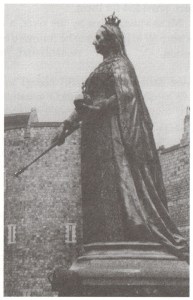
After this the procession continued up Castle Hill to the Laate where, later in the evening, a Grand State Banquet was held.
Much later in the evening the 900 Eton boys gave a dazzling display of formation marching. Between such formations as ‘a rose’ and the ‘union jack’ on the castle quadrangle, they sang a selection of songs including the Eton Boating Song and Rule Britannia, finishing off with GOOD NIGHT formed by the Chinese lanterns they were holding, and the singing of Auld Lang Syne.
The Queen’s dinner guests, who included members of nearly all the European monarchies, many of whom were related to her, were able to see the whole proceedings from the corridor windows but the Queen and her family did join the boys in the quadrangle to congratulate them.
The next day, 24th June, was very warm and the town was congested not only with people but also with firemen and fire engines. The Queen had allowed a procession from the Fire Brigades Association and reviewed the brigades and their engines in the Home Park. Before that a lawn tennis tournament had been arranged, while upwards of 6,000 school children from Windsor and neighbouring parishes assembled in the private part of the Home Park where the Windsor District Committee entertained them. The school children had marched through the town accompanied by music played by bands.
The Clewer children, accompanied by sisters from the Convent of Mercy made a brave show with their flags and banners. About 80 marquees lent by the Army Hospital Corps provided accommodation for the meal, which was given to the children. Subsequently they dispersed about the grounds where many amusements had been provided for them.
Meanwhile, down by the river, a regatta, swimming matches and aquatic sports were all in progress to be followed by a Venetian féte and an illuminated boat procession.
The front cover of a programme card of activites arranged for the Golden Jubilee in Windsor and Eton. It was issued by Herberts Supply Stores, a Department Store in Eton, and is now at the Royal Borough Museum Collection.
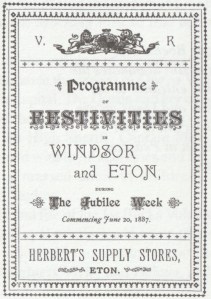
Soon after 2pm the fire brigades began to assemble on the Long Walk where they were each presented with a medal, and inspected by the Mayor and Colonel Sir Charles Firth. The whole force, which included 1280 firemen from 120 brigades and 100 fire engines formed a procession led by a band and drove through the town to form a line along Datchet Road from the South Western Railway to Grand Avenue. There the firemen in helmets, which gleamed in the sunlight, mounted their engines and waited for the Royal party. First came Prince and Princess Christian followed by the Duke of Edinburgh and Prince Louis Battenberg and then finally the herself, accompanied by Princess Beatrice and Princesses Alix and Irene of Hesse. There was much cheering from the crowds, which drowned out attempts to sing the national anthem.
Plans to demonstrate a fire drill were abandoned due to the lateness of the hour and the crowds of people. But the torch light procession went ahead where the firemen assembled in the Home Park carrying lighted torches and coloured fire. They marched through the town and assembled on the Grand Quadrangle of the Castle. Here the bands played on the north side while the firemen marched round, the light from their torches illuminating the towers. The Queen and her illustrious guests were able to watch the spectacle from the corridor windows.
After the cheers and the playing of Auld Lang Syne the firemen marched off like a stream of fire trailing down Castle Hill till it was lost amongst the crowds which thronged the brilliantly decorated town.
Sheila Rooney
 Windsor Local History Group