
Published in Windlesora 32 (2016)
© WLHG 2016
The early years of Princess Elizabeth (pictured below, aged 7) were spent in London at the family home in 145 Piccadilly and at Royal Lodge in Windsor Great Park at the weekends, together with the royal dogs. In Windsor, she would enjoy riding accompanied by a groom, a practice she has continued throughout her life. Her father, the Duke of York, later King George VI, encouraged his daughter to take part in gardening, and “Ty Bach’ (The Little House), a miniature, furnished, thatched cottage, a gift from the people of Wales, was splendid for playing ‘houses’.
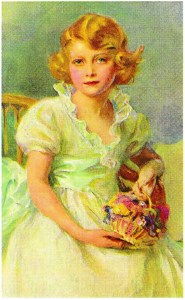
Buckingham Palace became her home after her father was proclaimed King on December 12th 1936, and Elizabeth was now heir apparent to the throne.
The Second World War was declared in September 1939, and in May 1940 Princess Elizabeth and her sister Princess Margaret, came to live in Windsor Castle. They were accompanied by Miss Marion Crawford, their governess, a number of other staff, and with four Grenadier Guards officers in attendance. It was to be their home for the next five years. The Princesses occupied a suite of rooms in the Lancaster Tower, and during alerts took refuge in an air raid shelter in a dungeon, equipped with beds and toilet facilities. Ration books and clothing coupons were issued to them just as they were to ordinary citizens.
The King and Queen continued to live in Buckingham Palace, visiting Windsor at weekends whenever possible. They would arrive in time for tea on Friday, and stay until Monday. The King wanted his daughters to lead as normal a life as pos ible so affairs of state were avoided, with the conversation centering on the Princesses’ activities. While Miss Crawford was in charge of their education, Sir Henry Marten, Vice-Provost of Eton, was appointed to teach Princess Elizabeth Constitutional History, and Miss Montaudon-Smith (Monty) gave French lessons, teaching them separately and together for duets to sing to their parents.

Between 1942 and 1944, pantomimes were staged in the Waterloo Chamber, on a stage erected in Queen Victoria’s reign for Household theatricals. The large ol paintings of various kings and queens were removed for safety, and in their place were a variety of brilliantly coloured pantomime characters, designed and painted by Claude Whatham, assisted by students of Wycombe Technical Institute. In King Charles 1’s frame was a picture of Dick Whittington and his cat, whilst in Queen Henrietta Maria’s frame was Mother Goose
The pantomimes were devised by Hubert Tanner, Head of the Royal School, with additional material contributed by the Princesses and their governess. Tanner also took a leading role and Cyril Woods was the Dame. Cinderella was staged in 1912, with Elizabeth as Prince Charming and Margaret as Cinderella. In 1943, Aladdin was performed with Elizabeth in the lead role, and Margaret as Princess Roxanna. A programme for Old Mother Red Riding Boots staged in December 1944, shows that audiences paid one shilling per seat with the cash going to the war effort.
Audiences were drawn from residents and officials in the castle, as well as court officials, estate employees and their relatives. The 1944 provramime reveals a highly professional production with a cast list of eleven, Elizabeth and Margaret were Lady Christina Sherwood and The Honourable Lucinda Fairfax respectively, with Cyril Woods as Mother Hubbard, Hubert Tanner as Sammy Suction, and Fairfoot the horse played by David Prescott and Cyril Sturgess. Costumes were supplied by L&H Mottram, and Mottram Wigs. Scenery was designed by Vincent Korda and F Bellan.* There was an interlude ballet with eleven dancers including the princesses, and a chorus of nine boys and nine girls , with the Salon Orchestra of the Royal Horse Guards providing the music.
At Buckingham Palace in February 1937, Elizabeth and Margaret were enrolled by their aunt, The Princess Royal, as a Guide and a Brownie. In 1942 it was decided to form a company of Guides and of Sea Rangers at Windsor Castle. Along with the princesses, members were the daughters of castle staff, estate employees, and evacuees from London’s East End living in the park.
Elizabeth became a Sea Ranger in 1943, and Margaret in 1946. Both princesses worked for many first class badges, including Interpreter, Cook, Horsewoman, Needlewoman, and Child Nurse, and they enjoyed the hiking and camping activities. The Mausoleum became the HQ for the Guide camp, Queen Victoria’s summer house was where their governess slept. A small sham temple built by Victoria was used by the Sea Rangers who moored their dinghy outside on the lake. The King and Queen visited the camp in 1944, and King George was delighted by their healthy activities, congratulating them on their orderly camp. Doodlebugs, or V1 bombs put an end to overnight camping, but starting early the day time activities continued. After the war, Princess Elizabeth continued her association with the Sea Rangers, and in 1949 she became Chief Ranger of the British Empire, and later, Patron of the Girl Guide Association. Princess Margaret became the President of the association in 1965, a position she held until her death in 2002.
When she was sixteen, in 1942, Elizabeth registered at the Windsor Labour Exchange like all other girls her age. In 1945, at the age of eighteen, she joined the Auxiliary Territorial Service (ATS) as a Subaltern. Her Mess was at Camberley and she took her turn at Mess duties, worked hard at car maintenance, only returning to the castle to sleep. On the last day of her tests, the King and Queen paid a visit, and having passed them all as well as her driving test, Elizabeth was promoted. She drove Commandant Wellesley to Camberley, and in the autumn drove to Buckingham Palace, through the heavy traffic and along the Mall in the blackout.

In May 1945, saw Victory in Europe, and the war finally ended in August. The Royal Family joined the nation in the celebrations. The princesses returned to Buckingham Palace and family life resumed. The annual summer holiday was spent at Balmoral, Christmas at Sandringham, and Easter at Windsor. The Garter Day service in St George’s Chapel was followed by daily attendance at Royal Ascot Race Course.
In February 1947, the sisters joined their parents on a four month tour of South Africa. Prince Philip was not included but kept in touch with Princess Elizabeth by telephone and letter, When his naturalisation papers came through, the Court Circular on Wednesday July 9th announced the betrothal of Her Royal Highness Princess Elizabeth to Lt Philip Mountbatten. They were married at Westminster Abbey on November 20th 1947.
After their honeymoon, they lived temporarily at Buckingham Palace while Philip worked at the Admiralty, fulfilling his wish to pursue his naval career. Elizabeth achieved her wish of having a baby in the first year of her marriage when Charles was born in November 1948, to be followed by Princess Anne in 1950.
Although the King’s health was giving cause for concern, arrangements for a tour of Africa were made for the Royal couple, starting in Kenya. The King and Queen waved them off, but it was while they were relaxing in Tree Tops Game Lodge in the shadow of Mount Kenya, that Philip was informed of the King’s death. He then had to give the sad news to his wife, who was duly proclaimed Queen in January 1952. As Royal Consort, Prince Philip, Duke of Edinburgh has accompanied the Queen on all state occasions, including the opening of Parliament Trooping of the Colour, entertaining Heads of State, and overseas visits. In a changing world, she is reported to refer to Philip as her rock.
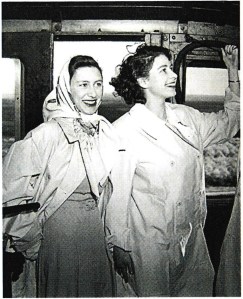
Source: M Crawford, The Little Princesses
Princess Elizabeth and her sister Margaret, on a steam train footplate during the tour of Africa with the King and Queen, in 1947
Joyce Sampson
*See following article Hollywood and the Queen
 Windsor Local History Group