
Published in Windlesora 31 (2015)
© WLHG
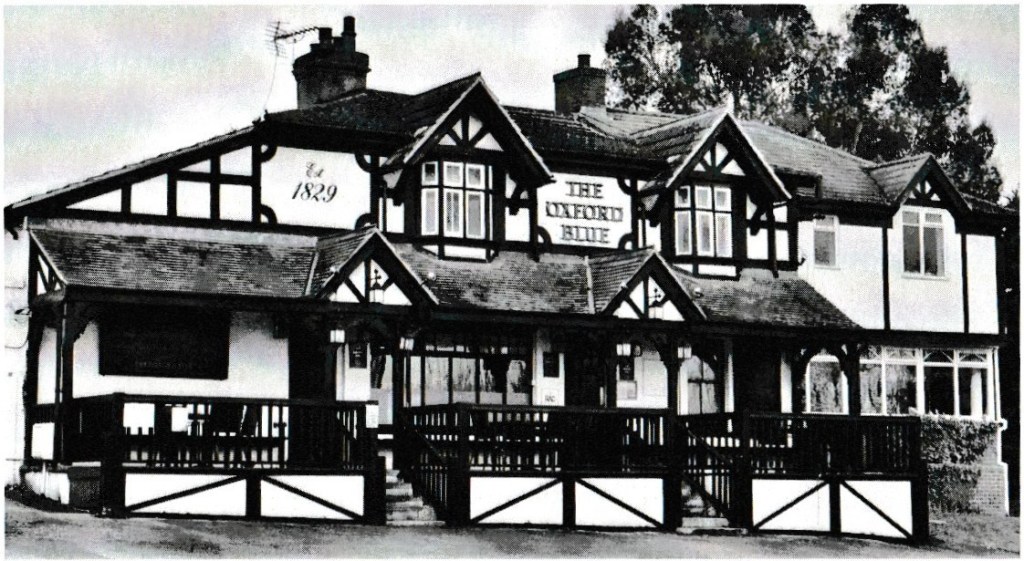
Thomas Evans, who became the first landlord of the Oxford Blue Public House was born in Collingtree, Northampton in 1781, where he cordwainer (shoemaker).
In 1800, the Royal Regiment of Horse Guards were quartered in Northampton and Evans, nineteen years old and six feet tall, enlisted. Later the regiment returned to its more usual home in Windsor and trained in the area including Winkfield, where Evans met Jane Broughton and asked her to marry him.
The regiment went to Portugal as part of Wellington’s Peninsular Army and Thomas Evans took part in the crossing of the River Douro, which according to the French general Soult was ‘bridgeless, boatless, and totally impassable’.
A Portuguese barber reported to the British that four large wine-barges were lying unguarded and using these the soldiers were conveyed silently across. Soult, awakened with the news that the English were coming, was reported to have said, ‘Bah its a party of red-coated Swiss who ’ve been down to bathe’. When the French soldiers guarding the river realised what had happened, they fled. In pouring rain, with brutality on all sides, the French were driven out of Portugal.
The Peninsular War ebbed and flowed in Portugal and Northern Spain, with famous battles such as those at Bussaco and Salamanca, but Vitoria is the next battle at which Evans is recorded. As had happened at Salamanca and was to happen at Waterloo, it rained before the battle, something that was felt to be a good omen. Again Wellington benefited from information from a local peasant – a strategic bridge was unguarded. The cavalry poured into the town and the French hastily attempted to cram their goods into carriages and escape. A Life Guardsman wrote home to say that Wellington had congratulated them:
Well done Life Guards, you have behaved yourselves as becoming Household Troops.
However, the battle of Vitoria was followed by an orgy of looting, not only of food and the treasures of the city, but also of the wagons which contained the booty of the French army. This included the French army’s pay of five million dollars of which only £100,000 reached the official coffers. Wellington had hoped the next morning to march in pursuit of the French, but his army proved to be too drunk and disorganised, and the French escaped over the Pyranees to France. Wellington called his army The scum of the earth.
By 1814 the army had returned home. Jane commented that Thomas had put on weight, so when 1816 the Blues were recalled to go to Belgium, Thomas was considered unfit. He apparently told his Colonel, Sir Robert Chambre Hill, that if he couldn’t go as a trooper, he would go as a volunteer. Sir Robert relented and Thomas was at Waterloo. In the thick of the fighting Sir Robert, at the head of his troop, was wounded in the arm and surrounded by French cavalry. Thomas Evans came to his aid, killing four cuirassiers and breaking his sword on a fifth, while leading the Colonel back to safety behind British lines. In 1816, he was later commended for valour at a ceremony at the Windsor Riding School in 1816.
In 1817, Evans married Jane Broughton at Winkfield Church. In 1829 he returned from the army and was installed as landlord of the Oxford Blue . He stayed in Old Windsor until his death in 1859 at the age of 78. He is buried in Old Windsor churchyard and was survived by his wife, three sons and a daughter.
Margaret Gilson
 Windsor Local History Group