
Published in Windlesora 32 (2016)
© WLHG 2016
In the early 19th century, long before the coming of the railways, there was only one route in to Windsor from the west. There was no Clarence Road, no Arthur Road and no Dedworth Road. All of Dedworth was farmland and all of the area between Peascod Street and Clewer village was meadow, liable to flooding in most years.
The only route from Oxford and Maidenhead was via Clewer Village and Clewer Lane (now known as Oxford Road). This joined Peascod Street the ancient Duke’s Head Inn, which also marked the parish boundary between Windsor and Clewer. The frequent floods meant that Clewer Lane was often impassable. This led to the development in the 1830s of the “New Road’ above the flood line, which we now know as Clarence Road, and the Bedborough estate including Clarence Crescent, Trinity Place and Holy Trinity Church.
By 1842, before the Great Western Railway was completed in 1849, there was just a smattering of small businesses in Clewer Lane – a bakery, a boot and shoemaker and two general grocers. There were also several beer retailers and two public houses, The Clarence and The Free House (later The Prince of Wales). Most of the retail premises in Windsor at that time were still situated in Peascod Street, High Street and Thames Street.
Once the railway had arrived, with the new station replacing George Street, residential building started in earnest. Terraces of houses arrived on the meadows, firstly in Gardner’s Cottages, then Victoria Cottages (Denmark Street, Edward Square and Grosvenor Place.) Others nearby included Arthur Road, Goswell Place, Bridgewater Terrace, Oxford Road, Bexley Street and Albert Street. All of these new residents needed local shops for their day-to-day requirements — butchers, bakers, grocers, hardware stores and of course, a few pubs.
The High Street, Thames Street and the top half of Peascod Street were the province of the Aristocracy and Gentry. There were furniture shops, fashions, tailors, milliners, saddlers, gunsmiths and smart hotels, many of them sporting “By Royal Appointment’ coats of arms.
Oxford Road and Lower Peascod Street became the province of family businesses catering for the local tradesmen and working people. Names such as Darville, Wellman, Denney, Wells, Ogilvy and many others were still familiar to local people well into the 20th century.
By 1890, Oxford Road had become a busy community hub. The section between Vansittart Road and Alma Road was mainly residential with a few shops and pubs, and most of these properties still exist today. The section from Alma Road to Peascod Street was lined with shops, including three bakers, five greengrocers and fruiterers, four grocers, two butchers, three fishmongers and a dairy. There was also a hairdresser, a draper, a boot and shoemaker and numerous others. The number of pubs and beer-houses in this one road increased from two to include The Globe, The Coach and Horses, The Black Boy, The Why Not, The Perseverance, The Elephant and Castle and The Mitre.
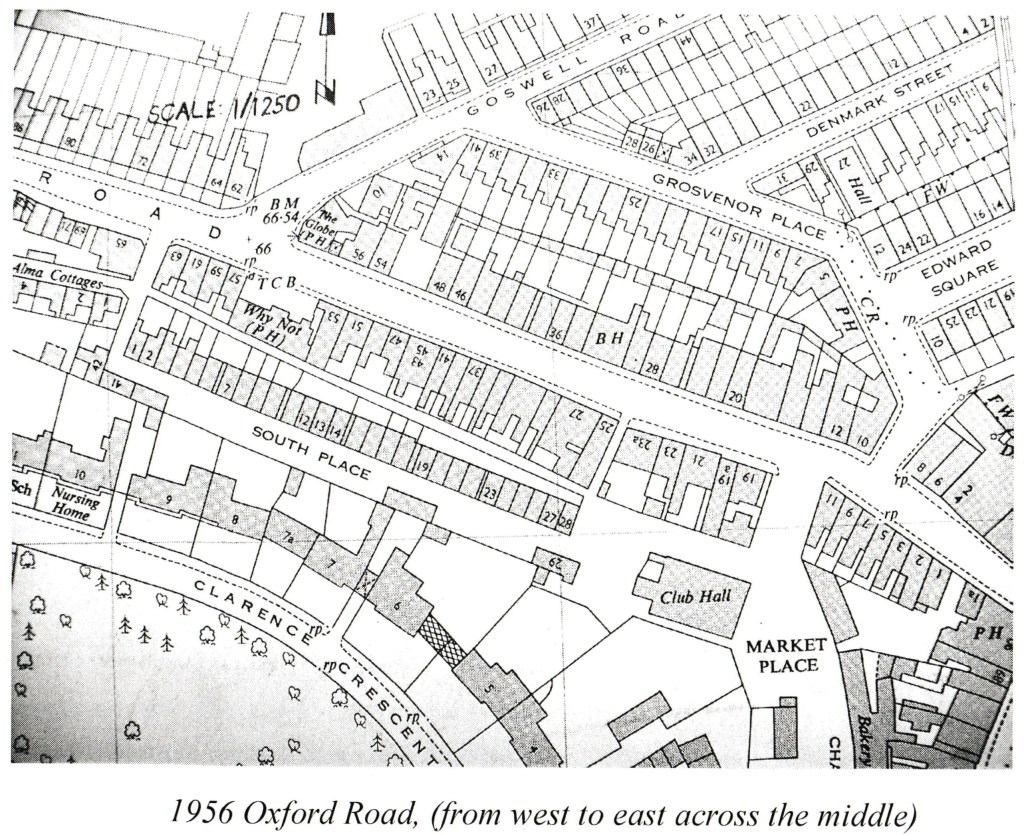


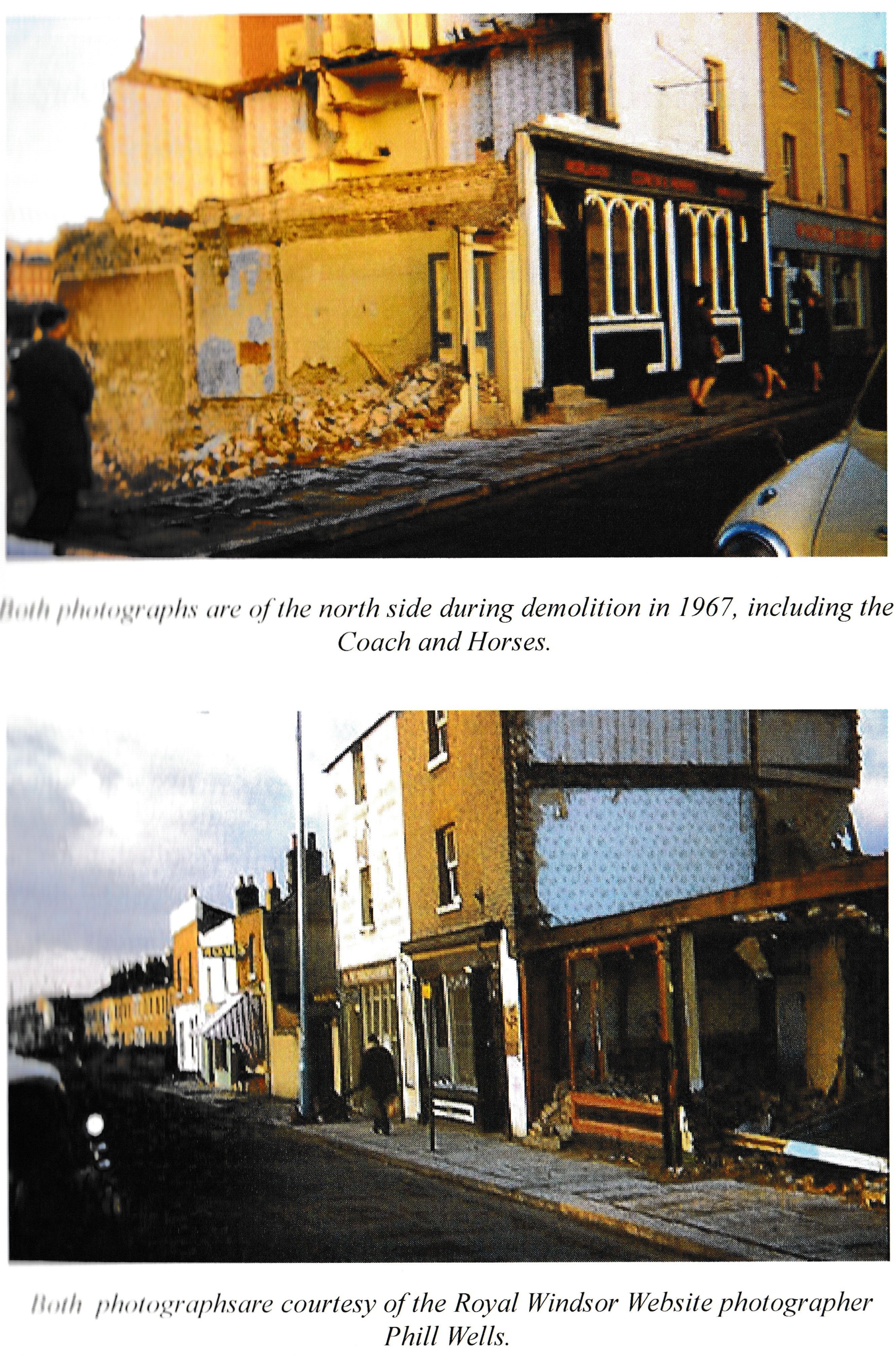
So it remained until the mid-1960s, when the whole area between Alma Road and Peascod Street was earmarked for redevelopment. Shops and businesses closed in anticipation of the bulldozers, and residents moved out, many of them to Dedworth.

A final New Year’s Eve party in 1966 at The Coach and Horses reportedly went on until the early hours of the morning. The businesses which were still trading at that time included:
- On the south side (left side going from Peascod Street)
- Kiddie’s Corner Pet Stores, Martin’s Fish Restaurant, London Hairdressers,
- Vickers Newsagents, Payne’s woodwork supplies and Park Stores.
- On the north side, (right side going from Peascod Street)
- Darville’s grocers, Walter Lawrence, tobacconist and turf account, Sidney Valentine, grocer, Baxter’s butchers, Symons Fish Shop, Alfred Heather, boot repairs, Windsor Builders Supplies, Daph’s Diner and Stevens bakery.
Demolition started in earnest in 1967 and just two years later, on 23rd June 1969, the newly-built Ward Royal block of flats was opened on the site by the Queen.
 Windsor Local History Group