
Published in Windlesora 09 (1990)
© WLHG

Sport as a pastime has been taken very seriously by both gentry and villagers for some two hundred years. In the early Victorian era, cricket had become an accepted leisure time activity and quick to show their enthusiasm were the inhabitants of Old Windsor.
By 1860 the Cricket Club was playing under the banner of Windsor Great Park and was prepared to travel many miles in pursuit of the game. Annual fixtures were made with Westbrook Park at Eashing, Bracknell and Easthampstead Park, then the property of the Marquis of Downshire. The Club entertained its guests in an elaborate manner in the grounds of Cumberland Lodge. In 1869, to add to the enjoyment, the Band of the Second Battalion Coldstream Guards was in attendance and dinner, held in the evening in a large marquee on the grounds, was supplied by Mrs Tily of the Fox and Hounds. At a fixture later in the year the spectators were entertained by the Drums and Fifes of the Scottish Fusiliers.
The President at that time was W. Menzies, who was supported in the team by F. Simonds, a notable batsman and wicket keeper, A. T. Draper, the Revd. V. H. Aldham (bowler), the Revd. T. E. Harwood, Capt. the Hon. W. N. Hood, who fielded at point, and other players were F. Bartlet, H. and C. Ruck, C. and W. Morris, G. H. Perkins, E. MacDonald, H. Smith, F. Pelham, M. Mortlock, R. Wrye (described as a tricky bowler) and D. Lines noted for his twisting underhand bowling.
Alongside the game of cricket the interest in soccer was taking off, with the success of the local teams like Old Etonians in the F.A.Cup. Old Windsor boys took part in many friendly matches. Playing on Runnymede as a home base, and calling themselves ‘Runnymede’, they did in fact reach the second round of the Cup in its very early years, when they had the misfortune to lose to the Swifts.
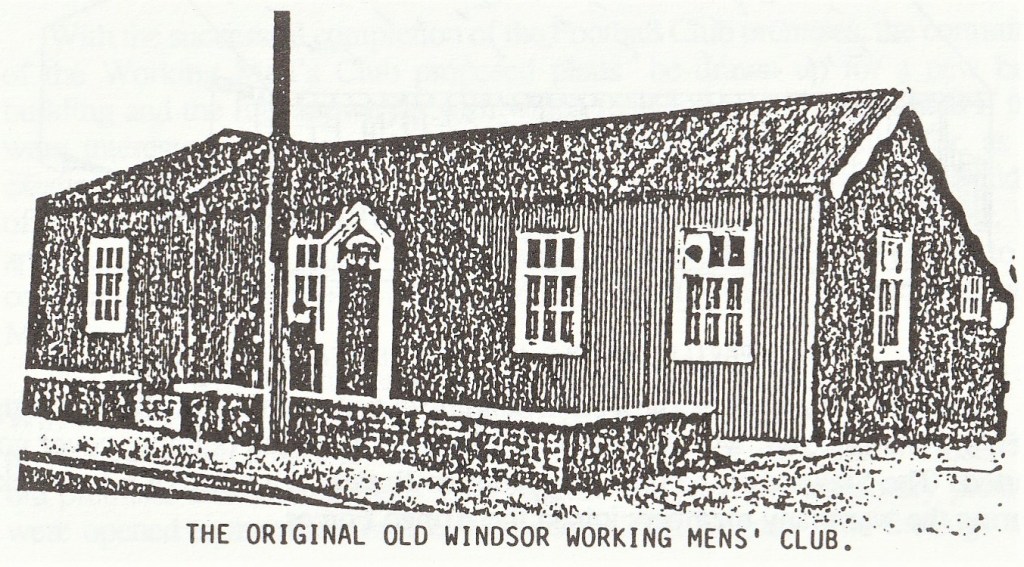
By the year 1881, the first mention of a Club for the Working Men of Old Windsor was recorded, and Queen Victoria’s Commissioners of Woods and Forests agreed to let a piece of land for the erection of an iron building for this purpose, which was generously donated by Colonel Follett.
The first meeting of the Club to form a working committee was held on 27th February 1881. Colonel Follet was elected President, the Vicar and F. Ricardo, vice-Presidents. Mr Keer was Secretary and Mr Bitmead Treasurer. There were 50 members willing to join and the committee consisted of C. Sainty, A. Sinclair, J. Willis, J. Gould, W. Hunt, G. Cox, W. Blake, R. Collins, W. Barker, W. Swabey, J. Williams and J. Tindall. The premises were officially opened by Lady Julia Follett on 25th May 1881, followed by prayers from the Vicar who wished every success for the future. Colonel Follett expressed his pleasure in donating the building and was sure it would benefit the people of the village. The speeches led to the enrolment of members, some of whom remained to read the newspapers and magazines which had been supplied. In the first year the Club flourished and made a clear profit of £9 and on 22nd November the following year a concert consisting of ventriloquism, mimicry, duets and a recitation was held before an audience of 32.
Football was increasing in popularity and by 1898 the Old Windsor Football Club was officially formed. W. J. Young was the appointed Referee, J. Cooper the Linesman and H. French the Trainer. The first games were played on ‘Ricardo’s Meadow’, now all part of Meadow Way and Ricardo housing estates. In 1908 St Peter’s School won the McGloskie Shield and the outlook for a successful team during the coming years was good but, unfortunately, this was shattered by the outbreak of the First World War with some of the boys making the supreme sacrifice.
At the outset the Football Team colours were selected as red and black, one tradition that still exists and, although information received says that the players changed into their gear in the Working Men’s Club, and walked through Miller Lane (now all part of the Recreation Ground) to ‘Ricardo’s Meadow’, it is more likely they either changed at the ground or left home already equipped. No washing facilities were available so players trapesed home with mud and dirt still on them to be washed off in the tin bath in the living room. Even then, wives and mothers must have been cursing the day that soccer was invented.
In 1919 the Working Men’s Club was granted a licence to sell intoxicating liquor and Dr. Shaw and R. Gosling arranged to purchase a Nissen hut from the Army on Salisbury Plain, and had it moved to Old Windsor where it was joined to the main building. At the same time, the Football Club which had Colonel and Lady Julia Follett, Mr. Owen Tudor and Mr Ricardo as Presidents, Mr. W. Ellis as Chairman and Sid Blore, Secretary, had become a member of the Windsor, Slough and District League which had been newly formed.
A year later the Working Men’s Club became the first lending library in the village with Mr Franklin as the Librarian. By the mid 20s the Boxing Club was holding many competitions that were well supported by the members and, with a donation of land – now the Recreation Ground – by Mr Ricardo, the Cricket and Football Club found a new base complete with on-ground changing facilities. A grand opening ceremony took place with Lady Julia Follett as guest of honour.

Plans were drawn up for a new brick building to replace the tin hut the Working Men’s Club used, but with the outbreak of war in 1939 the building never got started. The Steward at the time was Norman Butler on a wage of £2 a week. During the war many members joined the Armed Forces.
The Club building was used by many organisations during the War: as an overflow school for evacuee children, A.R.P. lectures, ante-natal clinic, British Legion, a Catholic church on Sunday mornings and, later, as a doctor’s surgery. After the War the NAAFI organisation donated some money towards Club funds. Many children’s parties were held in the village to celebrate victory and a firework display was held on the Recreation Ground. The fireworks were donated by Lupino Lane who, at the time, was a member of the Club.
The Football Club was now at its peak and, following promotion to the Premier Division and two appearances in the Slough Town Cup Finals, became one of the senior sides in local football. During the years 1858-62 the Club built its own premises on a piece of land in Queens Close which was purchased for £75. All the hard labour supplied on building the clubhouse was voluntary and enthusiastic, which affected the Working Men’s Club which seemed to be on the decline. Mr. W. E. Ellis, the Club’s President, called a special meeting to ask members to rally round and decide what to do. A vote was taken and a new committee formed, with younger members being elected to serve with the older generation. Volunteer painters and decorators from the committee and members gave the Club a face lift and two sixpenny fruit machines were installed. In 1960 the committee sampled a new bitter – Anchor – at one farthing a pint. The men’s bar was renovated and a new beer store built.
The Cricket Club, finding that soccer ruined the playing surface of its the pitch, found it necessary to move and carried out its activities on the delightful grounds of Cell Farm until the developers built Meadow Close and Cell Farm Avenue. Undeterred the Club moved to the grounds of The Manor where a clubhouse was built by the Parish Church, the remains of which can still be seen, before fate left it without a ground to play on and subsequent extinction.
With the successful completion of the Football Club premises, the committee of the Working Men’s Club proposed plans be drawn up for a new brick building and the four breweries with which the Club traded were asked if they were interested in the project. A new Crown lease was applied for, as the existing lease had expired, and Sir George Bellew was appointed building officer, submitting a sketch of the new club building. Mr. T. Allan, Jnr, was appointed to draw up plans. The plans for the new building were shown to the committee and an offer of help came from Messrs Thomas Wethered and Son of Marlow.
The Club, with its long association with the officers and committee of the Old Windsor Football Club, came to an agreement and a temporary building was hired and erected adjacent to the Football Club premises in Queens Close. The old premises closed on Sunday 25th August 1968 and the temporary premises were opened to members on the Wednesday 28th August. The footings were laid for the new building in St Luke’s Road and work begun. On 12th July 1969, the new Club building opened its doors to the members and, on Wednesday 1st October, the Club was officially opened by Mr. B. G. W. Boyer, a director of Thomas Wethered and Son. Many local dignitaries attended and representatives of the firms which had helped in the project.
On 22nd May 1970, His Royal Highness The Duke of Edinburgh made an informal visit to the Club. He was welcomed by the Club President, Major J, K. Purdy, and Sir George Bellew and then introduced to the officers, committee members and their wives who were seated in the lounge. After drinks, The Duke made his way round the Club meeting many of the members present.
In the years that have followed several additions and alterations have been made to bring it to the impressive building it is today, a credit to our Victorian ancestors who had the foresight to instigate such an institution over a hundred years ago.
Meanwhile, the trials and tribulations of the Football Club continued when the Parish Council urged the sale of the Recreation Ground, in an attempt to move these facilities to The Manor in Church Road; but, with heavy village support, the Football Club were able to convince the Council that its ideas were foolish. A decision which has proved to be the right one as time has passed, In 1978 the Football Club adopted the village boys’ teams who exchange vigils with the boys of Goslar in Germany.
Over the last decade, the Football Club began a downward trend until 1987 when the Club eventually became part of the Working Men’s Club, which has now introduced it into the East Berks League on a Saturday and the Thames Valley League on a Sunday and continues to encourage the junior sides.
Who knows what the Centenary of the Football Club will bring in 1998 or what the twenty-first century holds for the Working Men’s Club; only time can tell.
Keith Moore
 Windsor Local History Group