
Published in Windelsora 02 (1983)
© WLHG
It must have been a rare occurrence that my mother took me shopping in Windsor as a small child, because my memories are mostly of the river; swimming at the baths or feeding the ducks and swans predominate. Perhaps I was left with someone while my mother went shopping. This was doubtless a sensible precaution since an active child has no place in a shop, particularly one selling breakables, as I have since discovered. There is however one place in Peascod St. of which I still have a vivid picture and that is Daniel’s haberdashery.
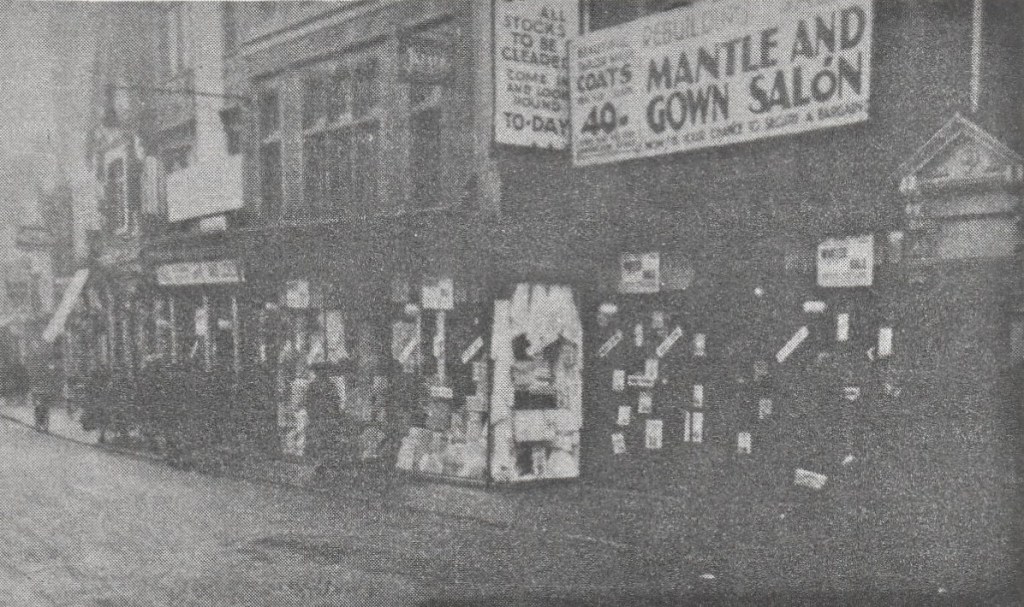
Open the heavy glazed door which responded with a loud dull ‘chunk’ and you entered a different world. Down both sides and down the middle were shiny glass counters through which could be seen stacks of sloping fronted drawers with all the wares on view but which could not be touched. On each end of the counter were stands displaying a selection of goods; behind the counters were the assistants, men with black-suits and white shirts and ladies in black crepe dresses with white collars. There was no queueing for service: as soon as you had gone to the right department (where your item was displayed) someone was there to serve you. If you were not sure, a black suited man appeared from nowhere to answer the hesitation in your actions, and you were quickly directed.
Standing at the counter, you could look through the glass front and select the drawer containing your required item and the assistant would slide it out and put it on the counter. In some cases, this was of highly polished mahogany, and had to be sturdy enough to carry all the bales of materials which would be stacked on it. In the material or ribbon department a brass ruler for measuring was set into the wood.
Behind the assistants who served next to the walls were stacked boxes with either glass fronts so that the wares could be seen or with labels clearly marking the contents; the boxes could be pulled down from the walls and put before you for your selection.
The floor was a shiny brown lino with brass trims in many places. I am sure that many a child was severely punished for running and sliding on it but that was not for me. I was firmly sat upon one of the high bentwood chairs that were placed for the customers, two for each counter. I am sure that I did not mind being restrained because the fascination kept me spellbound. My legs swung far from the floor, and I was sure that the diamond pattern of holes in the seat would be there on my dress for all to see when I was finally allowed to get down.
A gloved finger pointed out an item, a scarf perhaps, or a soft voice asked for a twin set or some ribbon – no voice was raised in this place of unhustled activity – the box or drawer was placed on the counter, the merchandise was selected and the box returned to its place. The price was pointed out and the money was paid over the counter to the assistant, the bill was written out and the magic began.
The assistant reached up and unscrewed a cup from the bottom of a container hanging from some wires above her head; she put two copies of the bill with the money folded into it inside the cup and screwed it back on again. She then pulled a handle next to the container and a hidden mechanism propelled it so that it shot with a ‘whoosh’ along the wires which were strung across the store, sometimes reaching a junction and noisily changing direction until it got to a small room high above the shop. This small room projected outwards and as it had windows on three sides the person seated inside could see all around her and watch the moving containers as they came towards her from all directions on their separate wires; with an audible ‘chunk’ they stopped in front of her and she reached up and unscrewed the cup, the duplicate bill was pushed onto a long wire spoke, with others, the money put into a cash box and the amount noted in a book. The top copy of the bill, with any change, was returned to the container and it shot back on its return journey across the shop to be given to the customer who was waiting for it and the bill put into the bag with the purchase.

Of course, I did not mind waiting because from my tall chair I could watch the whole process.
At the end of the shop furthest from the entrance was a wide flight of stairs which divided halfway up, leading right, and left, to a gallery with more goods on display. Take the left-hand flight and you arrived at the millinery department where the hats were placed on tall wooden stands and displayed on mahogany chests of drawers which contained other hats.
If you lent over the gallery rail, you could see the activity in the shop below and watch the little containers running along the wires with children trying to race them to their destination. They never kept pace with them and often a black-suited floor walker would stop them and send them back to mother. From the end of the millinery department, you could lean slightly over and peer into the office and see the rows of containers, the money box, and the big books, but you kept out of sight. The accountant seemed to us children a fearsome and powerful being sitting there and no-one was sure what she would do if she saw you.
When the purchase was made and I slid down from my perch, my shoes made quite a noise on the shiny lino and I had to walk quietly so that the lady in the high room did not notice me because I was sure that she saw everything and would not approve of a rude and noisy child. It was very difficult to walk quietly and not slip on the brass edges to the steps which led to that heavy door but always a dark-suited man would appear from nowhere to open it for us and with a little bow which made me feel very grown up, wished us, “Good morning” or “Good afternoon” as we passed out into the street.
Valerie Batt-Rawden
 Windsor Local History Group