
Published in Windlesora 25 (2009)
© WLHG
The first motor car to be driven on the public roads in England was imported from France to Datchet by the Hon. Evelyn Henry Ellis in 1895. Intense excitement was caused by the Panhard-Levassour on its arrival at Rosenau, Ellis’s riverside house just south of Datchet village, with visitors and reporters being taken for an exhilarating spin at ten miles an hour.
Mary Ellis, aged six, was the only child at Rosenau at that time. (Ellis’s first daughter had died aged two and his son was born in 1894.) Her father involved the young Mary in his pioneering feats, as shown by this photograph of them both in the driving seat of a 4/2 HP Daimler which he had driven up to the top of Malvern Beacon to demonstrate its hill climbing capacity. This was one of the first cars to be built by the new Daimler Motor Company at Coventry which Ellis had helped to finance and establish. At this time, in 1897, Mary was only nine but was already familiar with her father’s amazing collection of motor cars, motor driven fire pumps, river launches and motor cycles. The stables at Rosenau were converted to garages, with an inspection pit built into the yard, and his gardeners were adept at running engines to power Ellis’s eccentric machines; all of which must have been relished by the young daredevil Mary.

In 1910, when Mary was twenty-two, her father gave her a motorcycle of her own. Described as slightly-built and under five foot tall she was clearly an experienced rider already, writing that the machine was, ‘... a four cylinder machine called an FN. When going well it was the most Becatifid smooth running machine imaginable, like a Rolls Royce. Unfortunately it was anything but reliable. Almost invariably one cylinder would conk out and I would find myself pushing the rather heavy machine to the nearest garage’.
Starting the FN meant sitting astride it and tiptoeing along to get up cnough speed. If that failed she would offer a passer by a shilling for a push, leaving him exhausted in the road when the engine fired.
This first motorcycle was replaced by an 8HP Matchless with a sidecar, s0 she could take a passenger and her suitcase. It also enabled her to enter speed and reliability trials with her cousin Christabel who owned a side car made by the firm GWK in Datchet. Mary wrote:
‘I hired a splendid mechanic called Knight from Harrods stores which cost me the vast sum of 5 shillings a day. Knight sat in the flimsy basket work sidecar and risked his neck balancing the machine as we swept round hairpin bends or sharp turns during cross country runs.’
On this machine Mary’s success was reported in the Motor Cycle:
‘Miss Mary Ellis, handling the big Shp Matchless and sidecar made a fine performance — a good climb of Chesham Bois hill and one of the most conspicuous performances in the Second Speed Tests. She designed a special motor cycling rig and had it made at Gamages: black riding breeches, black laced boots and leggings, long black riding coat, worn over a white shirt and tie, plus wool cap and goggles.’

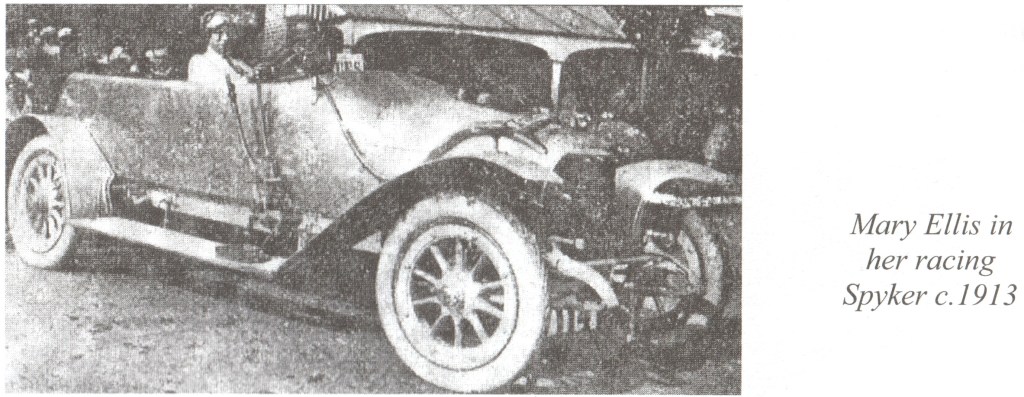
When Evelyn Ellis died in 1913, acclaimed as a far-seeing pioneer of the British motor industry, Mary came into her considerable personal fortune. She decided to make the move from motor cycles to racing cars, ordering a custom-built 20hp Dutch Spyker and passing the RAC’s new driving test with flying colours.
She wrote: ‘When at last my Spyker was delivered it almost exceeded my expectations. The body was long and low, with a fishtail, and mudguards which could be removed when required. Silver painted, it had upon the bonnet in red letters the words The Flying Dutchman. Its horn was a magnificent snake, the head and forked tongue starting at the front of the bonnet and the tail coming down to the driving seat, it made deep wailing sounds.‘
This Spyker could do 70 mph in racing trim or 90 mph with a higher axle ratio for Brooklands. Mary used it for both racing and touring for a dozen years, although she gave up racing when she married in 1916. It was in this car that she met her future husband, Denis Granville Coskey Critchley Salmonson.
In Mary’s words again: ‘He happened to be riding down the village street when I passed him in the Spyker doing, I am quite sure, a very reasonable speed. Unfortunately he thought otherwise, the horse shied badly and nearly gave him a nasty spill. He went home in a very bad temper and told his parents that he had seen ‘that bloody heiress’ tearing through the place in her blasted car and he hoped he would never see the infernal woman again!’ (Unfortunately it is not recorded whether this incident happened in the village of Datchet or not.)
After her marriage Mary ran a substantial farm in Devon until her death in 1971, aged 83. She had three children, and her daughter Denise Critchley-Salmonson, kept the family archives and her mother’s diaries, which have contributed to the history of early motoring. Most of the detail given here about Mary is from Denise’s 1997 article for the RAC’s Archive magazine; this was very appropriate since Evelyn Ellis was a founding member and Chairman of the RAC. In 1996, at the centenary of the first London to Brighton motor run, Denise was able to take pride of place in her grandfather’s Panhard-Levassour, brought out of the Science Museum as a stationary exhibit for the occasion, seated next to Neil Cossons, Director of the Museum.
Janet Kennish
 Windsor Local History Group