
Published in Windlesora 17 (1999)
© WLHG
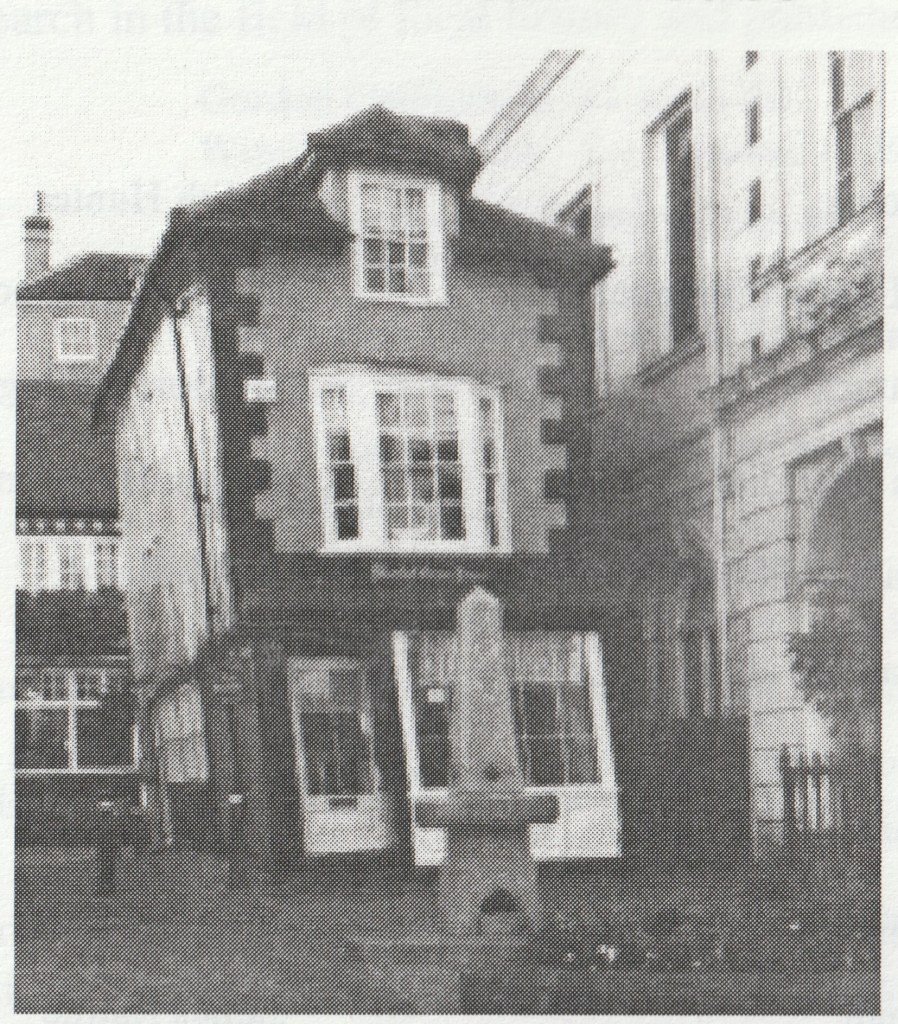
On Tuesday, 18th February 1718, the people of Windsor were witness to an extraordinary incident. It had probably begun peacefully enough a few days earlier when, at the orders of Silas Bradbury, a butcher’s shop adjacent to the Guildhall was pulled down. By Tuesday, the demolition of the building was complete, and the workmen had begun digging the foundation for a new building, the present Market Cross House. In the opinion of the Mayor and other members of the Corporation, however, the site was part of the waste owned by the Borough, and no new building was to be allowed to be built there. The council minutes outline this part of the story:
“This Court having notice and being Informed That severall workmen Laborers and other persons are now Digging and throwing out of Earth and other Rubbish out of and from a Peice of wast ground lying at the upper End of the markett house (Guildhall) and shambles belonging to this Corporacion and on which peice of ground lately stood some buildings which was lately Pulled down by the order of Mr Bradbury and the said Mr Bradbury being sent for and appearing at this Hall and refusing to produce or shew any Title to the said Ground which this Court doth think and take to be of right belonging to this Corporacion and that Building thereon will be very incomodius and inconvenient to the Publick, This Court doth therefore agree and order That the said Earth Rubbish and other stuffe thrown out from the said ground and laid upon the wast or ground belonging to this Corporacion be forthwith taken and thrown into the said Ground from whence it was taken and that the said Ground be forthwith filled up and made levell and so from time to time as the same shall be throwed out again or occasion require and that the persons doing the same shall bee Indemnified and saved harmless by this Corporacion and that such other methods be taken to prevent building on the said Ground as Mr Mayor shall think proper or be ordered by Councell from Time to time.”
This was the only business of the meeting and now, having gained the official approval of the Council, the Mayor, Thomas Rutter, could take the next step to put a stop to the work. He summoned constables and tything men and several labourers to accompany him to the site and ordered the foundation trenches to be filled up. There is no description of exactly what happened, but the report made out the next day makes it clear that Mr Rutter was prepared to use force.
“Thomas Rutter Esq. Mayor of Windsor (having gotten an Ord. of the Corporation) came with Constables tything men and many Labourers and violently filled up the Foundation that had been digged and threatened to send the Labourers there working for Mr Bradbury to Goal, pretending the ground where the presses stood belonged to the Corporation.
“Mr Mayor not satisfied with filling up what Mr Bradbury had caused to be digged hath tho’t fit violently to take possion of the presses as belonging to the Corporation and hath enclosed the whole premises with rails to prevent Mr Bradbury coming thereto.”
It was not an idle threat to send Bradbury’s labourers to gaol, for the Mayor was the chief magistrate of the Borough Quarter Sessions Court. But why did Mr Rutter behave in such a high-handed manner – and why did Silas Bradbury not produce evidence of his ownership of the site? No explanation has come down to us from the past, but understanding of the events can be discerned from the wording of the minutes of the Council meetings and from a legal report drawn up on the following day.
The shop certainly belonged to Silas Bradbury. The deeds were seen by the author of the report, H Page, and he set down the evidence of his title to the property. It had been purchased by his great-grandfather in 1656 for £82 when it was described as a “house or tenement used for a Butcher’s Shop and a Dwelling house near the Markett house”. After seventeen years, it was sold to his son, Thomas and his wife Elizabeth, and in due course it passed to their son, Silas and eventually his son Silas, who owned it in 1718.
How long it had been a butcher’s shop or when it was built is not known, but the area behind the Guildhall and the market house, which preceded it, had been used by the town’s butchers since the Middle Ages; the area occupied by their stalls was known as The Shambles. Before 1689 when the Guildhall was built however, the shop would not have been quite so close to a main civic building. The Elizabethan market house, which was demolished when the Guildhall was built, stood a little further to the south. Perhaps this was the crux of the matter. Did the Council object to the close proximity of a butcher’s shop to the Guildhall but if so, why? The Shambles was not removed until a century later, when the Guildhall extension was built. Perhaps the reasons were more personal, the result of a clash of personalities. If so the outcome was to prove expensive. The paper drawn up by H. Page also includes Counsel’s opinion as to the
rights of the matter:
“Qu Whether Bradbury hath not an undoubted Title.
Mr B as this case is has certainly an undoubted Title.
“Qu Whether the proceedings of the Mayor are not illegal and what cours Mr B may take for redress.
Mr B may bring his accon (action) of trespass agst the Mayor and all others concerned in this act of violence or may Indict them or . . . .get leave to file an Informacion . . . . .
“Qu Whether Mr Bradbury may not break down the Rails whereby Mr Mayor hath enclosed the presses Tho’it is admitted that the Rails are set on the Corporation Ground.
He may break downe the Rails soe as he dos itt not in a Tumultuous or Riotous manor and may keep his possession and goe on with the work for as itt be as above menconed.”
What action the Mayor took next and how and when Silas broke down the rails and ordered his workmen to resume digging is not known, but the matter did not end in February. Sometime before late July the dispute was taken to the court, a costly business involving the expense of travel to Reading or Abingdon and the legal costs. Silas won his case and on 20th July it was duly minuted that the Chamberlain (the old name for the Borough Treasurer) should pay Thomas Shefford, Henry Anson and Christopher Clarke, all three members of the Corporation, £ 23 13s 5d for damages and law charges’ in an action brought by Silas Bradbury against Thomas Rutter.
By this date perhaps, the house had already been rebuilt – a tall. A narrow timber-framed building which almost filled the whole of the site. It is too tall for its size and perhaps this is why it leans to the north, though the fanciful reason suggested by Olwen Hedley makes a fitting end to the story:
Is it in memory of that old quarrel when it was built that the little house cold-shouldered the Guildhall, forever drawing its walls a little further away?
The Bradbury family owned the property for over a century, during which time the shop remained as a butcher’s. Eventually, it passed to new owners and since then it has changed use many times and taken on its modern name of Market Cross House. The original market cross was the medieval market house, which stood more or less where Queen Victoria’s statue stands today. It was demolished in 1690 when the Guildhall was built, its only reminder today is the picturesque Market Cross House, a timber-framed building that owes more to the architecture of the 16th century than that of its own century.
Judith Hunter
Web Editor’s note [August 2025]: Market Cross House, also known as the Crooked House, is shown on the front cover of Windlesora 17. The painting of it is entitled ‘The Royal Standard Beer House, High Street, Windsor‘, and is by William Josiah Redworth (1873–1947), c.1900. It belongs to the Royal Borough of Windsor and Maidenhead, and is part of the museum collection. The leaning effect of the house was evidently due to the use of green oak, which was not properly seasoned, causing the house to develop its peculiar slant. The wonky building is one of the most photographed locations in Windsor. It leans towards Queen Charlotte Street – the shortest street in England. The Crooked House has changed hands many times since starting out as a butchers, and it later became a brewery, tea rooms, antiques shop, a jewellery shop and a bar, and is currently tea rooms once more.
Web Editor’s note [12 Sep 2025]: BBC Sounds published an article entitled The Crooked House as part of their Secret Berkshire podcast. Our chairwoman, Margaret Kirby, along with local historian, Dr David Lewis, were interviewed as part of it. Katie Tyler was the interviewer.
We can recommend visiting the BBC Sounds website for other articles.
 Windsor Local History Group