
Published in Windlesora 33 (2016)
© WLHG 2018
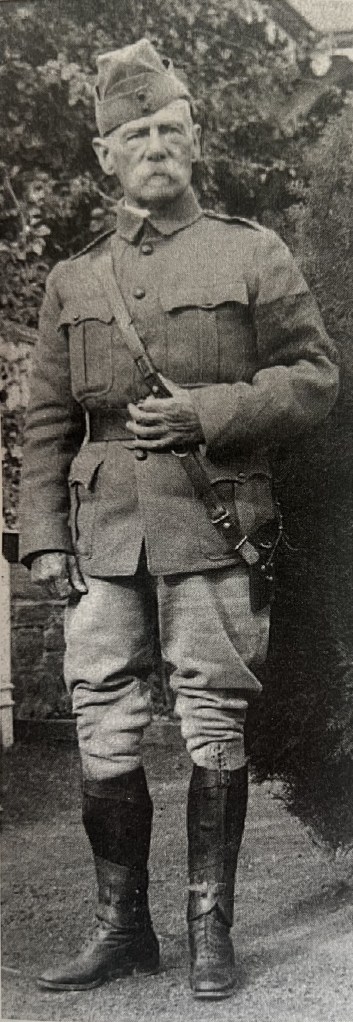
Copyright: Shooting the Past
Lord Roberts, or to give him his full name, rank and title, Field Marshal Frederick Sleigh Roberts, 1st Earl Roberts of Kandahar, Pretoria, and Waterford, VC, KG, KP, GCB, OM, GCSI, GCIE, KStJ, VD, PC (see key on Page 44) was not only one of the most senior British soldiers of the 19th century, but he was also one of the most successful. He led his soldiers through the Indian Mutiny, the Abyssinian Expedition, and the Second Anglo- Afghan War, as well as to great acclaim in the Second Boer War. Before the post was abolished in 1904, he was the last Commander-in-Chief.
On October 11th 1899, war was officially declared between Britain and the Boers of the Transvaal and the Orange Free State. The British government thought that the war would be easily won as they considered their opponents to be incompetent and backward. They had however, underestimated the Boer commandos, and to their embarrassment not only did British Forces suffer a series of humiliating defeats, three cities were under siege: Mafeking, Ladysmith, and Kimberley. Back in London at this point, Roberts was informed of the decision to put him in overall command of the forces in Africa, replacing General Redvers Buller. In December 1899, Roberts returned to Africa and a large number of reinforcements.
Almost half a million British and Colonial soldiers and auxiliaries were engaged in trying to outmanoeuvre and outsmart the very effective guerrilla warfare carried out by the Boers. Roberts launched his offensive, personally leading the advance into the Orange Free State. He raised the siege of Kimberley, and after the Battle of Paardeberg, captured some 4000 Boers with their General, Piet Cronje. In March 1900, he had captured Blomfontein, the Orange Free State capital, and followed that in May with the capture of Pretoria, capital of the Transvaal. The newspapers at home were hysterical with the news; church bells were rung, songs were written – Roberts was a hero and the nation’s darling.

Meanwhile, Windsor was the first Borough in England to congratulate and honour the Field Marshal, when in August 1901, the Council has unanimously voted to offer him the Freedom of the Borough. Roberts accepted but indicated that he was unwilling ‘to over and the bulk of the troops had returned’. It wasn’t until 1903 that Field Marshal (now Lord) Roberts was able to come to Windsor to receive the Freedom of the Borough. He agreed also to unveil a statue of the late Prince Christian Victor, (son of Prince Christian and Princess Helena, and grandson of Queen Victoria) on the same day. The prince had died in Pretoria on October 29th 1900.

On November 3rd 1903, thousands of people had gathered in Windsor, lining the route from the Guildhall to the bottom of Thames Street. Lord Roberts arrived by carriage, attended by his daughters Aileen and Edwina, and his aide-de-camp, Colonel Hutchinson, and was greeted by the Mayor, Councillor Shipley, in company with Council Officers and almost all the Council members. After the usual greetings and pleasantries, Roberts was taken to two rows of men, lined up in military fashion. The formation was made up of some 24 veteran soldiers, all local men, and all of whom had served under Roberts in various military actions including the Indian Mutiny, the Umbeyla Campaign, the Lushai Expedition, and the 2nd Afghan War. Roberts was clearly pleased to see the old soldiers. He took his time and spoke to every man, shaking each one’s hand, looking at their medals, and talking of the campaigns in which they had served.
Next to the veterans was a Guard of Honour made up of men from the Windsor Fire Brigade, under the command of Chief Officer Dyson. Roberts stopped to look over the men and ask Dyson about his medals, one of which was for the Chief Officer’s long service. In the course of their conversation, Dyson proudly told the Field Marshall that every one of his firemen was proficient in the use of the Lee- Metford rifle. This weapon had been in service with the army since 1888, and the topic was of great interest to Roberts. As Commander in Chief, he had recently brought into service a replacement in the form of the Short Magazine Lee- Enfield, a design born out of a need to deal with the pressure of smokeless powder, to find a compromise between the lengths of carbines and rifles, and to make improvements gleaned from experience in the Boer War.

The dignitaries and guest all moved into the Guildhall where the ceremony granting Roberts the Freedom of the Borough ensued, during which he was presented with the inscribed vellum certificate, encased in a carved wooden box made from Windsor oak. The veterans moved to the Star and Garter Hotel on Peascod Street, where they were treated to an excellent dinner at the Mayor’s expense, and presided over by Chief Officer Dyson, as the Mayor’s proxy, with SgtMajor Bennett as Vice Chair. Toasts were drunk to the King and to Lord Roberts, all accompanied by loud cheers as well as to the Mayor. Bennett pointed out that the Mayor was responsible for finding and gathering them all together. As always with military men, Bennett proposed a more sombre toast, ‘to comrades gone before’, which was drunk in silence.
The Windsor and Eton Express reported that a short time was ‘spent in the enjoyment of the weed’, in other words, they all had a cigarette or two. Joining the gathered crowds, the veterans cheered their old Commander as he made his way to the bottom of Thames Street in order to unveil the statue of Prince Christian Victor. As with any group of old soldiers, after the parade had passed, they gathered together again to renew acquaintances, re-tell their battle stories, and talk about the ‘good old days’.
Carol Dixon-Smith
Roberts’ Awards
Victoria Cross, Knight of the Order of the Garter, Knight of the Order of St Patrick, Knight Grand Cross of the Order of the Bath, Member of the Order of Merit, Knight Grand Commander of the Order of the Star of India, Knight Grand Commander, of the Order of the Indian Empire, Knight of the Order of St John, Volunteer Officers’ Decoration, Member of the Privy Council, and Mentioned in Dispatches.
Windsor Veterans
This photograph was posted as a mystery on the Royal Windsor Website, which holds the copyright. After considerable research, I was able to confirm that this was Field Marshal Roberts, meeting Veterans in November 1903.

Each man is smartly turned out to the best of his ability. Note the hats, collars, neckties, coats, hair, beards and moustaches are neatly trimmed in accordance with the standards of the day; faces are otherwise clean-shaven.
Each is in a military stance, no slouching. Their heads are up, shoulders back, and though at least two of the elder veterans each have a walking stick, they remain almost at attention.
Most of them have their hands at their sides in military fashion, with thumbs lined up along the seam of their trousers. Others are ‘at ease‘ with their hands behind their backs. Medals or medal ribbons are proudly worn.
This is November, so the light would have been dull, but look carefully at their feet. Each and every pair of shoes visibly reflects the light. These shoes have been polished to a high shine in fine military fashion and are on the feet of proud soldiers.
The Veterans
Sgt Major Walter Bennett
Sgt Major M O’Keefe
Sergeant T Hare
Lance Corporal Pickman
Trumpeter George Rous
Private H Hawkes
Private W Hing
Private Edwin Butler
Private G Macklin
Private John Atkins
Private James Beevers
Private Robert Stobie
Private John Stratham
Private T Barnett
Private Harry Hankins (see below)
Private G Grey
Arthur Patrick Crayen
W Sellar
Samuel Bond
John Brown
J Cannon
C Joyce
T Bovington
W Clarke
Henry (Harry) Hankins
In 1871, the Hankins family were living on Chaloner Row in Datchet, and consisted of Ambrose and Catherine (parents), William (15). Harry (9), Kate (7), Alfred (4), and Charles (10 months). Ten years later the census shows Ambrose living with Harry, an 18 year-old Assistant Photographer, Charles, an 11 year-old Farmer’s Boy, and James, a 9 year- old Scholar. On November 17th that same year, at the age 19 years and 7 months, Harry enlists in the 2nd Battalion, of the newly formed Leinster Regiment at Aldershot, when he states that he is a labourer. A year later he is transferred to the 1st Battalion.
Records tell us that Harry was 5ft 6in tall with a 34.5 inch chest, had light brown hair, grey-blue eyes, and is a member of the Church of England. Harry served for 12 years in Ireland, India and the West Indies. He was promoted to Lance Corporal in March 1887, and then to Corporal in May 1888. There is no indication that he was demoted back to Private, the rank he is listed under in the local news report. He had a good military record upon his discharge in 1893, after fulfilling his period of enlistment.
Leinster link with Windsor
The regiment was born by amalgamation of the 100th and 109th Regiments of Foot and became the local regiment for five counties in Leinster, one of the provinces in Ireland.

After its disbandment in 1922, the regiment deposited the Colours of its two regular battalions, in St Georges Hall, in Windsor Castle.
Sources
Packenham, Thomas, The Boer War
Jerrold, Walter, Lord Roberts of Kandahar, VC
British Newspaper Archive
Windsor and Eton Express
W&RB Museum Archive
Ancestry
Find My Past
 Windsor Local History Group