
Published in Windlesora 30 (2014)
© WLHG
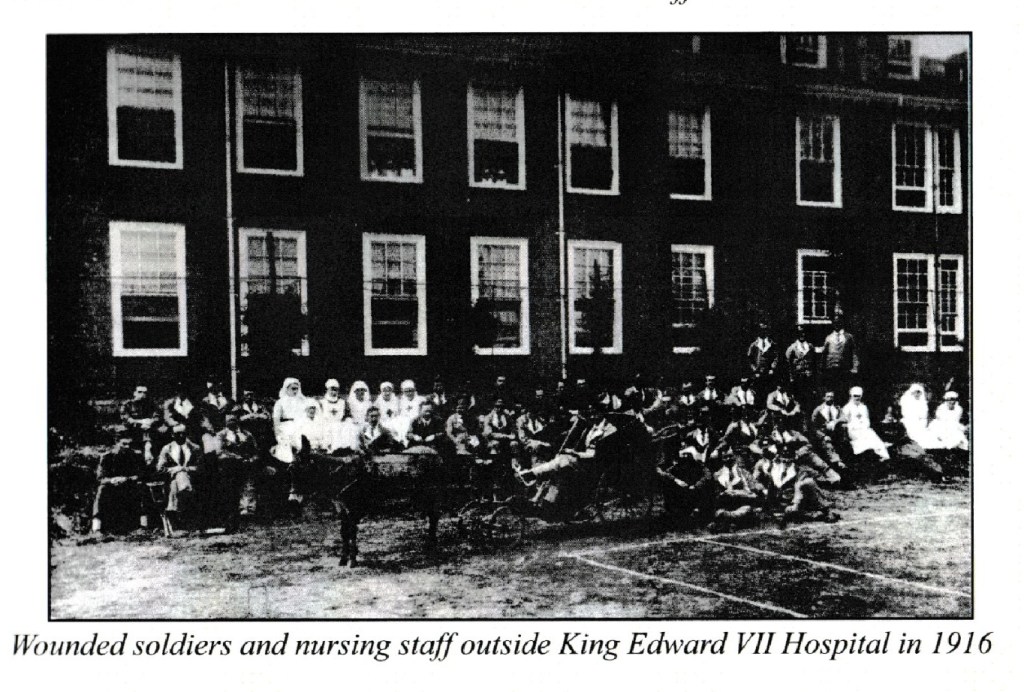
Casualties from the First World War were admitted to the King Edward VII Hospital from the outset, and during the course of the war, the numbers increased, with men coming from military field hospitals overseas, as well as Windsor Garrison barracks, and later from a camp in the Great Park.
Early in the war, an offer was made to the War Office by the hospital to set aside a ward solely for the use of wounded soldiers. The War Office did not take this up, pressures on the rail network meant they could not make arrangements to move under one hundred men at one time to Windsor.
In 1916, Sir Alfred Keogh, Director General of the Army Medical Services, on consultation with the hospital board, decided that beds in the hospital could be used for the sick and wounded from overseas. So Alexandra Ward at the hospital was fitted out with 40 beds, and the outpatients department was converted into a soldiers’ ward adding a further 25. Mrs Elliman, wife of benefactor James Elliman, (of Elliman’s Embrocation in Slough), funded this conversion. The Outpatients Department was moved to the isolation block.
Lady Edward Spencer Churchill opened her home at Queensmead as a VAD Hospital and was appointed its commandant. She also put together a team of 77 women to volunteer at the King Edward VII Hospital. In May 1917, Lady Churchill was able to provide the finances to build an annex at the hospital which provided 16 open-air beds, helping with the treatment of bad wounds. At the same time, a permanent balcony outside the Alexandra Ward was partially glassed over to provide a further 7 beds. With the opening of the military ward, Joseph Skevington (later Sir) was appointed Commandant of the hospital until being sent overseas in June 1918. He was replaced by Dr F Hathaway who worked at the hospital until December 1918.
The first convoy of wounded from abroad arrived on September 22nd 1916 and had come directly from the Somme. Arriving throughout the day and night, they were met at the railway station by members of the hospital staff and bearer parties from the 2nd Life Guards. The wounded were taken from the railway station by ambulances sent from the Royal Army Services Depot in Kempton Park.
Parts of the hospital were transformed into recreation areas to help the wounded in the recovery process. This included the hospital Board Room being transformed into a Dining and Recreation Room (furnished by a Mrs Mocatta) for the convalescing soldiers. A fund was set up to provide comforts and amusements for soldiers at the hospital. Contributions came from the schoolchildren of Wraysbury and from the boys of Eton College who donated a sum of over £55 to the cause.
Princess Mary opened an Orthopaedic Room for the use of wounded soldiers on May 3rd 1918. The British Red Cross Society and the Order of St John of Jerusalem had donated £1000 for this room, which was used for both wounded men at the hospital and also for discharged soldiers.
The hospital had three visits from the King and Queen – on September 25th 1916, shortly after the arrival of the first convoy; then April 2nd 1918 on the occasion of the St George’s day celebrations; on September 18th 1918 when the King decorated several wounded men for gallantry. Over the course of the war, some 1,094 wounded soldiers passed through the wards of the King Edward VII Hospital. Only nine of these soldiers died at the hospital, representing 1 % of the total admissions, perhaps demonstrating the high standard of care at the hospital throughout the war.
Elias Kupfermann
Acknowledgments
Extracted from a pamphlet entitled ’King Edward VII Hospital, Windsor and the European War – A Short Record of Military Work done at the Hospital 1914 – 1919’- Author unknown – in the Berkshire Record Office.
 Windsor Local History Group