
Published in Windlesora 19 (2002)
© WLHG
The Victorians were not only avid builders, they also pulled down many fine houses that got in the way of their development plans. In 1896 Clewer House School was sold. It had been a school since 1839. The only reminder of Clewer House today is a splendid cedar tree in the middle of the pavement in St. Leonard’s Road. The whole area around Clewer House was going to be re-developed, along with a iiearby terrace of thirteen houses along St Leonard’s Road, called Keppel Terrace.

Keppel Terrace was built in 1829, a year after George Place was completed. In April 1830 two of the houses were offered for sale as desirable residences for small genteel families, in a respectable neighbourhood. There were three floors each with two rooms, and a basement with front and back kitchens. A nice feature must have been the balconies on the first floor. Interesting to note is that the backs of the houses offered fine views of St Leonard’s Hill and the river Thames.
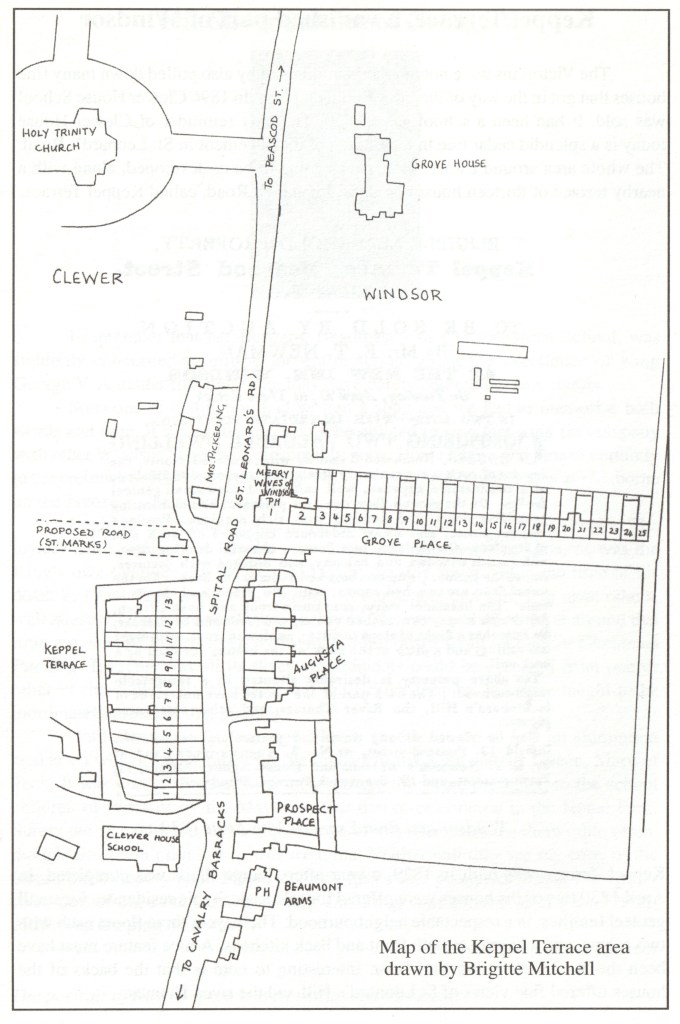

Who lived in this beautiful terrace? Not the genteel families the developers had envisaged, although in 1851 number 13 was occupied by the Rev. Hawtrey, incumbent of Holy Trinity Church, but from as early as 1831 parish registers show that an increasing number of army families rented rooms in Keppel Terrace.
The Household Cavalry, stationed as it is today at the nearby barracks, always had large numbers of women and children on the strength, few of whom could be accommodated in barracks. In any case, cavalry soldiers’ families preferred to rent, rather than live in the barrack rooms with the soldiers for company, as was the custom in those days. But it is only through census returns that we get a clear picture of the numbers of army families living in Keppel Terrace; in 1841 there were 40 soldiers’ families from the cavalry barracks, with 68 children. In addition to these, 15 civilian families with a further 33 children lived in the 13 houses. Thus each building housed an average of 4.2 families, or 17 individuals. In fact of course some houses were more overcrowded than others. For instance, number one was occupied by six families, 12 adults and 10 children. Next door housed eight adults and 14 children. One can imagine the din!
Subsequent census returns show that overcrowding diminished and less soldiers’ families lived in Keppel Terrace, as the army started to provide married family quarters during the 1860s. By 1861 No.1 had been taken over by the school and was used to house one of the masters and several pupils, even the shed at the back of the house was occupied by the gardener.
What about the Windsorians living in Keppel Terrace? They were not of the genteel variety either, but tradesmen, craftsmen, shopkeepers and a large number of women living on their own, often with several children, earning a living as laundresses, charwomen or dressmakers. Some of these may have been soldiers’ wives or camp followers.
Why this splendid Georgian terrace was demolished in 1896 to make way for a new police and fire station is a mystery. It offered superior accommodation to Grove Place just around the corner, which suffered similar overcrowding by army families during the nineteenth century. Keppel Terrace was in the parish of Clewer and Grove Road in the Windsor parish, but this could hardly have been the reason.
If anybody has any information about Keppel Terrace I would like to hear from you.
Brigitte Mitchell
Sources.
Windsor and Eton Express newspaper files.
Census returns for 1841, 1851, 1861, 1871 and 1881.
Registers of Baptism for Windsor parish church, D/P 149 1/17-18.
Registers of Baptism for Clewer parish church, D/P 39 1/7-8.
 Windsor Local History Group