
Published in Windlesora 32 (2010)
© WLHG
In 1812 Parliament granted a charter to the London and Westminster Gas Light and Coke Company, the first gas company in the world, and by December 1813 Westminster Bridge was lit by gas. In October 1817 some of Reading’s streets had gas lamps, but the suggestion of introducing gas lighting to Windsor in 1821 was strongly opposed by Windsor brewers, who claimed ‘it would injure the water and spoil the beer’. (1)
Thus it was not until 1827, when King George IV expressed a wish to light Windsor’s street with gas, that the Windsor Royal Gas Company was set up.(2) W J Voules was secretary and Messrs Ramsbottom and Leigh treasurers. C Hollis was Saturday 31st March 1827 Windsor and Eton Express the surveyor and shares were offered at £20 each.(3) A site was looked for, and initially land behind the Nelson Public House in Old Windsor was suggested, but in November 1827 the newspaper announced that land for the gas works had been purchased in the Goswells.(4)

Less than a year later the gas company had started to light up the town ‘to everyone’s delight’. The newspaper reported that the light started at the bridge, continued along the High Street and reached as far as Frogmore.(5) The gas used was obtained from resin, which was claimed to be better and cleaner than the more commonly used coal gas, a decision they were soon to regret.
In November an explosion at the gas works destroyed 2cwts of resin and shattered nearly all the windows in the building.(6) This was a serious setback, and it was not until October 1830 that the gas works were up and running again, this time using coal gas, which was safer, cheaper and produced a more brilliant light. Most importantly it was said to be safe enough to be used in private dwellings. This did not impress Queen Adelaide, who demanded that the recently installed gas be turned off inside Windsor Castle, ‘lest an accident might be caused by an explosion’ .(7)
There were a few other problems, lamps were regularly vandalised; a reward of £20 – a huge sum – was offered in March 1830 for information ‘about the evil persons who have removed 4 caps from gas lamps in Frogmore’.(8) In October 1831 Windsor was in darkness, as all public gas lamps were turned off.(9) Soon however, even the darkest alleys of the town were illuminated, like Bier Lane [River Street] and in particular the area around the gaol to discourage the frequent escapes.(10)
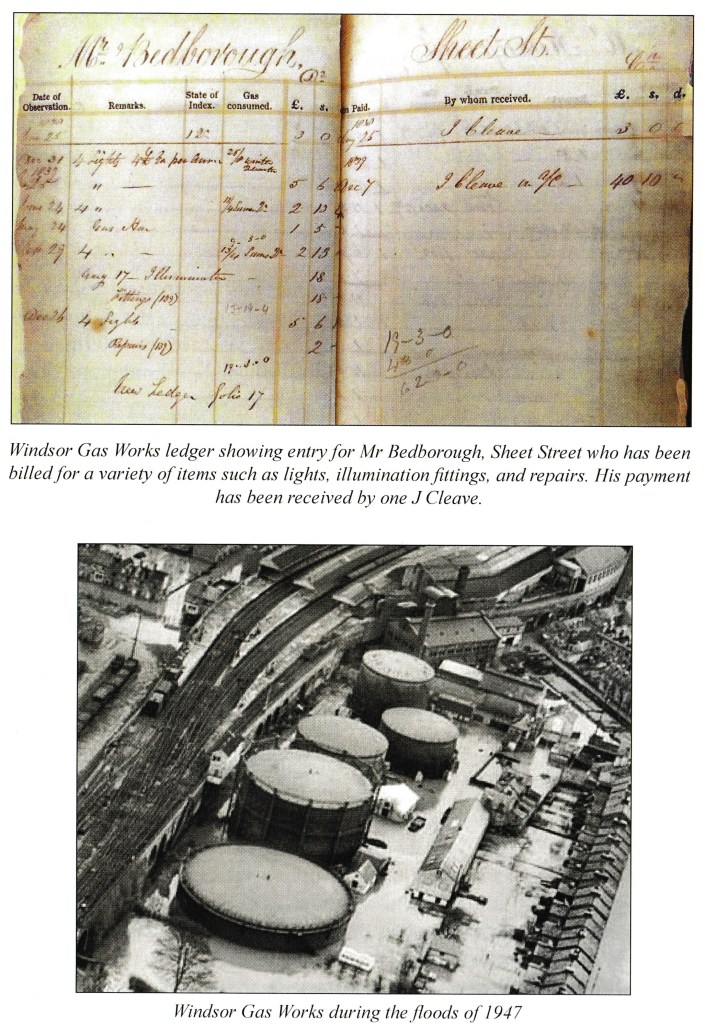
A ledger of gas customers, at present in the Windsor museum, shows that the Royal Gas Company had acquired a number of private customers. First on the list is Mr Bedborough of Sheet Street, who was charged £5 6s 8d for four lights on 31 December 1839. Other customers included Mr Oliver of the Adelaide Inn, Mrs Dorset of the 5 Bells in Sheet Street, Mr Smith the baker, and Mr Rangecroft the grocer both of Sheet Street, and Mr Oxley who had recently bought the Windsor and Eton Express. In 1841, the new Royal Mews and Riding School were lit by gas;(11) Queen Victoria did not seem to have any objections to gas lighting at Windsor Castle.
Windsor was once more plunged into darkness during the Great War when the young Reginald Try working as an apprentice at the Gas Works accidentally pulled a leaver, which turned off the gas supply. He swiftly went to join the Royal Flying Corps.(12)
Dr Brigitte Mitchell
References
- Windsor and Eton Express [WEE] December 1821
- WEE 3 March 1827
- WEE 17 March 1827
- WEE 3 November 1827
- WEE 6 September 1828
- 6. WEE 8&8 November 1828
- 7. WEE 10 July 1830
- WEE 27 Mar 1830
- WEE 1 Oct 1831
- WEE 27 April 1833
- WEE 6 May 1841
- Geoffrey Try recollections of his father.
 Windsor Local History Group