
(Part One)
Published in Windlesora 33 (2016)
© WLHG 2018
In about 1814, Dedworth was a hamlet just a couple of miles outside Windsor, and in their home on Roses Lane, John and Elizabeth Cox, a poor labourer and his wife, welcomed the arrival of their new baby, Henry. The following years were times of great change and unrest. Developments in agriculture were reducing the numbers of labourers needed to work the land, especially in the winter months. Poverty and hunger were commonly widespread in agricultural areas where crime rates grew by 30%, mostly in the theft of food and aggravated by the reduction in Poor Law expenditure. By 1830, the Cox family had grown in size, with John and Elizabeth raising ten surviving children; Henry was fifteen years old and working as a labourer like his father.
The Speenhamland System, a form of poor relief meant to alleviate rural poverty, had been taken advantage of by employers who reduced wages to below subsistence level, knowing that the Parish would make up the rest. By 1830, the Poor Law per capita spend had dropped to 9/9d from the 12/10d it had been between 1815 and 1820; over the same period labourers also faced increasing levels of rent. In addition, the poor harvests between 1828 and 1830 not only increased levels of unemployment but also crucially raised the price of bread.
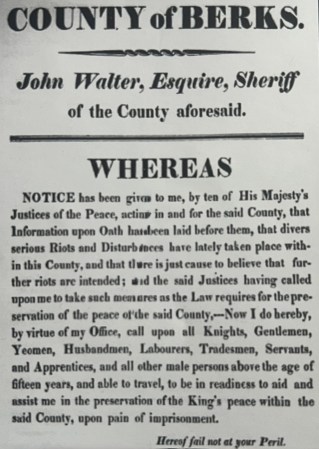
County poster calling on men over the age of 15 to be ready to aid in the suppression of the ‘Swing Riots‘ – on pain of imprisonment
In 1832, the unemployed, eighteen-year-old Henry left home to seek work. For six weeks, his parents heard nothing, then a letter arrived telling them that he had been convicted of theft and was incarcerated in Lewes Gaol. Both John and Elizabeth were illiterate, as evidenced by the petition document with their marks rather than signatures, and so they would have had to find someone to read the letter to them.
Henry was caught with another young man, and both were charged with larceny; they had each stolen a hat. The trial was held on August 4th 1832 at the Sussex Assizes, where he was found guilty and sentenced to be transported for life. John and Elizabeth believed that hunger had driven their son to steal, (the stolen hat, if sold or pawned, would have provided cash to buy food.) With the support of Isaac Gossett, the Vicar of Windsor, they submitted a plea to the Secretary of State for the Home Department for ‘mitigation of that punishment which now awaits him, by substituting one more lenient as you in your judgement may think proper.’
The list of signatories reflects the ‘great and the good’ of Windsor society of the time, and include John Ramsbottom, Windsor’s MP, and Bedborough who was one of the Church Wardens. Sadly, the mitigation was refused. Henry left England on the prison ship Georgiana which landed at Van Diemen’s Land in February 1833.
| Iasaac Gossett | W Moore | Thos Adams | Wm Legh |
| J Bedborough | Chas Layton | W Brown | Chas Hodges |
| Chas Hawick | indecipherable | Thos Noke | Wm Miller |
| Chas Mashin | Wm Harris | Thomas Pond | Dani Griffin |
| Thomas Pond | Danl Griffin | Adam Chapman | Thos Brister |
| indecipherable | Ramsbottom MP |
While awaiting the outcome of his family’s appeal on his behalf, Henry was held in the Prison Hulk Leviathan in Portsmouth. HMS Leviathan launched in 1790 at Chatham, was a 1707 ton, 74-gun, third-rate ship-of-the-line which had fought at the Battle of Trafalgar. She was used as a prison hulk from 1816 until 1846, when she was used as a naval target until broken up in 1848.
We have some details about Henry from Australian convict records. He is described as being five feet seven and three-quarter of an inch tall, with a round head, long visage, and florid complexion, brown hair and grey eyes. The convict register notes that he had tattoos: a woman on his right arm and the initial EC (possibly his mother) on the back of his right hand, as well as a heart on the ring finger of the same hand.
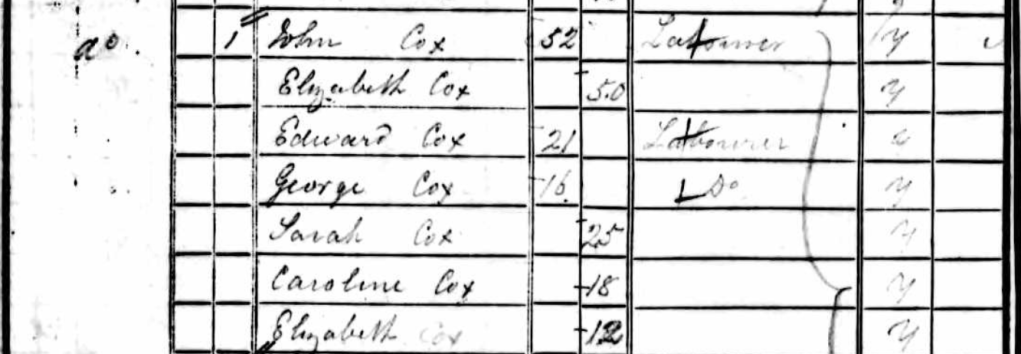
As far as I can ascertain, Henry never returned to England, and what became of him in Australia is a matter of ongoing research. According to the 1841 census the Cox family were still living in Dedworth.
 Windsor Local History Group