
(1742 – 1819)
Published in Windlesora 31 (2015)
© WLHG
Blücher was one of the main players in the downfall of Napoleon.
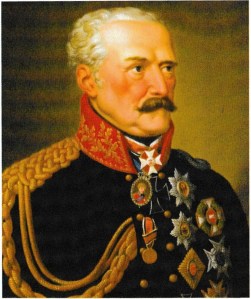
Most people only know about Blücher because Wellington supposedly had pronounced: ‘Give me night or give me Blücher’ at the height of the Battle of Waterloo. The fact is that Wellington was in constant communication with Blücher through dispatch riders.
He was already 73 in 1815 with a distinguished military career, and had been promoted to Field Marshal. His troops called him: ‘Marschall Vorwarts’ [Marshal advance].
After he had led the combined armies of Prussia, Russia and Austria against Napoleon at the battle of Leipzig, and chased Napoleon all the way to Paris, he retired to his estates in Silesia, only interrupting his retirement by a visit to London in June 1814, where he was cheered wherever he went. He was created Prince of Wahlstatt by the King of Prussia.
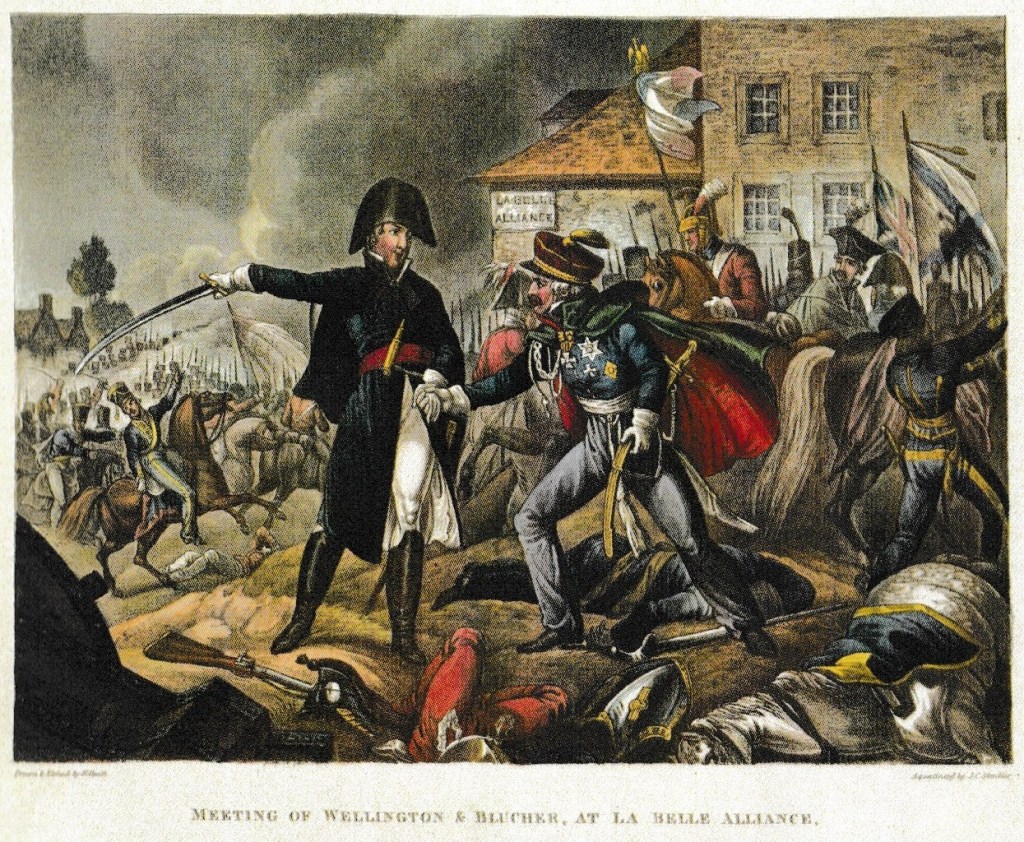
When Napoleon returned from Elba he was recalled, and rushed his army to aid Wellington. He was intercepted by a detachment of Napoleon’s forces at Ligny on 16 June. During the battle his horse was killed, and Blücher lay trapped under the dead horse for some hours, while cavalry repeatedly rode over him. He was rescued by his Aide de Camp, and spent a day recovering, rubbing his wounds liberally with brandy, by all accounts externally and internally. His chief of staff August von Gneisenau rallied the defeated army, then Blücher led his troops on a grueling march —the roads had turned into mud after torrential rain the night before- to come to Wellington’s aid in the late afternoon of 18 June.
Dr Brigitte Mitchell
Sources:
Michael V. Leggiere, Blücher: Scourge of Napoleon (University of Oklahoma Press; 2014)
 Windsor Local History Group