
Published in Windlesora 06 (1987)
© WLHG
Vansittart Road can be seen by visitors to Windsor as they enter the town along Maidenhead Road; Windsor residents are familiar with the name, but perhaps few think about its origin, other than having a vague idea that the Vansittart family owned land locally.
The descent of the Vansittart family is vast and complex, but this article is concerned mainly with those members of it who held the Lordship of the Manor of Clewer for many years.
The Vansittarts descended from Peter van Sittart who came to London about 1670. The family originated from Sittard in the Netherlands although they had migrated to Danzig in Poland by the time Peter was born in 1651. He gained a fortune as a Merchant Adventurer, his fleet trading from Russia to the East Indies. In 1678, he married Susanna Sanderson and they had a number of children. Their fifth son, Arthur, who was born in 1691, became a merchant like his father. Among the appointments which he held may be counted Deputy- Lieutenant for Berkshire, High Sheriff for the County in 1732, and also a Senior Verderer of Windsor Forest.
In about 1718 Arthur purchased the Manor of Clewer, and also the Moat Park Estate, from Lord Lansdowne; he already had a London house but may have intended to live at Clewer. However, his eldest brother Robert died childless in 1719 and Arthur inherited his property, which included the Manor of Shottesbrooke near White Waltham. From then onwards Shottesbrooke became the family home of Arthur and his direct descendants, and there is no evidence to suggest that they were anything more than absentee landlords at Clewer.
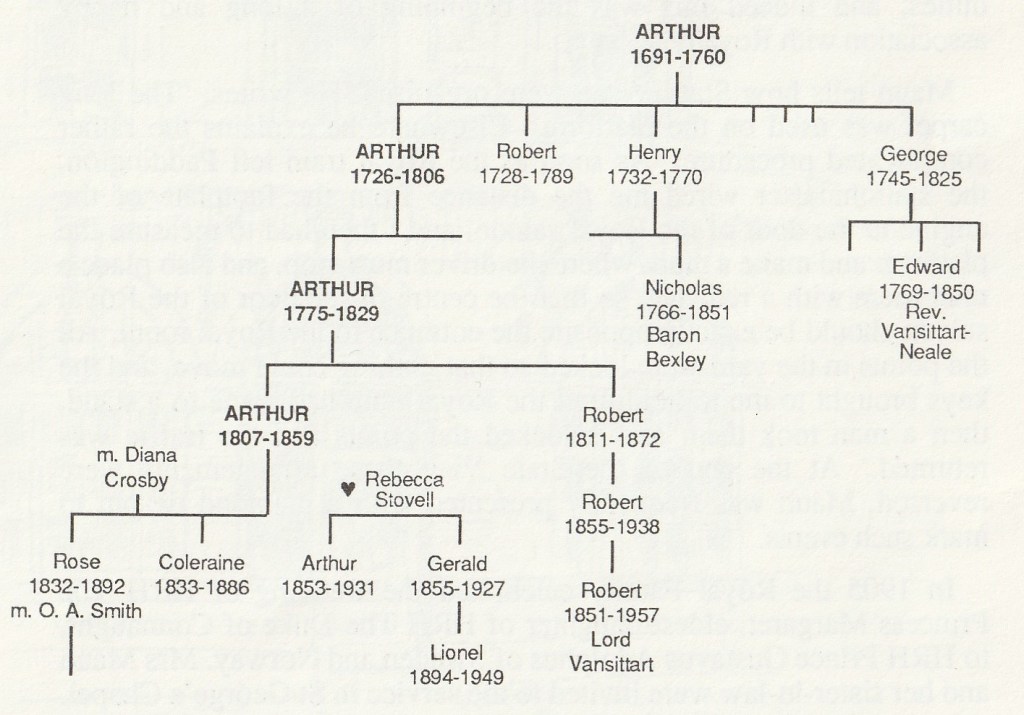
In 1723 Arthur married Martha, the co-heir of Sir John Stonhouse of Radley, and one of the beauties at the Court of King George II. They had a large family, and three of their sons, Arthur, Robert and Henry, were members of the notorious Hell Fire Club founded by Sir Francis Dashwood of West Wycombe Park. But by the time the first Arthur died in 1760 his sons had become respected members of society. Henry had entered the service of the East India Company, and in 1761 he sent from India two elephants, a rhinoceros and a beautiful Persian mare. These were presents for George III, who had just come to the throne, as it was well-known that the King was fascinated by exotic animals. A later Vansittart in his book, The Family of Sittart, says: ‘The two elephants and the Persian mare were allowed to roam about the park at Shottesbrooke, while the rhinoceros took his ablutions in the village pond. They were looked upon with awe and wonder by the rustics; and people used to flock from the neighbouring towns and villages to gaze upon the unprecedented visitors. Eventually the King, accompanied by the Princesses, drove over from Windsor to view the animals, who were then presented to His Majesty by Mr Arthur Vansittart’.
Henry’s youngest son, Nicholas Vansittart (1766-1851), became one of the most famous members of the family. For twelve years he was Chancellor of the Exchequer, and later took an active part in various religious and charitable societies. He was created Lord Bexley, a name commemorated in another Windsor street, although no closer local connection has yet been found. (His home at Footscray Place in Kent was the birthplace in 1881 of Robert Vansittart, a diplomat who was created Lord Vansittart in 1941 and who died in 1957).
Another of the first Arthur’s sons was George who bought Bisham Abbey in 1780. This estate was inherited by George’s second son, the Revd Edward Vansittart (1769-1850), who added his mother’s family name (Neale) to his own, and later became well-known as Rector of Taplow.
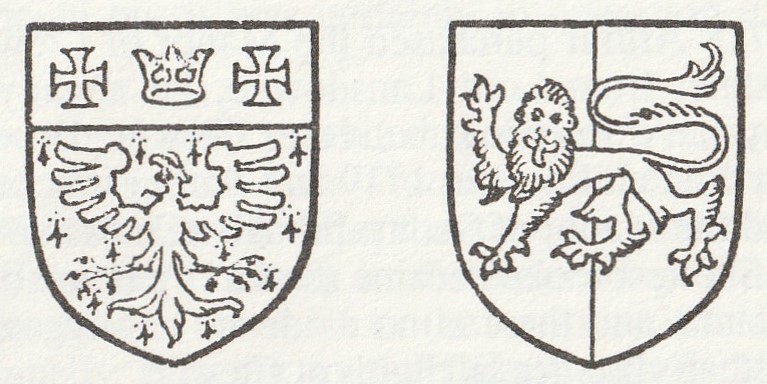
The second Arthur, born in 1726, was, like his father, a Verderer of Windsor Forest. He was also the M.P. for the county of Berkshire from 1757 to 1774, a Deputy-Lieutenant and then Vice-Lieutenant for the county, and Colonel of the Berkshire Regiment of Militia which he raised in 1758. He was known as a swordsman and duellist and was a favourite of Frederick, Prince of Wales. In his Life of Dr Johnson, Boswell says of him, ‘… Mr Vansittart, a flourishing sort of character, shewed off his graceful form by fencing with Mr Seward ..’. He was 47 years old when he married the Hon. Anne Hangar, daughter of Lord Coleraine, in 1773.
Of their four children the eldest son, Arthur, born in 1775 succeeded his father in 1806. In the same year enquiries began prior to the Enclosure of Windsor Forest, an Act which was to revoke the rights of the tenants of the Manor lands in Clewer. Enclosure was taking place, or had already occurred, in many East Berkshire parishes, and in 1812 Arthur had his Clewer estate surveyed. Almost certainly this was ordered as a preliminary move before the enclosure of the open fields, greens and waste lands within the parish of Clewer, which took place in 1817. Both the Vansittart estate map and the Clewer Enclosure map have been deposited in the Berkshire Record Office at Reading.
In 1812 this third Arthur Vansittart sold the lease of Clewer Manor house to Richard Foster, and a year later he sold his Moat Park Estate to the Crown. In 1842 Richard Foster bought the Clewer Manor house freehold, the deeds including the house and sixty acres of land. It was Richard’s son, Edmund, who rebuilt the reputedly Elizabethan house which the Court Rolls of 1584 had described as being ‘in a ruinous state’ a Edmund Foster died in 1882 and was succeeded by his son, also called Edmund, and who is still remembered locally as ‘Squire Foster’. He died in 1917 aged 93, and following the death of his widow in 1921, the Imperial Service College needing a Junior department for its school in Alma Road, bought Clewer Manor and its surrounding land. Upon the amalgamation of the ISC with Haileybury College in 1942, Clewer Manor became Haileybury Junior School, and remains so at the time of writing. Thus the house passed from the Vansittarts.
The third Arthur Vansittart was Colonel of the Berkshire Militia and a Deputy-Lieutenant for the county; he was MP for Windsor 1804-6, and from 1806-8 was one of the Verderers of Windsor Forest. In 1806 he married the Hon. Caroline Eden, daughter of Lord Auckland, and they had thirteen children. Their eldest son Arthur, born in 1807, succeeded his father in 1829, at which time he held a cornet’s commission in the Life Guards and at 6′ 7″ was the tallest man in the Regiment. He resigned his commission in 1831 and unsuccessfully contested Windsor for Parliament in 1833. His younger brother, William, was more successful and was MP for Windsor from 1847-59.
Arthur was a great patron of the turf and even his marriage was the outcome of a wager. It was said that Diana Sara Crosbie was one of the belles of the Court of William III. She had many suitors and they wagered to race from London to Brighton, the winner to ask for her hand. Arthur won the race and was accepted by Diana. They had three children: Rose (1832-92), Coleraine (1833-86), and George (1835-36).
Arthur Vansittart died in 1859 and it was then that his stunned family discovered what only a very few already knew: that he had another family in St John’s Wood. His son-in-law, Oswald Smith, kept a diary in which appear the following entries:
‘April 18 1859 … Col. Vansittart’ [probably Arthur’s brother Robert] ‘came to see me. The dreaded denouement is at hand. He’ [Arthur] ‘is dying by inches in his mistress’s house in St John’s Wood, and the Colonel came to make a clean breast of it to me and to take my advice about Coleraine etc. I wrote to Coleraine’ [who lived in Paris] ‘telling him of his father’s state…’
‘April 20 1859…Rose, from my description and the directory, discovered that her father has been and is living with a woman who was her maid, Rebecca Stovell.”
‘April 21 1859…1 was shocked to hear that Arthur…was dying…On hearing the state of affairs Rose implored so vehemently to be allowed to go to her father that I could not resist… Col. Vansittart had arrived and Rose, he and I remained all night in that sad bedroom.’
‘April 22 1859 … He expired at 1/2p. 6 exactly on this Good Friday morning… Mrs Stovell had been at the foot of the bed all night and Rose by the bedside … Mrs Stovell’s sister brought down the two boys, Arthur and Gerald, to see Rose saying it had been her father’s wish she should see them. Such handsome little fellows of 5 and 3. The eldest, Arthur, is like Coleraine and Rose.’
Following the funeral it was discovered that Arthur had made a will in 1858 in which he left everything he possibly could to Mrs Stovell and the two boys. Shottesbrooke was entailed and passed to Coleraine at whose death it was inherited by his sister, Rose, the wife of Oswald Smith. Subsequently through the Smith’s grand-daughter, Nancy, Shottesbrooke passed to the present owner, Mr John Smith.
Arthur had already begun selling off the Clewer Manor lands during his lifetime and after his death the sale of the Clewer estate continued. Much of the westward expansion of Windsor in the mid-19th century was on land which had once been part of the estate. During the 1860’s housing development resulted in new streets such as Bexley Street, and during this period other streets were named after the family, such as Vansittart Road, and possibly Arthur Road.
In later years Arthur Stovell gave Clewer a field between Maidenhead Road and Barry Avenue which was called the Stovell Recreation Ground, although it was known locally as ‘the cricket field.’ Some resentment was caused when this was incorporated into the Windsor Boys’ School playing fields and was thereby lost to the community.
Arthur Vansittart’s will requested that he be buried in Clewer churchyard and there his rather grand tomb may be found beside the main path – the only Vansittart to be buried at Clewer.
Jean Kirkwood
The assistance of Mr John Smith of Shottesbrooke Park in making available the diaries of Oswald Smith is gratefully acknowledged.
Footnote:
(1) VICTORIA COUNTY HISTORY: Berkshire Vol. 3 p. 73
Sources:
VANSITTART, Nicholas The Family of Sittart (in Berks Record Office)
COMPTON, Piers The Story of Bisham Abbey (Thames Valley Press, 1973)
VICTORIA COUNTY HISTORY: Berkshire Vol.3.
 Windsor Local History Group