
A Grammar School for Windsor?
Published in Windlesora 06 (1987)
© WLHG
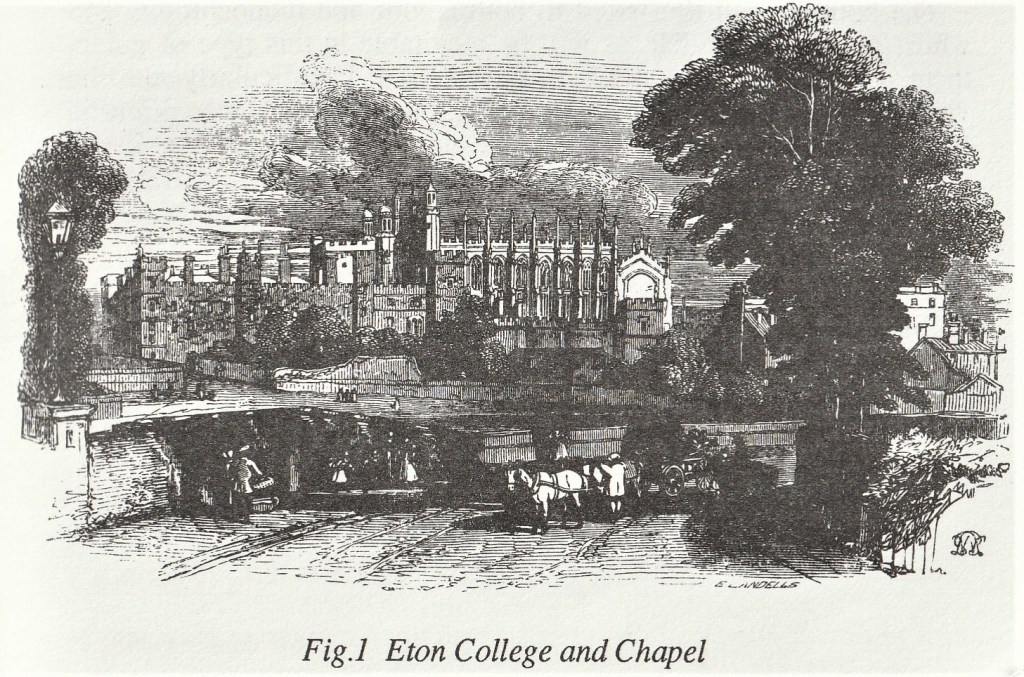
Most historic towns in England have a Grammar School or school of similar status which was founded in the sixteenth century in the wake of the dissolution of the monasteries. Reading, Abingdon, Guildford and my own school, Maidstone Grammar, are four among many. But not Windsor. Windsor Grammar School-or, as it was known in its early days, Windsor County Boys’ School-was founded in 1908 under powers given to County Councils and County Borough Councils by the Education Act of 1902. In November 1957 I had a correspondence with Tom Lyon, Librarian at Eton College, on the subject of ‘Why no Grammar School in Windsor until the twentieth century?’ 1 reproduce his letter as a fascinating and scholarly exposition of the relationship between Windsor and Eton on the one hand and Eton College on the other.
Raymond South (Senior History Master, Windsor Grammar School, 1930-68):
“Your letter raises an interesting problem. It is quite true that King Henry VI ordained ‘that the College should maintain “public and general grammar schools”, and to enhance their position, forbade the establishment of similar schools at Windsor or elsewhere within ten miles of Eton.” My quotation is from page 19 of the 1911 edition of Maxwell Lyte’s History of Eton College. The document which ordains this is not on the Patent Roll, but the warrant signed ‘R.H.’ by the King is among the Chancery warrants (Public Record Office C 81/1439 no 21).
Mr Noel Blakiston, the College Archivist, has summarised the document as follows:
‘Grant to the Provost and College of Eton that they may have in perpetuity within the precincts of the College public and general grammar schools which as they are to exceed all other grammar schools of the realm in affluence of endowment and in pre-excellence of Foundation so in the prerogative of name they are to excel the same, as is fitting, and to be named the general royal schools and called the mirror and mistress of all other grammar schools; and no other grammar schools are to be founded in Windsor or elsewhere within ten miles. The College of the Blessed Mary of Eton has been founded for seventy scholars to learn the knowledge of grammar and sixteen boy choristers similarly, while being sufficiently instructed in singing, to learn grammar, and one master instructor in grammar, and an usher to teach the said boys, scholars and choristers, and any others whence soever and from whatever parts they should flock to learn the said knowledge in the rudiments of grammar free of charge and without any pecuniary exactions.’
On the other hand I mentioned your letter this morning to the Head Master here and he observed that he doubted very much whether this legal prohibition of other grammar schools than Eton within a radius of ten miles could conceivably have been effective after the end of the Wars of the Roses. Had anyone in Windsor wanted to start a grammar school after 1485, R.Birley does not think that the Chancery warrant I have quoted would have stopped them.
I think myself that the answer to your problem lies partly in the fact that Eton College did act as a grammar school for Windsor at least until the early part of the 19th century.
‘It is worth remembering that the school as Henry conceived it was not only to consist of seventy scholars but also that sons of the nobility and gentry should attend as well as other boys, who paid for their own support and resided both in the College precincts and in the town.”.
Sir Wasey Sterry Eton College Register 1441-1698, introduction p xiv
‘Twenty privileged Commensals or Commoners were to be allowed to live in the College, and others were to be allowed to dine in the Hall, provided that the boys of both classes paid for everything except their tuition.
Maxwell Lyte op.cit. p.19
But besides scholars and commensals there certainly were from early times boys living in the town rightly called oppidans. William Paston in 1477 is an example of them. They had their instruction in grammar gratis (Statute xiv) and as they paid nothing presumably to the College they do not appear in the College accounts.”
Wasey Sterry Op.cit. p xxii
‘Viewed from another angle the Society at Eton was decidedly more democratic than it is today. … Whilst on the one hand Eton was never so full of representatives of the leading families as it was under the regime of Dr Barnard (Head Master 1754-65; Provost 1765-81) on the other hand it was still the practice for Eton and Windsor tradesmen to send their boys to the famous school which lay at their doors. Moreover the advantages of the foundation attracted boys of humble origin from the outside world. Thus tradesmen of the following description are to be found sending their sons to Eton: printer, hosier, vintner, ballet-master, coal merchant, shipwright, mercer, bricklayer, draper, packer, poulterer, cook, baker, druggist, teaman etc.’
from Austen Leigh’s Eton College Register, 1753-1790, intro. p.xxi
In his writes: ‘Fashionable as the school had become in one sense it was still decidedly democratic, and boys of plebeian origin were to be found, especially among those who sought the benefits of the foundation. Thus we find parents belonging to the following trades and professions sending their boys to Eton: baker, book seller, brickmaster, calico-supervisor, cheesemonger, distiller, druggist, dry-cooper, fell-monger, grocer, innkeeper, mercer, poulterer, scarlet dyer, silk-weaver, stage coach builder, tea dealer, tobacconist, upholsterer, watch-maker etc.’ (Intro. p.xvi).
from Austen Leigh’,’s ERton College Register, 1698-1752
I think myself that the fact that Eton College for so long educated boys who were natives of Eton and Windsor must in some degree account for the absence of an ancient grammar school in Windsor itself but whether this is the whole story I do not know. Did the Canons of Windsor keep a choir school that may have provided education too?’
Raymond South
 Windsor Local History Group