
Published in Windlesora 25 (2009)
© WLHG
As you walk around Windsor town centre, doing your shopping or stopping for a cup of coffee, do you ever look up above street level at the buildings?
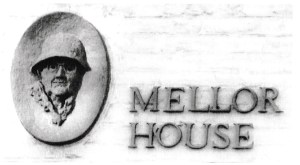
There are many historic structures in addition to the Castle, each with a story to tell. One of these is at 83-84 Peascod Street, currently Claudio’s restaurant. The first floor fagade tells you that this is Mellor House, and alongside is a cameo of an elderly lady with a cloche hat pulled well down over her forehead.
Not far away is Bachelors Acre, approached via Mellor Walk. Who was Doris Mellor, what is her connection with Bachelors Acre and why is she so important to the recent history of Windsor?
Doris Evelyn Mellor was born at 33 St Mark’s Road Windsor in 1894, and this was still her home when she died in 1981. Her father Albert was a music master at Eton College, and she had a sister Berta.
After gaining a degree in history at London University, she taught at Queen Margaret’s School, Pitlochry, where the headmistress Miss Fowler gave her a glowing reference when she left to join the Navy. She worked as a decoder at Holyhead and spent some time in Portsmouth before leaving in 1920.
Returning to teaching, she travelled to South Africa, and joined the staff of Wykeham Girls’ School, Pietermaritzburg, where she spent the next thirty years, twenty of them as Headmistress. Memories from staff and old girls who knew her at that time, give some clues to her personality and the skills which were to stand her in good stead when she returned to her home town.

South African photographer Leon Levson
Photograph from the Windsor & Royal Borough Museum
‘An unusual and very strong character with a good sense of humour, and at times a most entertaining turn of phrase.’
‘She had unlimited energy and expected others to be the same.’
‘On filling in government forms to get a grant, she disapproved of the questions, so crossed them out, put different ones in, and answered those.’
‘Her knowledge of History and Religions of the World was fantastic.’
‘She was far ahead of her time and was not fully appreciated at the time.’
‘She never accepted defeat if she knew she was right.’
‘She was lovable, warm-hearted, motherly and unfailingly loyal.’
‘She was a stickler for good manners, deportment and tidiness.’
‘She dressed in conventional spinster headmistress clothes of navy suits and sensible shoes but on Speech Days her one concession to femininity was a floppy organdie corsage pinned to her gown.’
She left Wykeham School on 29 June 1950 to return to Windsor.
There were numerous tributes to her achievements, not only at the school, but in the wider business community in South Africa, and she was welcomed back there on future occasions, including the school’s jubilee in 1965.
Miss Mellor found Windsor somewhat changed from the town of her childhood. The proximity of a rapidly expanding Heathrow Airport and the post-war increases in tourism and car ownership were creating a demand for parking spaces. Bachelors Acre was already being used as a car park, and there were proposals to convert it into a coach park. She recalled walks with her father, when he said, ‘Remember, this belongs to the people’.
So, what is Bachelors Acre, and why was it regarded by local people as a place of special importance? Today, in 2008, it is a pleasant, grassy, open space, actually about two acres in area, where office workers eat their lunch and toddlers play in the fountains on warm summer afternoons. From time to time there are community events such as the Ox Roast to celebrate the Queen’s Golden Jubilee in 2002, and these continue a tradition going back more than 200 years. More importantly, because of Miss Mellor’s campaign, supported by the Windsor and Eton Society, it is officially a Town Green, and as such is safe from future development.
Doris Mellor was secretary of the Landscape sub-committee of the Windsor and Eton Society, and arranged for the changing town centre appearance to be recorded in photographs. Many of the changes were not to her taste, and she was never afraid to say so. She felt that the Council had no right to use the Acre as a car park anyway, but their proposal to build a four-storey replacement set her on her campaign of conservation. The borough plans were turned down by Berkshire County Council in 1969, and in 1971 the Windsor and Eton Society applied for the Acre to be registered as a Town Green under the Commons Registration Act 1965.
On 13 November 1972, the refusal to allow a multi-storey car park was upheld in the High Court, and by this time Miss Mellor had accumulated a significant amount of information about the history of the Acre to support the claim that it should be a Town Green.
She found that ‘Batchelors Acre‘ was referred to by name in a lease of 1629. “The Provost of Our Blessed Lady of Eaton in Windsor leased to John Fishbourne of New Windsor three acres of arable land in a field called The Worth, adjoining at one side to pitts called Batchelors Acre.” In 1651 a 40-year lease was granted by the Borough to Richard Hale, stipulating that he set up Butts for archery practice and did not enclose the land, thereby making it available for ‘sports and pastimes.‘ By 1704, the Butts had disappeared, but the land had not been enclosed and it was declared that ‘all persons should have access’. Collier’s map of Windsor of 1742 showed the name Batchelors Acre for the first time.
Leases were granted, in 1749 to William Tyrell of the Inner Temple, and in 1761 to Christopher Lofft for 40 years at 3/4d per annum, under the description of ‘Bachelors Acre in the Parish of New Windsor, where the Butts formerly stood’, and about this time the Society of Bachelors of Windsor was founded to safeguard the amenities. Not all of the members were unmarried, so it was an association made up of leading citizens of the day, rather like the modern Rotary Club.
By 1789, the Acre was much neglected. It was used as a drain for the houses in the High Street, had been used for bull-baiting and was full of rubbish. As the Golden Jubilee of King George Ill approached, the Bachelors set about filling in the open sewers and restoring the amenities, and celebrated with an Ox Roast on 25 October 1809. This was attended, as part of a day-long programme of celebrations, by Queen Charlotte, the Duke of York and other Royal Dukes and Princesses, although the King himself was not well enough to attend. The following May, the Bachelors erected an obelisk in the centre of the Acre, to record the Jubilee event, and held a cricket match, which would previously have been impossible. The obelisk has since been moved, and now stands at the eastern corner, near Victoria Street.
In 1814, local people, led by the Bachelors, opposed the enclosure of (the Acre and in May 1819, the pasture was leased to William Perryman, a butcher, for £9 p.a. The lease mentioned rights and privileges, sports and pastimes, dating back to 1189.
Throughout the 19th century, Bachelors Acre was the focus of many local and national celebrations, and the Bachelors had annual dinners at local venues such as The Crown and The Swan. Revels were commonly held to celebrate Royal birthdays and there was a regular October Fair. The largest ever Revels were held for King William IV’s birthday on 22 August 1836.
The day started with a Royal Salute at 9a.m. followed by a perambulation of the Acre by the Bachelors with a military band, and numerous events and competitions for men and boys were held throughout the day. (Full details are recorded in the Windsor and Eton Express, but included climbing a soaped pole for a beaver hat, and a wrestling match for a purse of 10 shillings.)
In 1847, the Windsor and Eton Express reported the Battle of Bachelors Acre. Council workmen dug a well, but several hundred townspeople pelted them and the police with stones and then filled the well back in. They celebrated with a bonfire and fireworks and planted a flag on the site of the well, and the Council agreed to their rights and privileges.
By 1855, the annual Revels had developed a bad reputation. The coming of the railways meant that the town was flooded with outsiders, tramps, thieves and pickpockets. Local opposition meant that the Revels were finally stopped. The Acre continued to be used for sports, but lack of maintenance led the Windsor and Eton Express to report on 4 January 1863: ‘The Acre is a Swamp! Our representative observed for one hour to see how many people wishing to cross the Acre went across the bog, and the answer was none. The sooner the Bachelors re-make the pathways the better.’ On 6 December that year the paper reported a Council meeting and readers’ letters on the subject, protesting against any infringement of the Bachelors’ rights on this ‘historic parcel of land’. One local resident wrote, ‘People have the undoubted right to cross the Acre in any direction their fancy leads. I have done so for 50 years and I sincerely hope future generations of Windsorians will always claim that same privilege and boldly assert their rights against all comers.’
For the rest of the 19th century, maintenance was poor, but the Acre continued to be used for events such as bonfires. In the 1880s, Wombwell’s Menagerie with its noisy wild animals in cages camped on the Acre, but they got bogged down and had to be dug out by Guards from the Barracks. Buffalo Bill and his Wild West Show also visited Windsor to entertain Queen Victoria, and their wigwams must have been an unusual sight. Throughout this time, the Corporation was claiming ownership, and on Good Friday 1899 roped off the Acre to establish No Right of Way, but this barrier was torn down.
The Windsor Infirmary had been completed using part of a legacy of £500 from Mary, Countess Harcourt on an apex at the south western corner in 1844, and in 1903 the Corporation attempted to sell the Acre to the Infirmary. The Local Government Board overturned the decision and it was returned to a sports ground. Instead of an enlarged infirmary, the town gained the King Edward VII Hospital a little further from the centre. So Bachelors Acre continued to be used for occasional special events and bonfires, (including a particularly large one on VE Day in 1945, when the Mayor burned a Nazi flag) and as a playground for the nearby Royal Free School. By the time Doris Mellor began her campaign, over half of the Acre was being used as a car park, and there were garages all along the northern perimeter.
Following the High Court judgment in November 1972 to uphold the refusal to allow a multi-storey car park, there was ‘anger and dismay’ in the Council and many councillors believed that Miss Mellor and the Windsor and Eton Society had done the town a great disservice. They decided to appeal and their case was based mainly on the fact that the Acre had not been used regularly for recreation since 1875.

The Appeal was heard on 23 May 1975 by Lord Denning (Master of the Rolls), Lord Justice Browne and Mr Justice Brightman. In his summing-up, Lord Denning began:
‘Today we look back far in time. To a town or village green. The turf is old. Animals have grazed there for hundreds of years. Nowadays they are pleasant stretches of grass where people sit and talk. Sometimes they play cricket or kick a ball about. But in mediaeval times it was the place where the young men mustered with their bows and arrows. They shot at the butts. There might be stocks there where offenders were put for their petty misdemeanours. In the month of May they set up a maypole and danced around it.’
He summarised the history of the Acre from the 12th century and concluded that although it had not been used regularly since 1875, ‘it seems to me clear that the inhabitants of New Windsor had a customary right to indulge in lawful sports and pastimes on Bachelors’ Acre’. The Appeal was dismissed, and Doris Mellor became famous overnight, because of the ‘David and Goliath’ nature of the case. The national press dubbed her Dig-In Doris and Dogged Doris, and Woman’s Own magazine voted her Woman of the Month. In the New Year’s Honours 1977 she was awarded an MBE by the Queen, for services to the community of Windsor, namely giving Bachelors’ Acre back to the people. During the Silver Jubilee celebrations of 1977, the Acre took centre stage for many of the events.
In a speech to the Windsor and Eton Society in December 1977, architect Reginald Hyne described Doris Mellor as an ‘irresistible meddler’ who saved Windsor from quick changes through her heritage protection work. She was not always popular, especially with property developers whose plans she scrutinised and challenged, but she managed to charm people and earn their respect by the thoroughness of her research.
Doris died on Good Friday 1981, just before her 87th birthday. To some, her legacy is a chronic shortage of car parking spaces in the town centre, but to many she was a far-sighted conservationist who ensured that the historic open space known as Bachelors’ Acre will be enjoyed by many generations to come.
Sue Ashley
Sources
The Archives of the Windsor and Eton Express 1812-1981.
The website of the Royal Free School, http://www.royal-free.com.
Web editor’s note in 2023 – the website referenced is now https://royalfreeschool.uk/
The Court of Appeal. New Windsor Corporation v Mellor (1975) 1 Ch. 380 CA.
Thanks to Mrs Shirley MacLachlan from Wykeham Girls’ School, Pietermaritzburg.
 Windsor Local History Group