
Published in Windlesora 04 (1985)
© WLHG
It has been said that digging in the garden is one of the favourite hobbies of the British people. But nowadays it looks like being overtaken in popularity by the digging up of one’s family tree. Researching one’s family history has become an absorbing pastime for people all over the world.
But how to start? As Chairman of the Windsor, Slough and District Family History Society, this is one of the questions I am most frequently asked. So in this article I will briefly outline the first steps to take in finding out about your forebears. But be warned; once you have experienced the thrill of being a detective in time, you will never want to stop delving into the history of your ancestors. Their lives, their characters, their successes, their failures, it is all there when you know where to look for it.
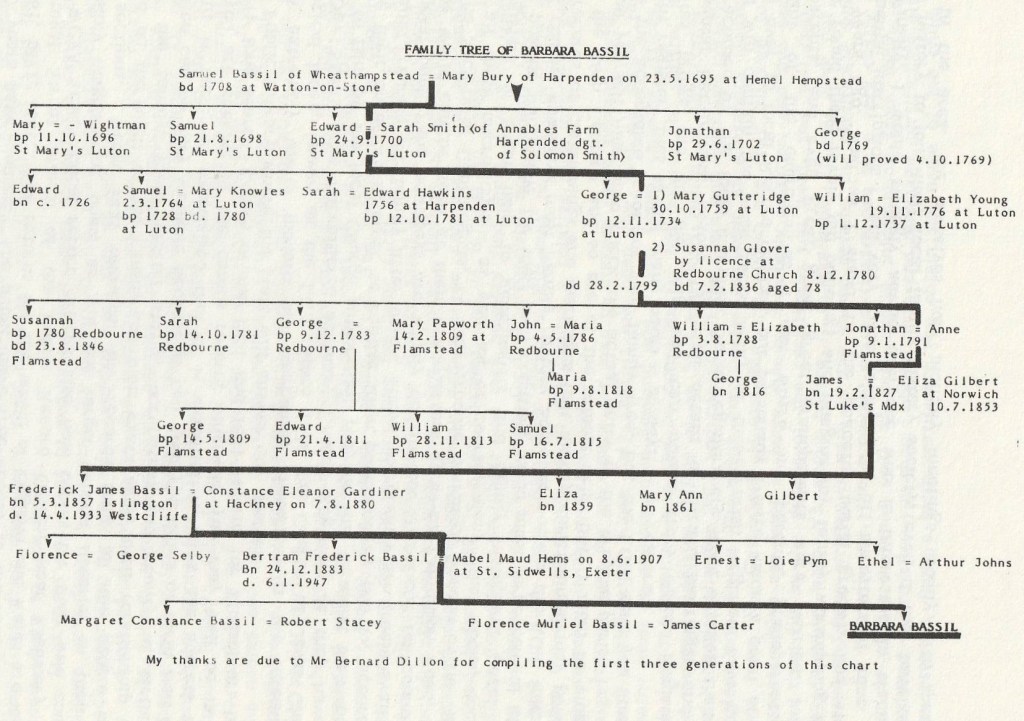
It is most important to remember that when compiling a family tree you must always work from the present day backwards, i.e. start with yourself and then trace back generation by generation, proving each step of the way.
First of all, obtain all the information you can from your relatives, however distant, about yours and their parents and grandparents. Do they have any old photographs or letters? Any birth, marriage or death certificates? Or perhaps school records or apprenticeship papers? Most important of all, do they possess an old Family Bible? All of these can provide you with most useful information and save you much time and expense. You can now start to make your family tree, setting out the names and dates of the major events in your own life, and that of your parents, grandparents, great grandparents, etc, keeping each generation on the same line of this pedigree chart.
Next, try and trace as many copies of old wills as possible. After 1858 all copies of wills for England and Wales are kept at the Principal Probate Registry at Somerset House, The Strand, London, WC2. The indexes may be consulted free and they are very detailed, summarising the basic facts of the wills. For a small fee the whole will may be seen and for a further small sum it will be copied and sent to you. In addition to wills there are ‘admons’, (letters of administration), when the deceased died intestate. These can also be consulted. The whereabouts of wills proved before 1858 is most complex and it is best to consult the local Record Offices for advice on where you may possibly find them. Two good books to consult are Anthony Camp’s ‘Wills and their Whereabouts’ and Jeremy Gibson’s ‘Wills and Where to Find Them’. Also don’t forget a will may not be proved for several years after the date of death, so do not assume a relative died intestate, when you have only searched in the year he died.
It may now be necessary for you to acquire some missing birth, marriage or death certificates. Since July 1837 it has been law that all births, marriages and deaths must be registered in England and Wales. Local Registry Offices were set up all over the country and can be consulted by the public. The central repository of the General Register Office is at St Catherine’s House, at the corner of Aldwych and Kingsway, London WC2 and contain all the birth and marriage certificates for all England and Wales. The death certificates are kept at Alexandra House, across the road from St. Catherine’s House. But the public are only allowed to search the indexes, which are kept in large, heavy, quarterly volumes, and this search is free. You then fill in the details of the certificate you want, this will cost £5 and you may have to wait 2/3 weeks before it is available. If you have not searched in person and have written in with all the known details, the certificate will cost £10.
As you will see, the acquiring of certificates can be a very costly business but you do obtain a great deal of very useful information from them. To gain the maximum information you should obtain birth and marriage certificates alternatively. For instance, from a birth certificate you obtain the name of the child, its date of birth, father’s name, address and occupation and the mother’s maiden name. From the marriage certificate, the date of the wedding, the bridegroom’s name, age, marital status, address and occupation, also the bride’s name, age, marital status, address and occupation. As a bonus, you will also obtain the names of both the bridegroom’s father and the bride’s, and their occupations. You can see whether the married pair could write their own names (in the old days they often signed with a cross). You can also learn the names of the witnesses, which were usually members of the family; all very useful information for your family tree.
Armed with all these addresses, now is the time to consult the census returns. Censuses have been held every 10 years since 1801, but the enumerators’ records were not kept until 1841. The returns for England and Wales cannot be consulted until 100 years have elapsed. The public have free access to the returns for 1841, 1851, 1861, 1871, 1881. The returns for the whole of England and Wales are kept at the Portugal Street branch of the Public Record Office, near Chancery Lane, London, WC2A 1LR. Local record offices also hold copies for their own counties,and possibly neighbouring ones, as will the larger central libraries in their local history sections. From 1851 onwards, the records show all the people in the household on the night of the census and their exact ages, their relationship to the head of the family, their marital status, occupation and county of birth. This information can be very valuable because it can give you dates of birth well before 1837. But it must be emphasised that it is essential to know the address of the family you are seeking in the census return, otherwise you may well be in for a very, very long search. Copies of the 1851 and 1881 returns for Windsor are held at Windsor Public Library where the staff will answer any queries.
An extremely useful modern aid to Family Historians is the International Genealogical Index, known as the I.G.I. Since 1976 the Church of Jesus Christ of Latter-Day Saints have microfilmed as many Church Registers as they have been allowed to film by the local Church authorities. They do this to assist their members to trace their ancestors in order to baptise them posthumously and so, according to their belief, reunite the family after death. These microfiches are freely available to the general public and nowadays are widely distributed. Microfiche for countries all over the world can be seen at their headquarters at 64-68 Exhibition Road, London SW7. The Society of Genealogists, 14 Charterhouse Buildings, London ECIM 7BA also possess all these microfiches – as well as, of course, many other books, documents and registers of great help to genealogists and family historians. Local Record Offices possess microfiche for their own counties, as do most large central libraries. And, of course, nowadays most Family History Societies possess the I.G.I. microfiche. These records of christenings and marriages (but mostly christenings) may go back as far as the 16th Century and so are of the utmost help. But it must be emphasised that you yourself must also check the actual entry in the original parish registers to provide the acceptable proof for your family tree. But the I.G.I. send you straight to the right register, thus saving many hours – or days! – of research.
This brings me to the help you can obtain from Parish Registers and Monumental Inscriptions. Before 1837, all details of Births, Marriages and Deaths were recorded by the local churches. Some registers are more detailed than others, but all will contain the basic facts. Many of these Parish Registers have now been handed over to local Record Offices, but personally I have made a point of visiting as many of the churches as I can where my parents, grandparents, great grandparents, and even great great great grandparents were married. I love to wander round these lovely old buildings and imagine my family worshipping there all those years ago. And as I stand in the peaceful burial grounds and study the monumental inscriptions I feel very close to those far off ancestors of mine.
Finally, I would strongly advise everyone who is interested in tracing their family history to join their local family history society, even if they have no actual roots in the area. We ourselves hold monthly meetings usually with speakers on special topics. We can help you with your research and it is stimulating to talk to people absorbed in the subject. We publish a magazine every 3 months and exchange our magazine with other societies all over the country and abroad as well. For further information you can contact our Membership Secretary, Mr. Tony Clark, 19 Thurlby Way, Cox Green, Maidenhead, Berks. SL6 3YZ. Telephone: Maidenhead 708833.
I hope this article will help you to begin to research into your family history. I have outlined only the beginning steps; once you have acquired the basic facts there are many other records and sources of information for you to study. Good hunting!
Barbara Bassil. Chairman, Windsor, Slough & District Family History Society
 Windsor Local History Group