
Published in Windlesora 06 (1987)
© WLHG
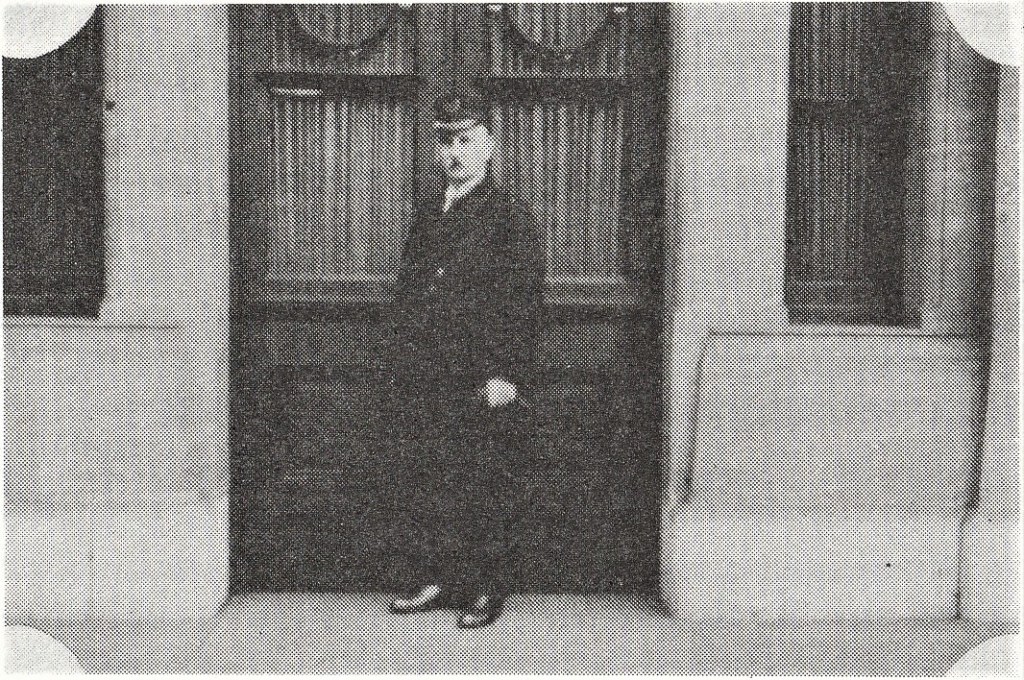
“Thank you for all you did for my father”. These words were spoken by King George V when he presented Samuel Thomas Maun with the medal of the Royal Victorian Order; and indeed for the 22 years from 1903-25 that Maun had been stationmaster of the Great Western Railway in Windsor, he had arranged for the arrival and departure of every crowned head in Europe. After he retired he recorded his memories of many events, both interesting and comical, in a small clerk’s notebook a copy of which is now in the Royal Borough Collection.
Maun started his duties as stationmaster in April 1903 and the first member of the Royal Family whom he met was HRH The Princess Christian. He had received a message to say that the Princess was to travel to London the next day and required the use of the special carriage reserved for her. She hoped he would be very happy in his duties, and indeed this was the beginning of a long and happy association with Royalty.
Maun tells how State Visits were organised. He writes, ‘The long carpet was used on the platform.‘ Elsewhere he explains the rather complicated procedure, ‘As soon as the Royal train left Paddington, the stationmaster wired me the distance from the footplate of the engine to the door of the Royal saloon, and I then had to measure the platform and make a mark where the driver must stop, and also place a man there with a red flag, so that the centre of the door of the Royal saloon should be exactly opposite the entrance to the Royal room. All the points in the yard were locked so that nothing could move, and the keys brought to me to hold until the Royal train had come to a stand, then a man took them and unlocked the points and the traffic was returned.’ At the end of the State Visit these arrangements were reversed. Maun was frequently presented with a diamond tie-pin to mark such events.
In 1905 the Royal Family celebrated the wedding of HRH The Princess Margaret, eldest daughter of HRH The Duke of Connaught, to HRH Prince Gustavus Adolphus of Sweden and Norway. Mrs Maun and her sister-in-law were invited to the service in St George’s Chapel. After the wedding there was a terrific thunder storm just as the Royal couple were driving to the station.

It was quite usual during Royal visits for Maun to organise as many as twelve special trains, and once when Mark Twain was a guest he asked Maun how he should get to the Castle. Maun said, ‘I told him to take one of the carriages, in fact I took him across the yard and put him in one and off he went. About half an hour afterwards I went to the front of the station and saw him still in the carriage so I said, “Have you been to the Castle?” and he said, “Oh yes, but they sent us back for another run round.” I wondered what he made of this when he got back to America.’
Maun’s diary rarely records his dealings with the general public, but he took trouble to see that the Royal Family and celebrated guests were suitably treated; so he was very upset one cold November morning when, having got the carriages well heated for the German Ambassador, Lord Rosebery complained that the train was too hot. Maun thought he would have appreciated the warmth.
In February 1914 Maun was invited to see Gustav Hamel, the aviator ‘looping the loop’ above Windsor Castle before the Royal family, and he records how they saw something fall off the aeroplane. It was a piece of the tail, and until it was found the demonstration could not proceed. After a long search it was retrieved and all was well. It was Hamel who in 1911 had brought the first aerial post to Windsor.
When King Edward VII died in May 1910, Maun had his busiest day, starting at 5 a.m. when special trains began arriving with soldiers and sailors. All traffic was stopped and the station cleared of the public. In the station yard one hundred blue jackets lined up to pull the gun carriage. At 11 a.m. the Royal train arrived with the funeral party. Grenadier Guards carried the coffin to the gun carriage, having previously rehearsed with a dummy coffin weighing the same as the real one. This had to be returned to London for the rehearsal there. The procession was headed by the massed bands of the Guards, followed by Garter King of Arms, then an officer carrying the Royal Regalia, followed by the standard bearer. These were followed by His Majesty King George V, HRH The Duke of Connaught, Kaiser Wilhelm II, HRH The Prince of Wales and HRH The Duke of York. Then followed the kings of nearly every country in Europe. Maun said it was a sight he would never forget.
King George V gave many Reviews, including one with 10,000 boy scouts, all arriving by special trains. When they left the next day the Officers Training Corps arrived on another platform.
In an amusing account Maun descibes the day when HRH The Princess Alice, Countess of Athlone, called him to her reserved compartment to catch a large moth. ‘I went into the compartment. It was flying about and I was striking at it when she said, “Here it is,” and I went to strike it and she moved her head on one side and instead of hitting the moth I caught her slap on the cheek.‘ The Princess laughed and said it was not his fault, but he caught the moth, and afterwards she would say, “No moths this morning.” She was a great favourite with Maun.
Crowds of Eton boys flocked to the platform to see the departure of Alcock and Brown, the first aviators to fly the Atlantic, who had been honoured by the King. They had to make their escape from the enthusiastic boys by running up the other platform and across the line.
Maun describes the sight of the brilliant breastplates of the Guards when the Archduke Franz Ferdinand and his wife left Windsor station at midnight. All the guests came to see them off, and their jewels sparkled in the light. Soon afterwards the Archduke was assassinated and war followed. During the war, hospital trains with wounded soldiers arrived at the station. Trains had to be halted during raids often causing great inconvenience to all concerned. Maun relates how Douglas Barry was once unable to return from a meeting; they chatted until 4.30 a.m. and refreshed themselves with whisky and biscuits fetched from Maun’s home. Mrs Barry sent Maun a letter of thanks for looking after her husband and gave him a silver cigarette case with the inscription, ‘S.T.M. from D.M.B. a friend in need is a friend indeed. Windsor Station March 31 to April 1 1916’.
It was quite usual during the Great War for Maun to be called up two or three times a night when there was a warning. One night he saw a brilliant light in the sky and a large object broke in two; it was a Zeppelin brought down at Cuffley. On the morning of November 11, 1918 Maun was privileged to be told by HRH The Princess Alice that the war was over, but it was to be kept a secret until 11 a.m.
One day Mr Hansel, tutor to the sons of King George V, asked Maun if he would look after the Royal children. Maun took them to the waiting room, and knowing a crowded train was due, he locked them in. When the crowd had gone and they were let out, Mr Hansel said, “Capital”.
Life continued as usual for Maun until he retired in April 1925, having bought a house in Windsor,(49 Frances Road), and here he enjoyed working in his garden. In June he was summoned to the Castle; the King thanked him for his services, and remarked that Maun had watched his children grow up. Maun refrained from admitting he had locked them up! He then backed from the room, having had a quick look earlier to make sure the way was clear.
In July 1925 at a ceremony in the Guildhall, Maun was presented with a cheque for £115. 1s. 7d. collected by the people of Windsor, and an illuminated address. Maun thanked the Mayor, Sir William Carter, and also the Colonel and Officers of the Royal Horse Guards, for a clock, the Rectors of Beaumont College for silver vases, and the staff of the Great Western Railway for a Sheraton clock. There is an account of this ceremony in the Windsor and Eton Express.
Maun is still remembered by a few people today as a tall pleasant man, who always attended Windsor Parish Church in top hat and tails. He died on September 27, 1948 aged 88 years and the funeral service was conducted at All Saints, Frances Road. The obituary in the Windsor and Eton Express quoted several incidents from the diary and suggested it should be published. A copy of this unique document with its many insights into the busy life of both Royalty and railways is just one of the many treasures in the Royal Borough Collection.
Elizabeth BrownAcknowledgements
Hon. Curator of the Royal Borough Collection; Librarian, Slough Reference Library;
the Misses Watkins;
the Misses Ayres;
Mr Douglas Brown;
Mrs Daphne Fido, for providing the drawing of the Stationmaster’s house;
Mr C. Pearce (Maun’s grandson), for use of photograph, (fig 2).
 Windsor Local History Group