
June 1953
Published in Windlesora 29 (2013)
© WLHG
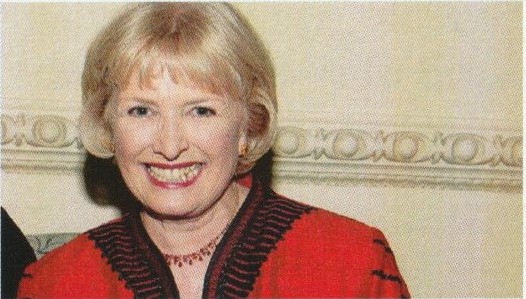
The early years of my life were spent at Lambrook Preparatory School in Winkfield Row – then a tiny village. My Mother worked at the school and we lived in one of the school’s boarding houses.
Windsor Great Park was close by and friends of my Mother had a key which opened one of the gates into the private part of the Park. Quite why her friends were privy to such a key is a mystery, but I remember picnics in the park — with the exciting possibility that we might meet the royal children, also playing games of hide and seek. Sadly, this was not to be — but we felt they were only a breath away.
The key also gave us entry to the part of the Great Park where the Royal Family changed from their cars to horse-drawn carriages for the traditional daily procession to The Races. With not a security person in sight, we watched from a respectful distance and were rewarded with waves and smiles, to which we responded with curtseys and bows. A full court curtsey was in my repertoire from the age of two!
Then came the day when I was told that the Queen was to be crowned. My Mother explained that there would be a huge celebration and we would be able to watch the Coronation on television. I remember receiving a coronation mug and a miniature of the Gold Coach and horses, which carried the Queen to Westminster Abbey. I still have these and they reside in the same place, in my late Mother’s glass-fronted cabinet. Some time later she bought the book of the Coronation — full of pictures — which joined the others on our bookshelves, published to mark Royal weddings and other special occasions.
In 1953, televisions were few and far between. I forget whose house it was into which we all crowded, but chairs were set for the adults, and the children sat on the floor, all gazing at a small flickering black and white television set — although we all stood to attention when the National Anthem was played. Ah, how times have changed.
I am not sure how much I really understood of what was happening – it all seemed very similar to the fairyland of my storybooks – but I was excited about wearing a party dress and anticipated the treats of sandwiches, cakes and ice cream to come. There were union jacks and bunting – probably left over from the street parties held to celebrate the end of World War II. This was a time when the Royal Family exuded magic and mystery, and little girls longed to be Princesses. The horse-drawn coaches, the beautiful gowns, uniforms, crowns and tiaras simply reinforced that view and “Coronation” games made for many happy hours in the following weeks.
Now sixty years have passed, during which time the Queen’s innate sense of duty and her deep religious faith have never wavered. It is due solely to her that the Royal Family is enjoying such a huge boost in its popularity. The fervent monarchist that was my Mother died two years ago, but as Jubilee year came to an end and Coronation anniversary year began, I thought how entranced she would have been by all the celebratory and ceremonial events. She would have waved her flag, raised a glass and watched the proceedings on her flat-screen colour television — all the while remembering Windsor Great Park, Ascot Week and Coronation Day in black and white.
Judith Potts
Television!
We were going to see the coronation on television!
No proper signals had yet reached Plymouth where I lived, but some people were already buying sets including a friend of my father’s who had invited us, plus other friends and neighbours, to his house to see the great event.
So on 21 June 1952 we all crowded into his living room and stared at the tiny screen in the middle of a very large wooden cabinet. It seemed to be snowing in Westminster Abbey, but the sound was fine, we got used to the blizzard and it was thrilling to feel that we were as good as ‘there’.
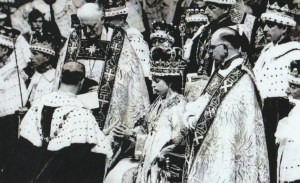
Later in the day we joined huge crowds on Plymouth Hoe, to watch a water pageant in the Sound, and see Drake re-enact his famous game of bowls. A great day was brought to an end by a huge celebratory bonfire.
Hester Davenport
“The twelfth of May is Coronation Day.” This was 1937 when George VI and Queen Elizabeth were crowned in Westminster Abbey. My school in Cardiff performed a pageant before the Lord Mayor, and my class re-enacted the procession in which I played one of the horses drawing the State Coach, en route to Westminster Abbey. Afterwards, we were presented with sweets and coronation mugs filled with fizzy orangeade.
Sixteen years later, on Monday 1* June, I joined friends in London, staking a place on the pavement by the Duke of York steps in the Mall. Armed with camp stools, rugs, thermos and sandwiches, we prepared for the long overnight wait. Undeterred by the weather more and more people arrived, and by 3.30 am were twelve deep behind us. By 7.15 am we were awake, watching the Guards’ markers taking their places, and cheering anything that passed by – all in anticipation of the procession to come.
The sun came up over St James’ Palace, the Band of the Scots Guards played outside Clarence House, loudspeakers in the trees relayed the BBC commentary of the scenes around and inside Westminster Abbey and Buckingham Palace, as well as the dignitaries, costumes, and dresses. As we waited, the streets suddenly rang with loud cheering as Richard Dimbleby announced that Edmund Hilary had reached the summit of Mount Everest.
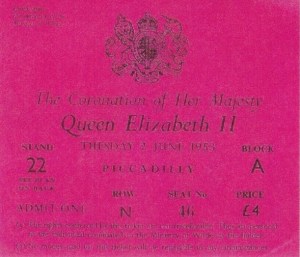
At last the pageant began. The Yeoman of the Guard marched by, followed by many of the world’s foreign and diplomatic representatives. A great roar of applause greeted Winston Churchill, as well as the Canadian Mounties escorting their Prime Minister. When the Royal Princes, Queen Mother, and Princess Margaret passed, the procession stretched the length of the Mall.
At last! Preceded by an escort of Guardsmen, the State Coach made its progress towards us, with a huge acclamation as it passed. Then silence, as the crowds listened to the commentary; Dimbleby’s low voice respectfully describing the ceremony.
London’s bells rang out at the Crowning, and we waited through rain showers for the procession to return to the palace. It was vast. The Armed Forces with their colours and bands, Heads of State, and finally our newly-crowned Queen looking radiant. All the coaches had their hoods up except that of Queen Salote of Tonga, who we cheered for ignoring the rain.
Another great roar from the crowd in the Palace area, marked the end of the Procession and the appearance of the Royals on the balcony, followed by a fly-past overhead. People began to move up the Mall towards the palace, but we walked across into St James’ Park where food wagons and conveniences were parked, and on towards the Abbey which was open to the public. The weather cleared, and in the sun the red, white, and blue street decorations were cheery. The Abbey was decorated in blue and gold, and we gazed at the Throne, the special chairs for the visitors, the beautiful flower displays, taking in the fact that just a few hours earlier it had been the centre of a piece of our history.
By 7pm we were at the Victoria Statue in front of the palace, waiting for the Queen to appear. Her speech, introduced by the Prime Minister, was broadcast, and at 9.40 pm the palace balcony was floodlit. Out stepped our Queen with the Royal Family, to a roar of cheering and singing from the dense crowd.
Eventually, the crowd dispersed, and a great wave of people was pushed to the side of the Mall, taking me with it, but good humour and sense prevailed, and I survived a dash to Paddington to catch the last train home to Wales.
The entire day was one of excitement and elation, and I was conscious of being witness to an historic event, still vivid after 60 years.
Sonia Sayed
I well remember where I was when I heard of the death of the King -University Road, Southampton, where I was a student. We all felt an air of gloom; this was the end of the established world of our childhood, and the man who had been our inspiration throughout the war.
But the mood quickly changed. Here was a brave, new world. A lovely young Queen, not much older than us, surely a new Elizabethan Age…all things were possible. So of course, I was determined to go and see the Coronation procession, although my parents were very doubtful about my going up to London alone, at night. Nevertheless, they took me to the station to catch the midnight train, and my mother was extremely relieved to see a young woman she knew as a Guider. She quickly arranged for us to travel together.
When we arrived at Waterloo Station, we were assailed by large placards announcing the conquest of Everest by Hillary and Tenzing. This gave a tremendous lift to everyone’s spirits; we walked through the station as if bouncing on air. Rule Britannia!
Making our way to Trafalgar Square, which at 2 am was already crammed with people, and on through Admiralty Arch. We agreed to stand in the Mall, because with Green Park behind us we did not feel so hemmed in as in the narrower streets. At about 6 am we took our places near the second of the four arches erected over the Mall, and we were about ten deep here. As it began to get light there was a little activity, and a lone policeman cycling past got a tremendous cheer, as did the refuse-collecting cart.
Of course, as always with a London crowd, there was conversation and jokes. Eventually the troops took up their stations between the policemen, and we hoped our view would not be obstructed by their broad backs.
The weather was dismal, and there was some drizzle. When the carriages started to appear, most of them were closed, but there was always someone who could identify the occupants. The heroine of this procession was Queen Salote of Tonga who endeared herself to all by riding with the carriage’s canopy down. She was a large woman, beaming with smiles, and waving to us all, completely oblivious to the weather.

Then at last! The golden coach with our Queen and Prince Philip – what a beautiful sight. We cheered and waved with all our might.
When the service was on in the Abbey, some people moved and we were able to sit on the kerb, eating sandwiches and listening to the radio broadcast. Then on our feet again to cheer the returning procession to Buckingham Palace. Afterwards, we left our positions and made for Green Park to find lavatories, and later a hot meal. We had not budged from the side of the Mall for 12 hours – those were the days when we had stronger bladders and legs!
Eventually, we got back to Southampton. I never saw my travelling companion again, but I am very glad I did get to see the Coronation.
Margaret Gilson
With a party of about twenty friends, I settled down on the Mall as comfortably as was commensurate with the barrage of sound which issued in persistent volume from the gathering thousands, and the four-column traffic jam whose individual components seemed determined to all reach their destination at the same time. By mid-afternoon, our encampment was suffering infiltration on both flanks by a truly terrifying platoon of teenage schoolgirls before which the creations of Ronald Searle would have resembled debutantes. By twilight, we had survived our first heavy downpour, and become resigned to our diminishing boundaries.
Several rows behind us a large and noisy group of London’s cockneys argued and laughed, and swore and joked with a sturdy vigour that scarcely faltered as the night advanced. A short distance away a party of bronzed Australians maintained a hearty, if only partially tuneful, rendering of ‘Waltzing Matilda’. Although a few of our party contrived to snatch some fitful sleep, I found this virtually impossible; there was too much happening around. As darkness fell, the street lights were turned on, in the roadway the flood of traffic continued with taxi-loads of sightseers perched on roofs and running boards, mingled with private cars of all shaped and sizes, nationalities and colours, in a hooting, screeching pilgrimage to the Palace. An endless flow of pedestrians surged between them in both directions, waving their flags, admiring and criticising the decorations with equal zest, and occasionally huge and loudly expressed delight.
The Australians songsters inspired a rival choir to manipulate the strains of ‘There’ll Always Be An England’. A dispute arose between our Cockney rearguard and an equally pugnacious band of pedestrians who, unable to secure space at the rear, were doggedly camping on the roadway in front of the pioneers who had secured their spots many hours before. When eventually they departed, we received unexpected protection from a gentleman, for whose ingenuity and resourcefulness I hold the strongest admiration. This worthy solemnly produced a gigantic bottle of Dettol with which he proceeded to soak the area immediately in front of us, for the length of about 20 yards, an area which was understandably shunned by prospective gatecrashers during the remainder of our sojourn.
The evocative news, verified by a hoarse and jubilant newspaper vendor carrying the first edition of the morning’s papers, spread as rapidly as the excitement that succeeded it. Mount Everest — the unconquerable Everest – had been beaten by a British expedition. A new warmth pervaded the chilled and cramped thousands. A voice, later identified as my own, called for three cheers, and the crowd responded with a cry of exultation that suddenly gave new meaning to our reasons for spending a physically exhausting night, on an equally uninviting pavement. One could sense the pride that seemed to surge through that entire great concourse. They were British, overwhelmingly British, these people who had come to cheer their Queen; then we sang ‘Land of Hope and Glory’.
At 3.30 we were standing, with feet aching, to make room at the rear, watching the hundreds of potential spectators arrive, only to be awed by the myriads that had preceded them.
At 4.30 we were enlivened by the arrival of the police, drafted into the Metropolis from all over England, and for want of anything better to do, we loudly cheered every contingent.
With the advent of the Welsh Guards for route-lining duties, the picture acquired a markedly different aspect from the mammoth cup-tie crowd it had previously resembled, their presence supplied an authentic prelude to the pomp that was to come. At 5.30 the loudspeakers which festooned the trees, conveyed the greetings of the BBC whose first-announced programme, ‘Music While You Wait’, was received with unchecked mirth. At 7.30, with barely twenty minutes before the arrival of the first procession, the atmosphere was charged with a throbbing electric expectation. Preceded by motor-cycle outriders, and accompanied by waves of cheering, the first of the procession reached us.
The brilliant uniforms of the Household Cavalry, with their gleaming helmets, flashing swords, and nodding plumes; the crescendo of tumultuous cheering; the unrivalled and unbelievable splendour of the State Coach; all have been captured for posterity. Some fragments cling more strongly to the raft of memory than others. The magnificent plume of the Commanding Officer of the Royal Horse Artillery; Lady Mountbatten leaning forward in her car to wave more easily; Sir Winston Churchill mightily pleased with his colourful escort of the 4″ Hussars; the youthful Duke of Kent seriously acknowledging the cheers with a white-gloved hand; Princess Margaret, fragile and serene, riding with her mother in the superb Irish State Coach.
And finally, to complete this moving canvass of tradition, the exquisite picture of our young Queen, set high up in the golden splendour of the coronation coach, a little overwhelmed perhaps, by the exuberance, and the glory, and the resounding cheers that swelled and rolled around her as she drove, with her husband beside her, to her coronation.
It was 11.00. The loudspeakers filled our ears with the clamour of pealing bells, and we prepared for the four hours to pass before the return of our newly-crowned Sovereign. This was a span of time I shall not readily forget. The Coronation Service, from the shrilling, ice-brittle notes of the fanfares, to the solemn epilogue of The Blessing, held our attention even as the rain began to pour. As the magnificence of the service culminated in the supreme moment of Crowning, and guns pounded out their salute in the park behind us, the strains of the National Anthem were invested with new meaning, and the drenched crowds rose to their feet to take up the singing.
We were again thrilled to the music of the massed bands, and again the Welsh Guards dipped their Colours as the long procession passed by, contingent after contingent; a proud and fitting escort for their Monarch. Again, there are memories not so easily forgotten. The Mounties, those colourful figures of schoolboy imagination, suddenly and magically come to life before us on their prancing steeds; the unusual sight of Viscount Montgomery, mounted and looking as if he had never experienced any other form of transport; the robes and coronets of the Royal Family; then at last the golden coach carrying Her Majesty, amid the torrent of her subjects’ exultant acclamation, with the great Imperial Crown, glittering and sparkling on her head, the Orb and Spectre in her hands, smiling and regal, now in very truth, a Queen.
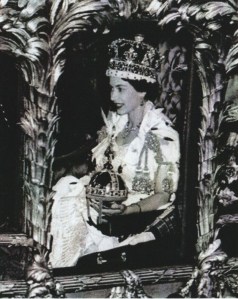
Later, as we wearily made our way towards Waterloo and home, and as we watched the RAF sweep thunderously overhead from Westminster Bridge, in the heart of the greatest city in the world, it was William Shakespeare who provided the closing word:
“This blessed plot, this Earth, this realm, this England.”
John Handcock
 Windsor Local History Group