
The Davis Family of Windsor 1640 – 1833
Published in Windlesora 33 (2016)
© WLHG 2018
The Davis family were iron-smiths and clockmakers working from Windsor between about 1640 and 1833. Over several generations, they produced some remarkably talented and exceptional craftsmen who also worked as blacksmiths, locksmiths, and bell-hangers.

Three generations of these men were called John Davis; this caused confusion and led to the incorrect attribution of work in later years.
William Davis fl(*1) 1640 – 1697
A blacksmith of Windsor during the reign of Charles I.
His claim to fame is that he founded this family of eminent smiths who worked in Windsor throughout the eighteenth century. We are told that he performed various works at the castle before the Civil War, and afterwards Oliver Cromwell was a patron. Although he continued to work at the castle during the interregnum, he would not touch a shilling of the usurper’s money. Out of loyalty to the king he wore a hat with the crown cut out, as there was in England in those days no crowned head (Tighe and Davis, p. 383). William was dead by the year 1697, but it would appear that his son John inherited the business some years before his father’s death.
John Davis (1) c1650 – 1713
Son of William Davis, the smith at Windsor Castle.
He was made a Freeman of Windsor in 1685, and in the following year on the 18 April, he married Mary Howard of New Windsor, by licence. They had three children: Mary born in 1687, John in July 1690, and Elizabeth in 1704. He succeeded to his father’s business about 1695, Davis had his own son apprenticed to a member of the London Blacksmiths’ Company (GL, BC, Apprentice Bindings, MS 2886, vol. 3). Little is known of his work, but in 1688, he was paid in part for the ironwork for the roof of the Windsor Guildhall designed by Sir Thomas Fitch about 1687. It is known that the bell windlass buttress supports in the Curfew Tower at Windsor Castle are inscribed. ‘John Davis the smith, 1689‘. He is also believed to be responsible for the clock in the Curfew Tower, which was also made in 1689.
John Davis (2) 1690-1762
Son of the above and the most successful member of the family. What little we know about the father, suggests that he was not a sophisticated craftsman, a defect he sought to remedy in his son, also John Davis, who was baptised at New Windsor on 27 July 1690. In November 1706, he was apprenticed to Thomas Pare of the London Blacksmiths’ Company., whose workshop was situated in Bandyleg Walk, Southwark. For some reason not stated Davis was not made Free of the Company until November 1724 (GL, BC, Apprentice Bindings, MS 2886, vol. 3). As Davis advanced in the world, he acquired an air of confidence, making him thoroughly at home in the company of the gentry. In the Royal Collection at Windsor Castle, there is an ink and wash drawing which depicts a group of figures at the Castle of which one is Davis. This is the only known depiction of a named ironsmith.
Davis was a skilled craftsman with many accomplishments, and had a long working relationship with Eton College, which started in 1722. For forty years he maintained the School Yard clock, and he supplied over 8 tons of iron work between 1725 and 1729, for the building of the new library. In 1736, Davis made a superb wrought iron roasting jack. Highly decorative, it was a weight-driven, clockwork machine that could drive six spits and was mounted on a wall at the side of the kitchen fire. It was in constant use until the 1920s.
Apart from being an ironsmith and engineer, he was also appointed to take care of the clocks at all of His Majesty’s palaces (PRO, Work 4, vol. 8, Minutes September 1739 to January 1744). As an engineer, his speciality was water-pumping engines, and for the Royal Works, he made one for Windsor Castle. In September 1739, he was ordered to prepare an ‘estimate for making a new engine on the principle of his own engine which serves the town of Windsor‘. The following February, Davis presented his estimate for £1,047, though it is not known if the engine was made. In April 1741, he was ordered to repair the old engine at Wind, the cost not to exceed £250. The work was completed in November 1741 In January 1740, John Davis, ‘an accredited workman in the office of Works‘, petitioned for higher prices with Joseph Pattison and Thom Wagg (King’s Works, v. p. 93).
Davis cast the gates at Baylis House, Slough, and possibly those for Hadleigh House, Windsor. Baylis House, was built about 1695 and was extended in the 1720s for Dr Godolphin, Provost of Eton. In March 1731, John Davis was paid for the general smith work, with further payments in 1734 and 1735, without specific mention of the wrought iron gates (Buckinghamshire RO, Godolphin Building Accounts). Pevsner records, ‘Good wrought iron gates with the Dolphin of the Godolphins‘. Davis also made an eight-day turret clock for Baylis House which was inserted into the kitchen block pediment in 1735.
John Davis (3) 1722 – 1801
Son of the second John Davis, and baptised at New Windsor on 3 March 1722.
It is presumed he was apprenticed to his father, though no details are known of his early life. On 20 December 1743: ‘It was ordered that Mr. John Davis Jnr. have the care of looking after the clocks in H. M. Palaces in the room of [i.e. in place of] Mr. John Davis, Snr.‘ (PRO, Work 4, vol. 8, Minutes, September 1739 – January 1744). In May 1748, it was ordered that John Davis Jnr. be entered as a partner with his father. It is believed that after this date, his father ceased to play an active part in the business, and the son was responsible for the everyday running of the firm (PRO, Work 4, Minutes).
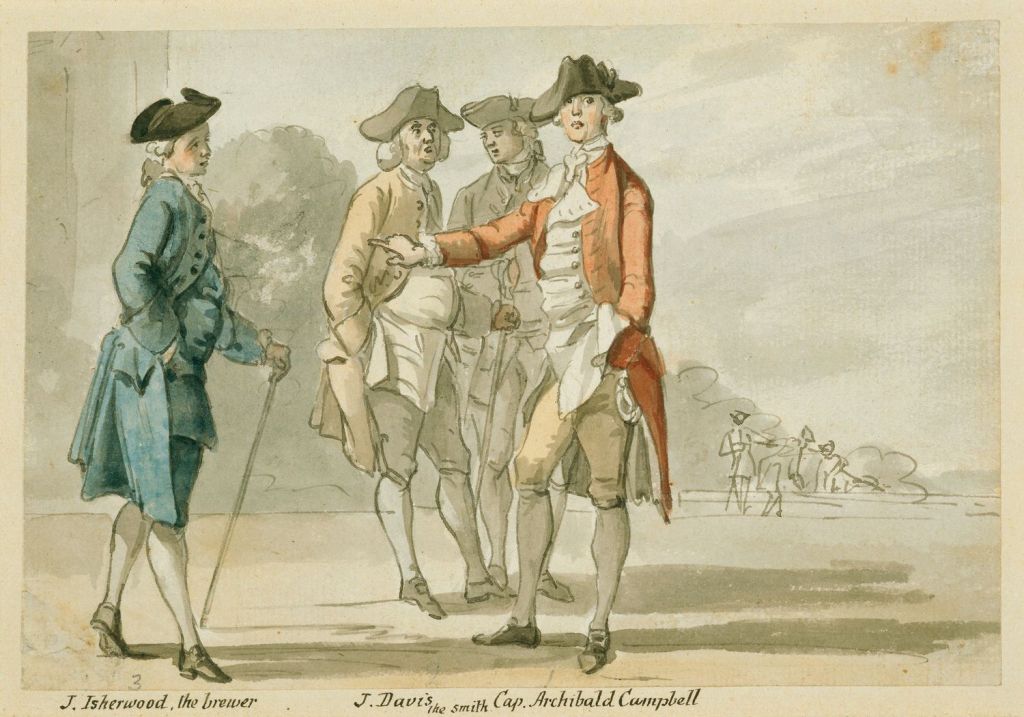
J Isherwood the brewer at Windsor, J Davis the smith, and Cap. Archibald Campbell
RCIN 914449; © Royal Collection Enterprises Limited 2025 | Royal Collection Trust.
In February 1762, John Davis submitted a bill to the Earl of Lincoln ‘For a pair of large circular headed double framed Iron Gates £87 55. 6d. and two small gates to the same pattern £23 0s 7 d (Nottingham UL, NeA 694, Vouchers). It is assumed these gates were intended for Oaklands, near Weybridge, Surrey, where between 1755 and 1767 the Earl of Lincoln employed the architect Fuller White, but later dismissed him for incompetence (Colvin, 1995, p. 1041). It is not known if these gates still exist.
George Davis 1760 – 1833
Followed in the family tradition and became a locksmith in Peascod Street, Windsor. He was most famous for inventing a double-chambered lock with cylinders, for which he took out a patent in 1799. It was sufficiently secure for the locks to be used on Government despatch boxes. (Windlesora 09).

He became Mayor of Windsor in 1819, and in 1820 George IV offered Davis a knighthood as part of his coronation gift. Davis declined, but asked instead for something that could be passed down to all future Mayors of Windsor. The King presented him with the gold chain and medallion he is wearing in the portrait, he was thus the first Mayor to wear the Mayoral chain. The King stipulated that the medallion would remain the property of the Crown, thus it can not be sold.
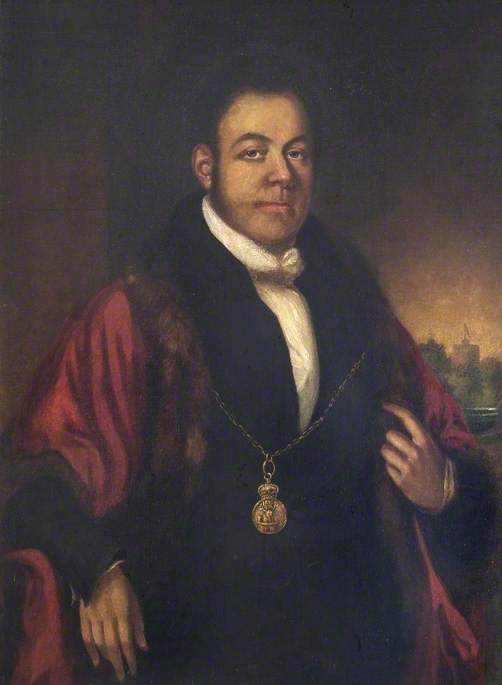
George Davis retired at the age of 62 and moved to Nightingale Place in Hatch Lane. The house later became the first home of the House of Mercy, only to be demolished in 1853 to make way for the new Convent building. His portrait hangs in the Mayor’s Parlour in Windsor Guildhall.
Elias Kupfermann
With additional material from Carol Dixon-Smith and Dr Brigitte Mitchell.
Notes
- fl – flourishing; not date of birth
 Windsor Local History Group