
Published in Windlesora 28 (2012)
©2012, WLHG
Clewer Museum, a celebration of the ancient village and parish of Clewer, came in to being as a result of the interest and enthusiasm of one man, the Reverend Denis Shaw, who was Rector of the parish of St Andrew, Clewer from 1972 to 1992. Before entering the ministry Denis had a varied career which included national service, acting in repertory, journalism and a period in India which coincided with the upheavals arising from Independence and its subsequent division. He was to bring his talents and experience to the service of his new parish. He took a keen interest in the history of the ancient parish church and the village of Clewer which had been mentioned in the Domesday Survey. His time in the parish coincided with the considerable expansion of Windsor westwards.

Many 18th and 19th century buildings had been demolished, including Clewer Park which was the former home of Sir Daniel Gooch, the original Clewer Rectory and Tithe Barn in Parsonage Lane, Clewer Court, the old Etonian Country Club, the Duke Edinburgh public house in Mill Lane, St Andrew’s Cottages and St Andrew’s Hospital.

Clewer in earlier times had had its own police station, fire station and post office, but in 1920 it ceased to be a separate Civil Parish and became part of the Borough of New Windsor. Local people had amassed both knowledge and memorabilia and Denis Shaw gradually acquired these, and when they could no longer be stored in the Rectory adapted the former sexton’s home, Church Lodge, to display them.
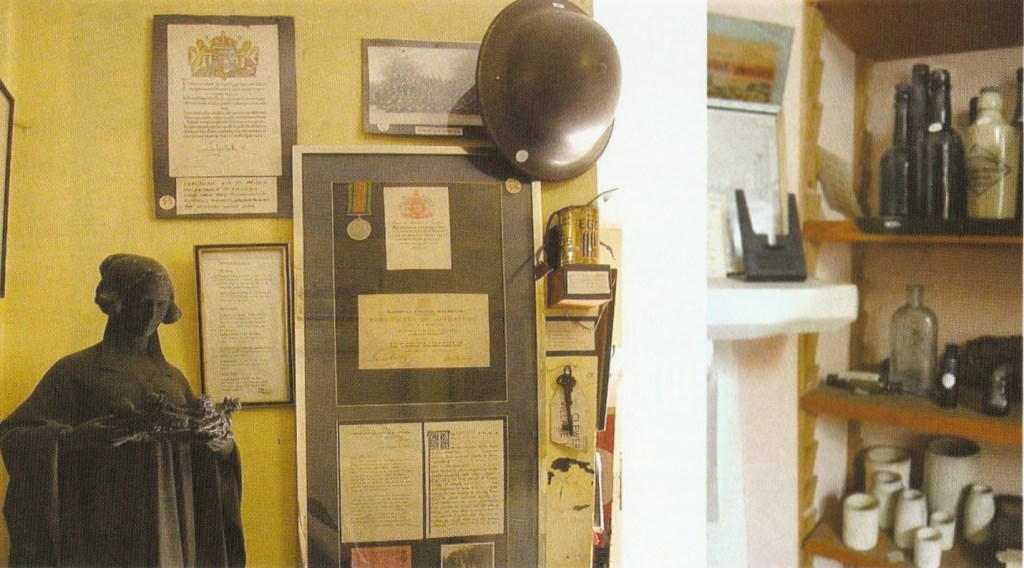
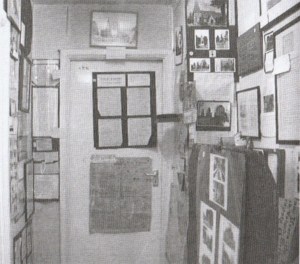
Two rooms and a corridor were used to display the Collection, which was officially opened as a Museum by HRH The Duchess of York on Wednesday, 21 June 1989. Denis Shaw prepared detailed catalogues for this visit but these rapidly became out of date as more and more artefacts were donated. As time went on the themed displays were almost lost due to pressure for space and revised catalogues were produced.
As a result of his research Denis Shaw produced a number of publications including Welcome to Clewer Parish Church, Windsor’s oldest building, which described the church and had a section on the interesting people buried in the Churchyard, and A Guided Walk around Clewer Church which included detailed descriptions of the church, its furniture and fittings including memorials on the walls and stone slabs set into the aisles. His lively monthly parish magazine The Clewer Messenger was also a valuable source of information for researchers in local history.
The new museum attracted much local interest. It was visited by parties of local school children and a schedule of Open Days was arranged. After Denis Shaw retired from the parish I took over as Honorary Curator and I arranged for a representative of Reading Museum to visit the museum. He remarked that he had enjoyed the opportunity to view such an interesting and varied collection. Clearly funds would be needed if the artefacts were to be appropriately displayed and I was advised to commence the necessary but time -consuming completion of accession cards which must be done if the Museum was to acquire registration. Beryl Hedges gave me a great deal of help with this project.
The degree of local interest in the Clewer Collection was shown in 2000. when I mounted an exhibition 1000 years of Clewer for three days in September at the Maidenhead Room in the Guildhall. There were twelve display boards and free-standing display cases containing artefacts from the Clewer Museum and the exhibition was then transferred to Windsor library. This exhibition was linked to an event in the Windsor Festival Programme which included a talk on the history of St Andrew’s Church, a visit to Clewer Museum and a Nature Trail in the Churchyard. Refreshments were served in Church Lodge and the Clewer Group hosted a walk round Clewer Village with a commentary on the interesting buildings.
Unfortunately it had become apparent in 2001 that as the Lodge urgently needed re-wiring and considerable refurbishment it would be necessary to remove all the museum artefacts. I discussed with Judith Hunter, Hon. Curator of the Royal Borough Museum Collection, the future of the Clewer Collection. Judith regarded the Collection as a valuable local history resource but with considerable regret acknowledged that due to her own storage problems she was unable to help. If Windsor could achieve its long-cherished dream of a town museum then one solution might be to create a Clewer Room. As a short-term solution, it was reluctantly decided that the Clewer Collection would be professionally packed and stored by Palmers of Windsor whilst its future was decided. Plans were drawn up to use the larger room in the Lodge for parish purposes and to provide in the smaller room new floor-to- ceiling cupboards and showcases to allow some of the artefacts to be displayed and the rest stored with the intention of having a rotating display. The showcases would be secure and dust proof thus enabling the Museum to be opened to the public with the minimum of supervision. It was suggested that St Andrew’s Church and Museum, together with the ancient village of Clewer could be developed as a considerable tourist attraction.
On 11 September 2002 the contents of the Clewer Museum, which numbered over 400 artefacts, were packed by Palmers. The smaller items filled 22 large commercial packing cases and 21 large items were packed separately. For a year they were stored by Palmers but, because of the high cost, they were then removed first to a parishioner’s garage and then to a damp unheated brick building, known as The Shed, at the back of St Andrew’s Church. There they languished for a number of years, and in due course, I voiced my fears of deterioration and possible destruction due to poor storage, to Caroline McCutcheon, the newly appointed Heritage Development Officer of the Royal Borough. Ambitious plans to create a Windsor town museum had again stalled and, since there was no hope of housing the Collection in Church Lodge, the future looked bleak.
However, the decision of the Royal Borough of Windsor & Maidenhead Council to make the Maidenhead Room at the Windsor Guildhall available for use as a town museum, thereby releasing space in the museum store, led to the re-opening of discussions with Caroline McCutcheon to consider accessioning the Clewer Collection into the museum collection. In the Summer of 2009 Caroline made it clear that all the Collection must be accessioned but if the incumbent wished to display any items in the Church, either permanently or in rotation this could be arranged on a ‘loan back‘ basis. The Reverend Louise Brown, vicar of the combined parishes of All Saints Dedworth and St Andrew’s Clewer agreed that on this basis the discussions could proceed. I met Caroline on 6 August 2009 at the Church’s Lychgate and took her to view the contents of the shed which she estimated at 29 cubic metres. At the time when the Clewer Collection was professionally packed by Palmers I arranged for a team of volunteers from St Andrew’s Church to be present. They used coloured stickers on the packing cases to identify the rooms where the contents had been displayed and kept a tally of the items as they were packed. This was necessary as the catalogues had been numbered in this way. The packers did not welcome this supervision but the volunteers tried to be accurate. There were difficulties and this was why it was necessary for me to be present each day in the two weeks commencing 22 February 2010 when the packages were re-opened and the contents sorted and eventually re-packed to help identify items which had lost their original numbers.
Caroline prepared for the Clewer Collection rescue with military precision and it was evident that a cost would be involved. A museum development grant was applied for and, in late November 2009 £1500 was secured to enable the necessary museum grade acid-free boxes and other equipment to be purchased. The Reverend Louise Brown had agreed that the process of unpacking, assessing, accessioning, photographing and measuring before re-packing should take place in Clewer Church. Initially volunteers were sought to carry out this work in the week beginning 18 January 2010. However due to snow and freezing temperatures in January the rescue had, with the agreement of the Reverend Louise, to be postponed until 22 February.
In the event seven volunteers who were members of Friends of the Windsor & Royal Borough Museum offered their services as well as some members of the congregation. Four members of staff also took part. A rota for each day was drawn up, which was divided into two sessions, numbers being limited to a maximum of seven people per session. Although the heating in the church would be on, everyone was advised to dress warmly with thermals or fleeces. Volunteers were asked to be sure to sign-in, including hours worked, on an attendance sheet as this record was required by the grant-awarding body.

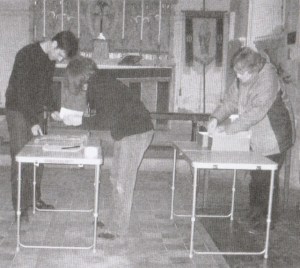
In the church individual pews were labeled for specific materials according to a list of some 16 categories ranging from ceramics, wood, metal, textiles to paintings, books, maps, photographs etc. The packing cases were moved gradually day-by-day from The Shed using a flatbed trolley. After the initial sorting of items to the relevant pews, each item was then measured, described, photographed and given a new Clewer Collection Rescue – CCR number before being re-packed. It took two weeks to complete this time- consuming work.

The Friends Newsletter No 62 Spring/Summer 2010 thanked the volunteers for their participation in this ‘fascinating work‘ and said the work of computerization was still continuing back at the store. The Reverend Louise Brown and Churchwarden Jack Trigwell were thanked for their co-operation in making the rescue possible. The Clewer Collection will soon be accessioned into the main Museum Collection and a number of Clewer items have been included in the new museum at the Guildhall.
As the Honorary Curator of the Collection I am saddened that the Clewer Museum, which had considerable local support, has ceased to exist as a separate entity. Its popularity was its ultimate undoing as; in the limited space available, meaningful displays were overwhelmed by donations. It was recognised that the way forward was to display the artefacts in rotating themed exhibitions.

We live in an age of mobility. In Windsor whilst some people have family roots in the area, many have not. One of the most popular exhibits in the Clewer Museum was a large scale 1901 Ordnance Survey map of the Windsor area. It was a constant source of interest to our visitors to relate the formerly rural area of Clewer to the modern streets where they now live. People benefit from a sense of belonging and pride of place. Museums can play a useful part in responding to this need.
 Windsor Local History Group