
Published in Windlesora 17 (1999)
© WLHG
“Mr Chariott’s House, Peascod Street, November 4th 1831”
“At a meeting of Friends of the Gospel belonging to High Street Chapel, met for the purpose of considering the propriety of purchasing a portion of land situated on the late Mr Voules estate on the south side of Peascod Street, with the intention of erecting a larger place of Worship thereon than our present Chapel which by the blessing of God had become too small for the Congregation.
Present – Revd A Redford, Mr Chariott, Mr Astle, Mr G Cooper, Mr J Hetherington, Mr Wm Hollis, Mr J Hatch, Mr J Ray and Mr G Weston
“It was unanimously agreed to instruct Mr T Adams, Builder, to purchase for us the Lots No 13 and 14 at the following rates if they cannot be obtained for less. To buy Lot 13 if he should be obliged to give as much as £250 and if necessary to give the same price for Lot 14 and one bidding over of £10 rather than lose it.
“In consequence of these instructions we learned after the public Sale which took place on November 5th that Mr Adams having been obliged rather than lose it to give £260 for Lot 13, was induced considering the valuable nature of the property to give £280 for Lot 14 making the whole purchase £540 being £30 beyond the instructions, but of which the friends approved.
Signed A Redford (Chair Man)”
And so our Church in William Street began. Of course, the beginnings of Congregationalism in Windsor date as far back as the Act of Uniformity passed in 1662. This Act compelled every clergyman “to receive episcopal ordination, to take the oath of canonical obedience, to abjure the Solemn League and Covenant, to renounce the lawlessness of taking up arms against the King and to declare his assent to everything contained in the Book of Common Prayer.” Many clergymen were forced to leave the Church, to the dismay of their congregations.
It is known that a Revd William Sheffield was minister from 1719 to 1726 and the Revd Benjamin Owen for two years. It seems that services then stopped until about 1777 when a soldier from the barracks preached in his quarters, a cottage known as “The Hole in the Wall” in Sun Passage on weekday evenings or early on Sunday mornings. The Regiment left and the soldier with it. A Mr John Searle followed a Mr Burgess who had obtained a licensed room and continued the services once a fortnight after the soldier left. By 1781 eight to ten people met in a room in Goswell Lane with the Revd William Ford. With the death of Revd Ford in 1783 Mr Burgess returned to preach in a rented loft in Bier Lane. The congregation increased and two cottages were turned into one and known as the Old Meeting. Various ministers preached there from the death of Mr Burgess until Lady Day 1804.
By this time the number of worshippers had increased so much that they wished to have a settled minister- one who would give the whole of his time to the work. Revd Alexander Redford was asked to preach and was so popular that he was invited to become the minister. He accepted and when the summer came he was ordained to the Ministry by Revd Rowland Hill. At the Ordination Service Revd Hill spoke of how, as a boy at Eton, he repeatedly “broke bounds” in order to worship at ‘The Hole in the Wall’. Later this place was called the cradle of Windsor Congregationalism. Two of the children of Revd Redford started a Sunday School and held it in a rented upstairs room opposite the Meeting House in Bier Lane.
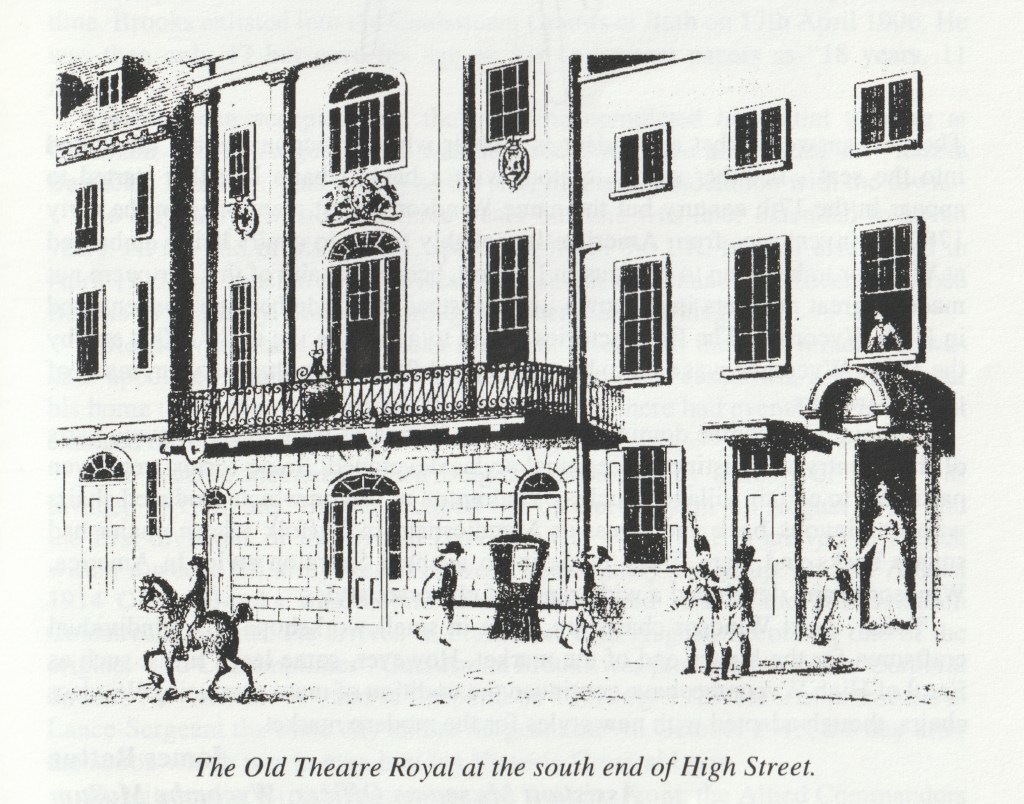
As years passed the Meeting House became (00 small for the now large congregation and the empty theatre in High Street was purchased for the sake of the site in 1807 for £600. The opening day collection raised £133. King George III heard about the church and its activities from his servants who attended the services and is quoted as having said of Mr Redford “The clergy are paid by the country to pray for me, but Mr Redford’s praying is without pay.” In 1811 a resolution was agreed to hold a meeting every Tuesday evening from nine o’clock to ten. The object of these meetings were twofold, not only to promote love and harmony but to raise a sum of money by small weekly subscriptions and to be applied to the following purposes:
“That whatever sum of money be collected from Midsummer Day 1811 to the time of the expiration of the lease of the theatre be paid at that time into the hands of the Minister and Deacons to help in defraying the expense of converting the same into a house for the worship of God.”
Each member contributed one penny a week which they brought or sent to the meeting. In 1913 at least 75 people were on the register including the names of Chariott, Hollis, Astle Hetherington, Ray and Redford. The building was changed when the lease expired in 1813 to accommodate as many worshipers as could be expected in a borough which was mainly an Established Church town, and it became known as the Chapel of Dissenters. The Sunday School prospered and teachers were supplied for services in Eton Wick, Winkfield and Chalvey. Soon the High Street church became too small for the congregations which assembled on Sundays and so the meeting at Mr Chariott’s house, which resolved to buy land in Peascod Street, took place.
Of course now the £540 had to be found to pay for the land as well as the cost of building. Nine men immediately agreed to give a total of £230, Joseph Chariott being the largest benefactor. There was a plan to sell part of the land to build houses, and it was Joseph Chariott who purchased a plot 20 feet by 100 feet. The freehold of the old chapel was sold to Mr George Cooper for £800, but the pulpit, benches, pews the fronts of both galleries and the doors were removed as they could be used in the new building. Mr Cooper had to promise not to use the site for public worship. The new building was designed by Mr Wilson from Newbury and is similar to one he had built in Ipswich.
The Committee took possession of the land in January 1832 when Mr Hollis dug a hole about five feet deep. He reported that it was a fine dry soil and some gravel appeared at that depth. The Chapel with its entrance on William Street was opened on 1st May 1833 when the collection was £137. The following day Dr Stoughton was ordained as co-pastor with Revd Alexander Redford. When people saw the enormous size of the building they thought it was a great mistake but they had failed to acknowledge the popularity of the preachers or the dedication
of its members . . .But that is another story.
Joan Seeborn
 Windsor Local History Group