
Royal Flying Corp
Published in Windlesora 30 (2014)
© WLHG
My father was born on 9th April 1900, and in September 1917 he applied to join the Royal Flying Corps, (RFC). In April 1982, when he was 82, I recorded his memories, he recalled:
My brother Archie, 2 years older, was an instrument technician in the Royal Naval Air Service (RNAS), and following his advice I applied for a Flying Officer Commission in the Royal Flying Corps at the age of 17.5 years – about September 1917. I was interviewed at Whitehall London and I was accepted. My Windsor County Boys School Education 10 to 14 years, and following experience with cars ‘Charabancs’ and machinery was very much in my favour.
If I had not been accepted, I would have been conscripted into the Royal Berkshire Regiment. If during my training as a pilot I had failed I would have been ‘Returned to Unit’, (RTU’d – a much dreaded term) in my case to the Royal Berks Regiment (RBR). Shortly after my acceptance I had to report to RBR at Reading where I was fitted out with ordinary foot soldier’s uniform.
After a few days drill I was sent to Hampstead where I was fitted with RFC uniform with a white band round the cap. A few weeks there with drill instruction my squad departed for Hastings. I passed the course, and then went to No 5 School Aeronautics Oxford where I was housed in Corpus Christie College, course 59 which I passed. At an interview, I opted for Single Fighter Pilot, a course that many failed to pass. There were 15 of us to be fitted out with flying officer Uniforms of the RAF in Oxford, as the RFC and RNAS joined in April to become the RAF. King George V reviewed our group in Hastings.
From Oxford I went to Uxbridge School of Gunnery where in a few weeks I became very efficient. This was mid October and the Germans were on the turn. Passing Uxbridge satisfactory I went to Ealing to await a vacancy in a squadron.
On Armistice Day we requisitioned a vehicle and ‘did the town’. We sat around for a few days and were informed that we were being ‘demobbed’ at once, as the Air Force would no longer be required. I packed my bags, disappointed and deflated and smarting at my treatment. I said goodbye to my pals and the RAF. We should have been given a chance to gain our ‘Wings’.
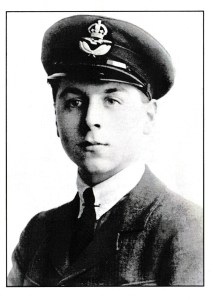
My father left photographs, exercise books and notes on the Beardmore 120hp, a six-cylinder water-cooled aero engine, with intricate drawings of the Beardmore Cam Mechanism, and instructions on how to repair a hole in a plane.
After the war, he returned home to Windsor disappointed and deflated but soon set himself up in business. He bought a military ambulance, turned it into a charabanc, (or Motor Coach) and called it Windsorian Coaches, after the name given to the old boys of his Windsor School, which eventually turned into Windsor Boys School. From small beginnings the coach company became a thriving enterprise, taking thousands of Windsorians on trips to the seaside or to London. They became the company of choice for the Royals, granting ‘By Appointment’, and becoming the first coach in history to carry the Royals on an outing, prior to the wedding in 1963 of Princess Alexandra of Kent to Mr. Angus Ogilvy.
 Windsor Local History Group