
The work of William Vertue at Windsor and Eton
Published in Windlesora 25 (2009)
© WLHG
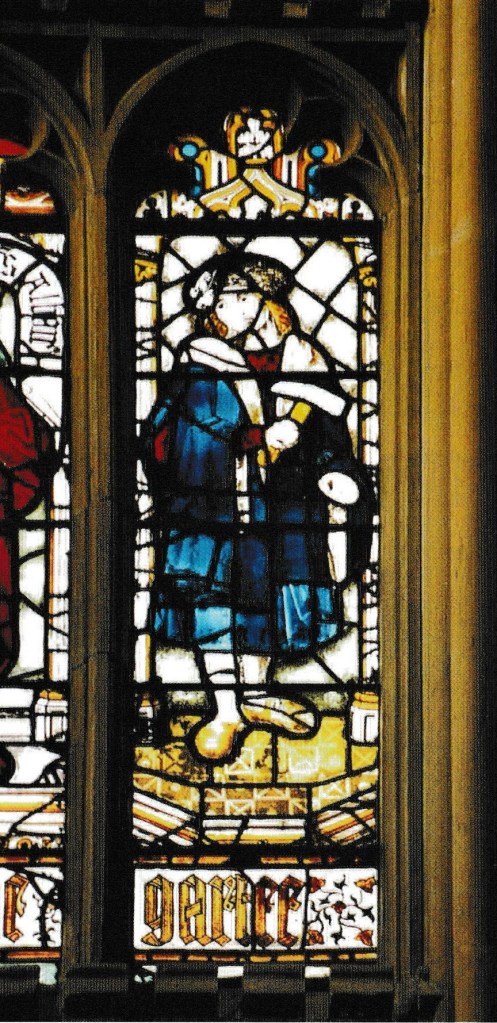
The West front of St George’s Chapel in Windsor is dominated by the great perpendicular Gothic west window, built in 1509, which depicts in stained glass a mixture of Kings, Popes and Saints. However, one person shown in this window was not of such venerable birth: this was William Vertue (f1. 1501-1527 ), the King’s Master Mason, the son of Adam Vertue, an ordinary working London mason. The window portrays the Master Mason in contemporary medieval dress, standing holding a hammer in one hand and a maul in the other. A maul was a wooden hammer which was used to set stones into position into a bed of mortar. The figure occupies the northernmost light at the bottom of the window, but its original position is unknown.
William Vertue was one of the greatest English architects, who excelled in the technique of fan vaulting. Fan vaulting is a form of vaulting used in the Gothic style, in which the ribs are all of the same curve and spaced equidistantly, in a manner resembling a fan. The initiation and growth of this design element can be regarded totally as an English phenomenon and inspiriation. The earliest example of fan vaulting in its simplest form dates from about 1351, and may be seen in the south walk of the Great Cloister of Gloucester Cathedral, which was built by Thomas of Cambridge. The technique of fan vaulting was refined over the next two centuries and reached its peak in the intricate work of William Vertue and his brother Robert. Examples of this technique can be found at Bath Abbey, Kings College Cambridge and at Windsor, all having direct and indirect connections with the Vertue Brothers.
William Vertue’s career as a mason was influenced by his older brother Robert who had worked on the nave of Westminster Abbey from 1475-1490, together with another London mason, Henry Redman. The construction of Henry VII’s Chapel at Westminster in 1506 was taken over by William Vertue after the death of his brother in the same year. The partnership between the Vertue brothers appears to have started somewhat earlier in 1501, with the constuction of the roof of the chancel and nave at Bath Abbey.
William Vertue himself became the King’s Master Mason in 1510 and during the same year he worked at the Tower of London on the rebuilding of the small church of St Peter ad Vincula. He was then involved in works at Corpus Christi College, Oxford (1512-18), possibly at Thornbury Castle (1511), and was responsible for the fan-vaulted cloister-chapel of St Stephen in the Palace of Westminister (1526). On the 12 September 1519 he received a new appointment as King’s Master Mason jointly with Henry Redman.
Earlier in 1516 William Vertue and Henry Redman, together with carpenter Humphrey Coke, were engaged in a joint venture to redesign a portion of Eton College’s West Cloister range (Lupton’s Range) and Gatehouse (Lupton’s Tower). This work replaced an earlier 15th century cloister which was partially removed to allow the insertion of a grand Tudor entrance tower together with the Election Hall. William Vertue and Henry Redman were each paid a fee of £13.0s 4d for devising the ‘platte’ (an architect’s sketch plan) of the west side of the court of the College, which included Lupton’s Tower. Humphrey Coke, the carpenter was also paid a fee of 6s 8d for his work. In 1520 Vertue was paid a further 10s for supervising the works at Eton.
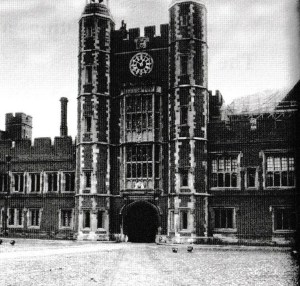
Lupton’s Tower (above) is named after Roger Lupton who was Provost of Eton College from 1503 -1535. In 1504 he was made a Canon of St George’s, Windsor and died in 1540. The tower is constructed with bricks and Kentish ragstone. The foundation stone for Lupton’s Tower was laid in 1517 and is recorded in the building accounts as follows:
‘..the second day off march the yere of our lorde a thousand five hundred and seventyne the first stone was layd yn the foundation of the west parte of the college whereon where ys byldyed Mr Provest loggyn the gate and the gate and lyberary.’
It is recorded in the inside cover of the earliest building accounts book that William Vertue came to Eton College for the first time on the 26 June 1517. By 1519 the audit books report that stone had been purchased for the uppermost parts of the tower. By 1520 finishing touches were being made by the glazier and painter, including painting the ‘jambs and of the great gate’ and painting figures in the ninches of the tower. The work on the tower and the west cloisters appears to have been completed by 1522.
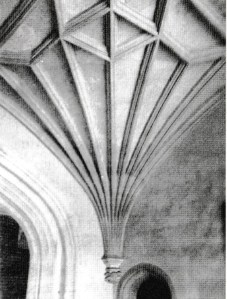
Vertue is also supposed to have been responsible for construction of Lupton’s Chauntry Chapel in Eton College Chapel. This was a small chapel built between two of the buttresses on the north side of the main College Chapel. The building of the Chauntry chapel was paid for by Roger Lupton, and it would appear that it was constructed during his lifetime rather than after his death. A College Audit book of 1514-15 mentions ‘a spout for the new chapel’ (spouts are normally associated with roofs) which would suggest that the chapel was nearing completion by this date and fits in with Vertue’s known time at Eton. The Chauntry Chapel has similar fan vaulting in other buildings associated with Vertue. It is similar to the vaulting found in Lupton’s Tower, as well as other known projects positively attributed to Vertue.
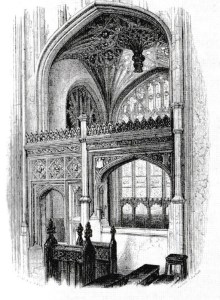
William Vertue’s greatest work is regarded as the fan vaulting over the Quire of St George’s Chapel at Windsor The foundations of the nave and the Quire were constructed in 1477. The work was carried out by the King’s Master Mason Henry Janyns and carpenter John Squyer. By 1501 the walls, aisles and transepts of the chapel were nearing completion. In June 1505 an agreement was signed between the Lord Steward and The Lord Chamberlain, togethr with all the Lords and Knights of the Garter, and William Vertue and London mason John Hylmer, to complete the building of St George’s Chapel: in particular the main vault of eight bays of the Quire for the sum of £700.
“… that the said John Hylmer and William Vertue at their owne proper costs and charges shall vawlte or doo to be vawlted with free stone the Roof of the Quire of the College Roiall of our Lady and Sainte George within the Castell of Wyndesore
‘Freestone’ was normally a soft fine-grained stone which was easy to cut, such as an oolithic limestone or sandstone. The vault keys were distinct bosses with the ‘King’s armes crowned with Lyons’ and also ‘Anteloppes, Greyhounds, and Dragons’ together with the arms of the King, and other bosses were also decorated with ‘roses and portecoleys’ (portcullis).
Vertue and Hylmer also carried out work to the external part of the building and were required to erect ‘Archebocens, Crestsys, Corses and the Kings Bestes stondyng on theym’. The term ‘Archebocens’ refers to the flying buttresses which were erected to support the internal vaulting and are a very distinctive feature of the surviving architecture of St George’s Chapel. Corses have now been identified as pinnacles (but wide enough) to place statues of the King’s Beasts on.
The beasts themselves were erected to fulfil both functional and decorative needs. Together with the ‘corses’ they were used to support the flying buttresses and also to ‘bere the fanes [or vanes] on the outsides of the Quere’. There are seventy-six stone ‘Royal Beasts’ on top of the roof of St George’s Chapel. As in the original contract for the work on the Chapel they hold wind vanes and coats of arms, and depict fourteen different heraldic animals associated with the Plantagenet and Tudor Royal families which were also found on the ceiling bosses in the Quire.
The following heraldic animals and their associated families are present:
- The Crowned Golden Lion of England.
- The Red Dragon of Wales.
- The Silver Falcon of York.
- The Black Bull of Clare (nce).
- The Beaufort Yale of Kendal.
- The Mortimer White Lion of March.
- The White Greyhound of Richmond.
- The Bohun White Swan of Hereford.
- The White Hart of Richard II.
- The Bohun Collared Silver Antelope.
- The Black Dragon of Ulster.
- The White Unicorn of Edward III.
- The Golden Hind of Kent.
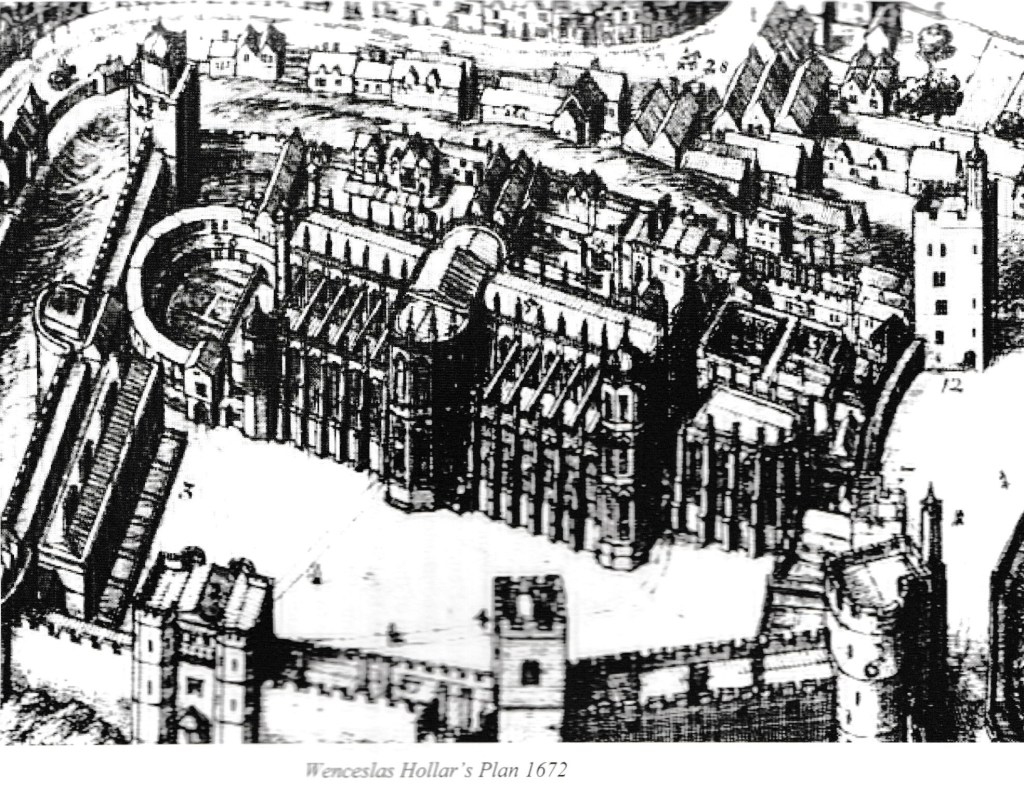
Each of these animals bears the heraldic crest of the family concerned as well as the aforementioned wind vanes. The earliest view of Windsor Castle to show the work carried out by William Vertue is by the Dutch engraver Wenceslas Hollar, and is a three-dimensional aerial plan which dates to 1672. It shows the flying buttresses, the pinnacles containing the Kings Beasts and the Lady Chapel.
The works to the Quire both internally and externally were completed between 1506 and 1511, and paid for in instalments ranging from £80 to £100. These were paid over two years on feast days ranging from Christmas and Easter, to the feast days of St John the Baptist, and St Michael the Archangel. The work was financed by subscription from members of the Order of the Garter, ranging from twenty to thirty pounds each. King Henry VII personally contributed £100 in his own name and that of Prince Henry. A further £100 was contributed by the Bishop of Winchester. The Duke of Buckingham gave £40 and the Earl of Arundel donated 50 marks. The contract allowed for the work to be completed by 1508, but was not finished until 1511
After the completion of the Quire roof, in December 151 1, the Dean and Chapter of St George’s contracted William Vertue to carry out further works to the Lady Chapel (now the Albert Memorial Chapel):
..To ‘vaute or doe to be vauted with ffreestone the roof of our Ladie Chapel … according to a platt devysed and drawen that propos.”
The Lady Chapel was originally intended to be Henry VII’s place of burial, but this was abandoned in preference for Westminster Abbey, which was renamed the Henry VII Chapel. Henry VII was interred there in 1509. Vertue was also contracted to carry out work to the parapets, and to the vault of the vestibule of the Windsor Lady Chapel. Only the last two elements were ever completed. By 1509 all but the crossing of the Chapel had been vaulted. The construction of an open lantern was intended, but this plan was later abandoned due to lack of funding from the Knights of the Garter. In 1528, a year after Vertue’s death, the crossing was ceiled with the existing fan vault. Vertue must have been responsible for the design but was unable to see the project completed, and the work was probably overseen by his colleague Henry Redman.
William Vertue died in 1527, and in his will he describes himself as ‘William Vertewe Squier marster mason unto the Kinges grace’. He left money and property in Kingston-upon-Thames to his family. The will also shows that he wanted to be buried with his pre-deceased wife in Kingston Parish Church. Sadly, today, there is no monument to him in the church, but his legacy can be found in the sheer beauty and quality of his work in the buildings he had worked on throughout his lifetime.
Elias Kupfermann
William Vertue Bibliography
Bond, M, St George’s Chapel, Windsor, The Quincentenary Book of Photographs (1975).
Colvin, HM, The History of the King’s Works (1975) Volume III, Part 1 1485 -1660.
Harvey, JH, English Medieval Architects, Biographical Dictionary (1984).
Maxwell Lyte, HC, History of Eton College 1440-1875 (1875).
Richmond & Scarft, St George’s Chapel , Windsor in the Late Middle Ages (1981).
Tighe & Davis, Annals of Windsor (1858).
Victoria County History of Berkshire, Volume I11.
Willis & Clark, The Architectural History of the University of Cambridge and of the Colleges of Cambridge and Eton (1886).
Wilson C, Robert Vertue/William Vertue, Oxford
Dictionary of National Biography (2004).
 Windsor Local History Group