
Published in Windlesora 30 (2014)
© WLHG
‘Windsor in the Great War‘
By Derek Hunt and Dr Brigitte Mitchell

As the title indicates, this book hinges on the experiences of the people of Windsor during the First World War; filled with sorrow and joy, and covers many topics that are still with us today — refugees from war and charity fund-raising for our military to name but two. We find out how everyone was affected by the war, from the Royal Household to the town’s families and shopkeepers.
Windsor in the Great War is an extraordinary, well-paced, and wide-ranging social history, whose sources and resources are well-selected and deployed. There is an amazing collection of letters, photographs, drawings, and advertisements to illustrate the chapters, and with tales of heroic deeds and heartbreaking loss, together with the inevitable squaddie humour, the result is a mix of voices that brings history alive.
Windsorians should read this and be proud of their town. Anyone with an interest in the soldier’s experience, or in how the war impacted on people’s lives should read this — whether they are Windsorians or not.
AS Heaton
‘The War That Ended The Peace: How Europe Abandoned Peace for the First World War‘
By Margaret MacMillan

WINNER of the International Affairs Book of the Year at the Political Book Awards 2014
Anyone who thought Britain’s entry into World War One was due to the violation of Belgian neutrality, will be surprised at reading Professor MacMillan’s fascinating examination of the causes which led to “the war to end all wars”.
Using an impressive array of sources (18 page bibliography) she examines the background of revenge, military and political ambition, fear and patriotism which prompted the involvement of all the combatants. A task so complicated that the reader might well balk at understanding the intricacies of diplomacy and politics, promises and assumptions, and shifting alliances of the European Powers.
The assassination of Archduke Ferdinand and his wife in Sarajevo was the spark leading to conflagration. The outcome of which was devastation which none could have predicted. MacMillan teases out the various attitudes of Europe, United States, Japan, and the Ottoman Empire with thumbnail sketches of the major personalities including the Sovereign Cousins of Britain, Germany, and Russia.
This compelling narrative, illustrated with photographs, maps and contemporary cartoons and posters, makes for an excellent read.
Sonia Sayed
‘Testament of Youth‘
by Vera Brittain

This is the first instalment of Vera Brittain’s biography, covering the years 1900 – 1925. Her life was one of struggle and loss. From her fight to gain a university education, through her training as a VAD, nursing the wounded of both sides in a war that took her fiancé, brother and numerous friends, to the re-building of her life and her world after the war; Vera Brittain was and still is an inspiration.
So many books are written about war from the fighting man’s point of view, or by the men’s power, if nothing else Testament of Youth shows the war from a very different perspective. It is a classic in the impact of the war on women and in its description of the war from a woman who witnessed it. We also get a very personal and revealing look at the lives of women at the start of the twentieth century, and in a society barely tolerant of educated women, Vera’s struggle to forge a post-war career.
If Testament of Youth isn’t compulsory reading in the school curriculum, it should be.
Carole Dixon-Smith
’24 Hours At Waterloo: 18th June 1815′
By Richard Kershaw
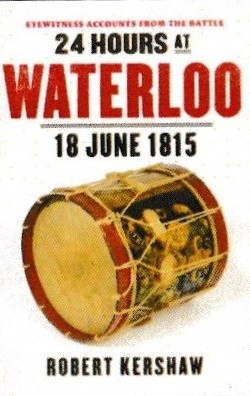
With just eight months until the 200th anniversary of the Battle of Waterloo, Colonel Richard Kershaw is one of the first into the field with his detailed, blow-by-blow account of the day, with a continuous marginal timeline, designed to get the course of the battle clear.
Using letters and memoirs to give detail and colour to the events of the day, as seen and experienced by those who were there, you can almost hear the bugle calls, the clash of sabres, and the crack of musket fire. From infantry squares to cavalry charges, this is one of the most compelling and vivid accounts I have read, and I couldn’t put it down.
Carole Dixon-Smith
‘Bringing History Alive: Through Local People and Places’
by Lynne Dixon and Alison Hales
A much-needed book that shows how history can be taught with the experiences of children at its centre, making connections between the child, the locality and community, the national and global past and concepts of time, showing teachers how to plan, select resources and strategies and reflect on ideas and case studies.
‘Tracing Your Ancestors Through Family Photographs’
by Jayne Shrimpton

A complete guide for family and local historians photographs, and essential reading and reference for any genealogical or local history research. Almost every family and local historian works with photographs, but often the information they contain is not fully understood. The author shows how images can give a direct insight into the past and into the lives of the individuals portrayed in them.
‘Making Sense of Latin Documents for Local and Family Historians’
by Brooke Westcott

This is not a guide to old handwriting or learning Latin, you need to be reasonably competent in both of these to understand Latin documents. The book aims to act as a crib; to set out and translate the basic form of the most useful and most common Latin documents, enabling the genealogist to get the most out of them. Examples of documents covered in this book include Parish Registers, Wills, Inventories, Final Decrees, Excommunication, Writs, Land Deeds, and more.
‘Tracing Your Ancestors’ Parish Records – A Guide for Family and Local Historians’
by Stuart A. Raymond
Essential for family and local historians, this explores and explains the fascinating and varied historical and personal information in Parish Records. In the first thorough survey of these resources to be published in over thirty years, this easy-to-follow text, describes where records can be found and how they can be used, emphasising and explaining their original purpose, and their relevance for researchers today.
 Windsor Local History Group