
Published in Windlesora 32 (2010)
© WLHG
On 1 July 1916, a fine summer Saturday morning, British troops left their trenches at 7.30 am and walked into no-man’s land. Allied artillery had bombarded the German trenches for a week before the attack started and it was confidently predicted that nothing could survive such fire-power. The advancing troops were instructed to walk, not run, with a one-minute interval between each battalion, and to capture the shattered enemy positions.
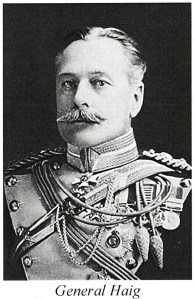
In many areas however, the Germans were ready for the attack having taken shelter in their deep underground bunkers at the start of the bombardment, emerging unscathed to set up their machine-gun positions. Wave after wave of British soldiers advanced to be mowed down by the guns they had been told were destroyed. Many did not manage to cross their own wire. It was to prove a tragic miscalculation. There were 57,470 British casualties on the first day, but Sir Douglas Haig, Commander-in-Chief of the British Expeditionary Force, was determined to continue the offensive.
With both sides bringing up reinforcements, it soon turned into a war of attrition and the Somme offensive dragged on until mid-November by which time British and Dominion casualties were 420,000 and 205,000 French, for the gain of just over eight miles along the whole front. German losses are estimated to be about half a million. The Windsor, Eton and Slough Express, in its editorial of 8 July commented:
The general offensive against the Germans appears to have commenced in earnest, and all the world is looking on at the terrible struggle with breathless interest. Following the blows on the Russian and Austrian Fronts, the British and French troops leapt from their trenches on Saturday morning, after a week of terrific bornbardmenT of the enemy lines, and they have now advanced some miles, over a twenty mile front, with gratifying results…
In truth, the results of the first few days were hardly ‘gratifying’. The casualties for the first day alone were the worst ever suffered in a single day by the British Army, but reporting restrictions were in force and reports from the front were censored. On 15 July the Windsor Express advised that ‘the advance of our Army from the line so long Held has given further evidence that the men of our New Armies are splendid fighters.’ This was a reference to the newly raised ‘Kitchener Battalions’ which bore much of the fighting. There were weekly Rolls of Honour published, but rarely sufficient details of where the fighting took place. It is possible however, to piece together information on Somme casualties. The ‘Killed in Action’ list of 15 July for example, contained two casualties of the opening day of the Somme offensive:
Curtis, Thomas (Old Windsor), Pte, Royal Berks Regiment; killed by a bullet from a German machine-gun 1 July.
Traill, Kenneth R (younger son of Dr and Mrs Traill, Sunningdale), Lieutenant of the Royal Berks Regiment; killed on 1 July, aged 22 years.
Both men served with the 6th Battalion RBR and the Batktalion War Diaries confirm that they took part in the opening attack on tlhe Somme. Curtis is commemorated on the Thiepval Memorial which contains the names of over 73,000 men who died on the Somme with out known graves; Lieutenant Traill is buried in the Military Cemetery at Carnoy where he took part in the first wave of the attack from trenches. A diary entry for 1 July timed at 7.50 am (20 minutes after the attack began) noted that he and other officers had been killed. A report in the Windsor Express noted that Pte Curtis was killed in action at 3.00 pm and that ‘he took up the duties of officer s servant to Lieutenant TrailL, who also gave his life for his country on the same date.‘
Another Windsor casualty of that first day was Pte Frederick Ash, also 6th RBR, a married man with a wife and six children, who lived in Clewer New Town, who re-joined the Army on the outbreak of war. He is remembered on both the Thiepval Memorial, Windsor War Memorials.

Pte Frederick Cox, 6th RBR, also died on 1 July. He was a sniper who had been wounded slightly as he was leaving a sniping post three days before the start of the Somme offensive. He returned to his battalion just in time to take part in the battle. He is remembered on both the Thiepval and Clewer War Memorials. On 15 July, it was reported that Pte George Habgood aged 21, had died of wounds on 5 July. He was one of five sons of Mrs Habgood, 86 Bexley Street in Windsor, all of whom served during the war. A member of 10th (Service) Battalion West York Regiment, he took part in the capture of Fricourt on 2 July.
The weekly casualty lists became longer, and on 5 August it contained 90 names, of which 29 men were either killed in action, died of wounds or missing believed killed; though not all had Windsor addresses. This compares with 11 names on the casualty list three weeks earlier. Among the dead was Pte Fred Ayres, the third Windsor Express employee to be killed in action. After leaving school he joined the newspaper as an apprentice and served in the local 1/4th (Territorial) Battalion RBR unit. He enlisted at the outbreak of war. After training in England, 1/4th RBR went to France and landed at Boulogne at the end of March 1915. It was attached to the 145th Brigade, part of the 48th South Midland Division (Territorial Force), which was in reserve at the commencement of the Somme offensive.

On 14 July a fleet of buses carried the whole of 145th Brigade to the La-Boiselle sector of the Somme to be ready for an attack planned for 23 July. Their objective was the German trenches just south-west of Pozieres, but the attack was met with an intense bombardment. Several companies of 1/4th RBR charged the trenches despite this, and fierce hand-to-hand fighting followed. Reinforcements from other battalions helped to clear the captured enemy positions, while the Australians seized the town of Pozieres. The German shelling continued in the afternoon of 23 July causing many British casualties. The War Diaries for 1/4th RBR for 23 July noted that:
Our attack began at 4.00 am. Their shell fire was incessant from dawn to dusk. The captured trenches, our right and all communication trenches being continually under fire… The Battalion did well in the attack and later when holding the captured trenches… Casualties 23 killed, 103 wounded, including shell shock.
That afternoon, during the heavy enemy shelling, Pte Fred Ayres was killed receiving a direct hit from an enemy shell while his battalion was holding a captured trench. Pte Ayres is remembered on the Thiepval and Windsor War Memorials. Captain C A L Lewis, a company commander wrote to Ayres’ parents to express his regret:
On the 23rd [July] we successfully attacked some German trenches, and later in the day, when we were holding the captured trenches, your son was killed instantaneously by a shell. Your son had been most brave, and it will be some consolation to you to know that he gave his life bravely, after doing his share in an important and successful advance.
His many friends in the company will miss him, and so shall I. He was one of those who had been with me some time, and I have always had special affection for the men of my old Windsor Company.
Fred Ayres’ Army records, like 60 per cent of soldiers’ records, were destroyed during the Blitz. His Medal Record gives his rank as L/Cpl, although his death notice in the Windsor Express in August quoted his rank as private. A member of Ayres’ family said that when he was promoted he was put in charge of rations and discovered the way they were distributed was so unfair he refused to be part of it and returned his stripes.
On 9 September, the weekly Roll of Honour recorded the death of Cpl Richard Wilson, 1/4th RBR, of 17 Victor Road, Windsor, killed in action on 14 August during an unsuccessful attack on enemy trenches near Thiepval. (Captain C A L Lewis, company commander 1/4th RBR, was wounded in the thigh in the same attack.) Cpl Wilson, an old National School boy and former member of the Church Lads’ Brigade, had been due to come home on leave shortly to get married. He is remembered on the Thiepval and Windsor War Memorials.
In June, an Army Order was issued prohibiting letters home that gave away too much information on the conditions at the front. This was designed to stop explicit letters being published in newspapers (particularly on the eve of the Somme Offensive), although a few letters reached the newspapers. On 26 August the Windsor Express published a letter from the front, under the heading ‘Helping in the Great Advance. Windsor Man’s thrilling experience.’ The letter was from Pte A V Pullinger to his parents at 37 Albany Road, Windsor. In it he wrote:
… Once again we are out of the line on a rest more than earned, for we have been in the hottest part of the ‘front’ helping in the advance… It seems wonderful to me that we had so few casualties, for 5.9 shells seemed to rain on the captured line, bursting at every yard. It took men with nerve to stand it, which the higher commands fully recognised… Before advancing we had two or three days to look about the position we were holding. It was all enemy works, and in their hands not a fortnight previous. Looking around one was astounded to think that we had driven the Hun from it; once deep, well-dug trenches, dugouts splendidly excavated and timbered with three or more entrances, some twenty to thirty feet below ground level, and what were once immense redoubts of concrete and stone… | would certainly write you a lot about this new experience, but it has all to be censored so I must stop.
Although he was not permitted to disclose his location, he mentioned working with Australian troops and it is likely that this occurred in the Pozieres area the previous month. Pte Pullinger was fortunate enough to survive the war.
Sgt Oliver Brooks VC, 3rd Battalion Coldstream Guards, was seriously wounded at Ginchy on 15 September, during the new British offensive to break the deadlock on the Somme. After spending three months in hospital in England he rejoined his regiment, but never returned to France. He lived in Windsor after the war and worked as commissionaire at the White Hart Hotel. Many local men were listed as wounded in action ‘during the recent fighting in France.’
On 21 October, towards the end of the Somme offensive, the Windsor I:xpress reported L/Cpl Luke Bowley, 3rd Battalion Coldstream Guards, aged 22 years, from 18 Church Terrace, Dedworth, killed in action near Ginchy on 15 September. His name is recorded on the Thiepval and Clewer War Memorials.

Derek Hunt and Dr Brigitte Mitchell
Sources
Windsor in the Great War by Derek Hunt and Dr Brigitte Mitchell, 2014.
Windsor, Eton & Slough Express.
 Windsor Local History Group