
Published in Windlesora 04 (1985)
© WLHG

Among the nineteenth century daybooks and registers of the Eton Porny School and its predecessors, the 1863 Eton St John’s National Schools and the 1812 Eton Charity Schools, is a manuscript book entitled on the inside of its cover “John Laming’s Book Jan. 26 1807” (1). It is a series of examples of arithmetic, laboriously written out presumably by John Laming; as no one of that name appears in any of the parish registers around that period he is unlikely to have been a pupil at the earliest town school – the Sunday School founded in 1790 – and so one cannot even guess at who he was or how his book has survived or how it came to be where it is. He must have been a boy, or young man, of some mathematical ability who perhaps wanted to demonstrate the sort of work of which he was capable – the type of sum with which a junior clerk in a mercantile firm might have been expected to cope.
The book is made up of twenty-three leaves of good quality paper, 153″ wide overall and 123″ high, sewn together in the centre and with the cover oversewn down the back; this cover has been marbled, perhaps by the author since it is a re-used sheet of an auction catalogue; various lots of casks of brandy, rum and Geneva (gin) are listed, the print being clearly visible under the blue and black marbling.
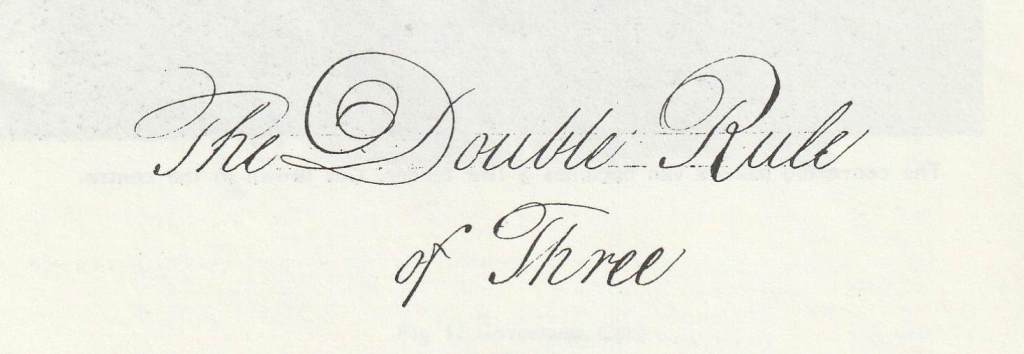
The writing, in ink on or between ruled pencil lines, is italic in style and recognisably the same as that taught to many of us in the nineteen-thirties. Each section of the book starts out bravely with a large scale heading complete with splendid flourishes (Fig. 1.), followed by an explanation of the type of sum by means of questions and answers; various examples of increasing difficulty are then set out, with poor John’s hand getting visibly wearier, the lines sloping and the letters less exact. It clearly took quite a time to write the whole thing, and his ink was of better quality some days than others (2).
The mathematical concepts in the types of sums involved cannot, in the nature of things, be different from those of today, but the names for them have altered. Reduction as a general term for multiplication and division is not heard nowadays, nor, 1 think, would many people recognise in ‘practice‘ the calculation of a total arrived at by multiplying, say, the price of one unit of goods by a number of those units. There were also the single and double rules of three, direct, inverse and conjoined proportion, simple and compound interest, rebate, discount and brokerage.
Laming’s book shows only the major part of the working of each sum, minor calculations being presumably done either in the head or in rough; even so, some of them cover most of a page.

Well might children wail, as they did from at least 1570 and into not-so-very-ancient living memory:
Multiplication is vexation,
Division is as bad;
The rule of three perplexes me
And practice drives me mad (3).
Laming’s opening page runs:
Q. What is reduction?
A. Reduction is the Bringing or reducing Numbers of one Denomination into
other Numbers of another Denomination but of the same Value.
Q. How are Denominations of any kind reduced from one to another?
A. By Multiplication and Division.
Q. When is Multiplication to be used?
When great Names are to be brought into small; as Pounds into Shilings
(sic) or Days into Hours and this is called Reduction Decending (sic)
And so on.
The early examples are simple enough; “In £7.14.64 how many farthings?” is one of the first, but even that involved a certain standard of knowledge and competence. A striking thing is the number of units of currency involved which are no longer used in the late twentieth century – farthings (sometimes called quarters or fourths of a penny), halfpence, sixpences, shillings and half-crowns are not long gone, but twopenny pieces, groats and crowns have not been in common use for a long time. Groats were struck from 1357 to 1662 and again between 1836 and 1856; perhaps some of these earlier silver fourpenny pieces were still in circulation in 1807, or perhaps just the name was still in use. The twopence may have been the small silver half-groat still to be found in Maundy money, but more probably was the huge copper ‘cartwheel‘ minted in 1797 and so heavy that it was totally impracticable (4); its companion penny (Fig 3) and halfpenny did, however, continue in use.

In one sum a noble is mentioned, most surprisingly as it was long out of use, having been a mediaeval coin of a value of half a mark, or 6s. 8d.; possibly it was still in use elsewhere. The guinea appears, a gold coin worth, by this time, twenty-one shillings. Though none were minted after 1813, the unit went on in use until decimalisation, latterly principally in pricing high-class clothes, works of art, professional fees and horses – curious stable companions. The only foreign coin that Laming mentions is the moidore, which, though Portuguese, was in the eighteenth century accepted in this country as currency and worth 27s; a shortage of silver bullion for minting coins led to such convenient arrangements, the Spanish dollar being another example that was in widespread use though in that case sometimes over struck with George III’s head, like a hallmark.
Units of currency were simple compared with units of measurement. Practically every type of commodity had its own; anyone who was at school before the Second World War will remember the tables of different scales printed on the back covers of exercise books, particularly those with squared paper for arithmetic. (My own favourite oddity was the difference in weight between a load of old hay and a load of new hay).
Some of the units used in Laming’s examples are:
LAND 40 Perches = 1 Rood
4 Roods = 1 Acre
SUGAR 16 Ounces = 1 Pound (and similar goods)
28 Pounds = 1 Quarter
4 Quarters = 1 Hundredweight (cwt)
The ton of 20 cwt is not mentioned, though in use at the time.
BEER 4 Quarts = 1 Gallon
36 Gallons = 1 Barrel (5)
13 Barrels = 1 Hogshead
WINE (canary) 8 Pints = 1 Gallon
126 wine gallons = 1. Pipe
(In Imperial Measure 105 Gallons = 1 Pipe)
TOBACCO Hogshead weighing 73 cwt
CLOTH 4 Nails = 1 Quarter
4 Quarters = 1 Yard
SILK (from Cyprus (sic) and Smyrna (now Izmar))
13 Common Pounds = 1 Great Pound
LEAD as sugar etc, plus the ancient measure of the Fother, reckoned as 19% cwt, or one cartload.
CORN was reckoned in Bushels, originally a measure of volume rather than weight;
2 Gallons = 1 Peck
4 Pecks = 1 Bushel
8 Bushels = 1 Quarter
(Coal used in the same units and then went on to the chaldron of 36 bushels).
One sum is additionally interesting in that the price of wheat and therefore of bread during the Napoleonic Wars, raging in Laming’s time, was of crucial importance, especially to the poor; it runs:
“If when the Price of a Bushel of Wheat is 6s 3d the Penny Loaf will weigh 9 oz. what must the Penny Loaf weigh when Wheat is at 4s 6d per Bushel.“
The answer given is 120z 10 dwts (pennyweights). John was either muddled or showing off in using this last unit, as pennyweights were a goldsmith’s measure (24 grains = 1 dwt, 20 dwt = | ounce) and would never have been used for weighing bread; he should have written 12% oz. And they are troy measure, not avoirdupois.
Windsor market was one of the test places in the kingdom where the price of best wheat was taken as the standard for setting bread prices; in 1795, for instance, eight bushels, or one quarter (of a ton) cost £4.11.8%, in 1801 £7.4.6; in 1815 it was back to £4.5.6 (6). The huge variation in price was due to how good or bad the harvest was, so that years of scarcity were literally lean ones for the poor. Laming’s sum makes the price of a bushel £2.10.0. or £1.16.0.,, so it must be possibly an academic exercise only unless some remarkably low quality grain was assumed.
One fascinating small unit of linear measurement mentioned is the barleycorn. Here it is taken to be one-third of an inch long, though sometimes, apparently, it was reckoned as a quarter of an inch – what an opportunity for confusion, especially as its sub-division was the poppy-seed which might be rated at either four or five to the barleycorn. John Laming’s charming example of reckoning with this unit was to calculate how many would be needed to girdle the earth, based on 69 degrees of 69% miles each, i.e. at the equator. The answer is 4,799,801,600.
Calculations became much worse when foreign trade was involved, since not only had currency equivalents to be coped with but the units of measurement differed from country to country even when called by the same name. This applied especially to the pound weight. A mind-boggling example of this appears in the Double Rule of Three: “If 25lb at London (7) be 22lb at Nuremburgh (sic); 88lb Nuremburgh 92lb at Hamburgh; 46lb at Hamburgh 491b at Lions (Lyon); how many lb at London are equal to 98lb at Lions?“. How many indeed. (The answer is 100 according to Laming).
Any goods that had to cross several frontiers – and in Laming’s time both Germany and Italy, for example, were composed of a multitude of states both large and small – must have given rise to appalling complexities of calculation. It was to try to bring order to at least part of Europe that the metric system was introduced in France in 1797, though it was not compulsory until 1801; gradually the rest of Europe followed suit, more or less – oddities of old units do survive in some places, and Great Britain is still only partially converted, in both senses of the word.
The poor commercial clerk had a further headache – discounts. The ones listed by John Laming are tare, trett and cloff.
Tare was the allowance to the buyer for the container in which the goods travelled, and it might be allowed per container, at so much per cent (presumably of the value) or at so much in the gross weight.
Trett was an allowance for reduction in weight during transit due to deterioration, or evaporation, and was reckoned at the extraordinary proportion of 4lb in 104lb, or one twenty-sixth. If tare and trett were allowable on the same consignment of goods, tare had to be deducted first, the remaining weight being called the suttle weight. The terms gross and nett – spelt neat – weights were also in use.
Cloff was of more limited application; on certain goods arriving in ‘draughts‘, or consignments, of over 3cwt, a discount of 2lb was allowed, the point being that it covered the inevitable loss when goods were sold loose in small quantities. The examples given by Laming are interesting; ‘Galls, Madder, Sumac, Argol, etc.! Galls are the lumps brought up on the leaf-buds of the gall-oak by an insect, and were used in the manufacture of ink; madder is a reddish-pink dye got from the root of rubia tinctoria; sumac is the dried leaves of a plant of the genus rhus and was used in dyeing and tanning. It looks as if Laming was in some way connected with the dyeing industry. I have not been able to discover whether argol, which is an impure form of cream of tartar (potassium tartrate) and was scraped from the inside of wine casks, was also used in that trade.
Laming was occasionally, it seems, misinformed; his answer to the question “What are these Allowances called beyond the Seas?” is “They are called the Courtesies of London because they are not Practised in any other Place” but is wrong – they were in use elsewhere in Britain though perhaps not abroad.
This by no means exhausts what could be learned by following up all the leads from this one humble clerkly manuscript. The main reaction in 1985 is likely to be gratitude that wrestling with such complexities is a thing of the past, and that there are calculators to cope with the complexities of the present.
Selina Ballance
Footnotes
The information on coinage has been taken from the Complete Oxford English Dictionary; it is a very complicated subject if taken further as the price and availability of metals was of great importance, and in many years no minting was done. It was shortages of small-value coins which led to the widespread use of trade tokens.
(1 ) In my book A Town Called Eton I wrongly give his name as Lanning (p. 107) and there is no evidence that he was a pupil at the Sunday School.
(2) He may have collected examples over years, or used older books, as one sum runs “How many days have passed since the Birth of Christ to Christamas (sic.) 1797
(3) Oxford Dictionary of Quotations (1981) 6.18
(4) The idea behind it was that it contained twopence worth of copper.
(5) But a barrel of ale was only 32 gallons. Originally the difference between beer and ale was that beer contained hops, introduced widely in the fifteenth century as their use meant that the liquor kept much longer; by the mid-seventeenth century there was no ale in the old sense. The word was re-introduced about 1700 for a different sort of liquor – a light, high quality beer, often strong; it has some of this meaning today. It is interesting that, if Laming is to be believed, the late-mediaeval 32-gallon barrel for ale was also used for the quite different later drink.
(6) The Winchester quarter of eight bushels or 64 gallons had only been established nationally in 1792; before that Windsor used the quarter of 72 gallons. At some periods and in some parts of the country the bushel was also a measure of weight – anything from 30 to 220lbs.
(7) Note the use of the subjunctive, rarely met nowadays but correct English grammar.
 Windsor Local History Group