
Published in Windlesora 25 (2009)
© WLHG
‘He was a man of contradictions and excesses. Roused by opposition would he the best epithet to describe him succinctly ’- of the Duc de Chaulnes.
The Younger Days
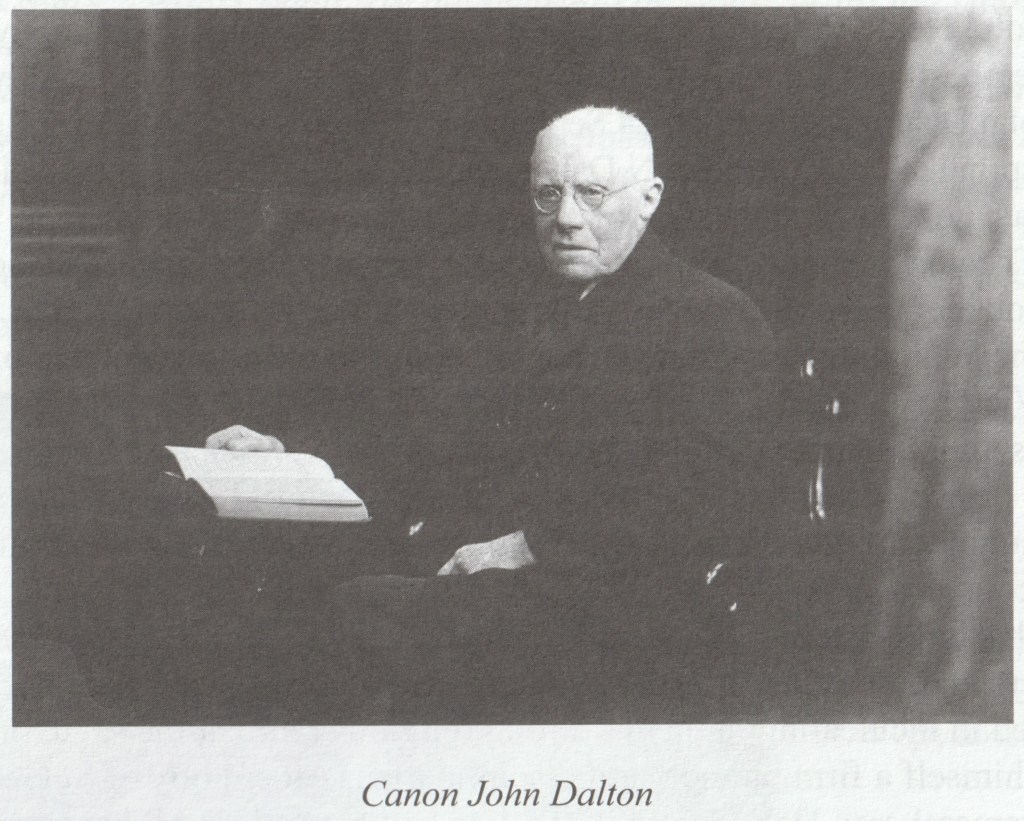
For over 660 years the College of St George in Windsor Castle has enfolded and endured within its walls numerous individuals of unconventional, even eccentric propensities; none more so than the Revd Canon John Neale Dalton. Dalton was a man of many talents and many flaws, whose tempestuous Canonical career at St George’s spanned some 46 years.
John Dalton was born on 24 September 1839 on the Isle of Thanet, one of nine offspring of the Revd John N Dalton and his wife, Eliza. After school in Blackheath he won a scholarship to Clare College at Cambridge where he took a First in Theology. After curacies in Milton Keynes and Cambridge, fortune’s wheel took him to his third curacy in Whippingham on the Isle of Wight.
The Whippingham curacy brought Dalton to the observant eye of Oueen Victoria at nearby Osborne House and it was this circumstance which led to his appointment in 1871 as tutor to the Queen’s grandsons, the seven year old Prince Albert Victor (Eddy) and the six year old George. Despite the over-indulgent interference of their mother, the Princess of Wales, Dalton, by most accounts, seems to have served his young charges tolerably well. Although short on academic qualifications he was, in compensation, long on the understanding of, and empathy with, small boys, besides which he succeeded in inculcating in them a strong religious faith; at the same time he showed himself a firm but not hard disciplinarian. An old boy of St George’s School remembered Dalton years later: ‘He had a mystique all his own, having spanked the King as a boy, when Dalton was his tutor’.
Dalton’s moral influence on the boys was not matched by noticeable success in the academic fields. Lady Geraldine Somerset acidly observed of liddy: ‘His ignorance! Lamentable. What on earth stupid Dalton has been about all these years! He has taught him nothing’. Much later an even weightier opinion was voiced. Queen Mary, as she became, trenchantly remarked: ‘He never really tried to educate the Princes. It was disgraceful that the King had not been taught more’. Nevertheless, as Duchess of York, she did not baulk when in 1901, as domestic chaplain, Dalton accompanied her and the Duke on their eight month tour of the Empire.
In 1877 Dalton persuaded the Queen that both Princes would benelit from a spell on the Training Ship Britannia where he remained with them as tutor for the next two years. Much debate then ensued in Royal circles, which extended to the Cabinet. Whereas the former eventually agreed with Dalton’s plans for the two Princes to embark on the Royal Naval Cruiser HMS Baccante for a round the world voyage preceded by two shorter ones, which would last three years, the latter objected that to submit the second and third heirs to the throne to identical dangers was a risk too far. Dalton, with characteristic anger, tendered his resignation which, the Queen having refused, the Cabinet gave way. Thus from 1879 at the age of 40, Dalton, as Chaplain and tutor to his Royal charges, embarked on board ship and on the next stage of his long career.
How far Dalton was successful in the pursuit of his duties on HMS Baccante 1s debatable. Assuredly, his concentration on their moral upbringing reaped future dividends, perhaps more so in the case of the younger boy than in the elder. However, most later accounts are in accord that whilst the strictures already quoted may be a little too severe – and those of Richard Davenport-Hines in the Oxford Dictionary of National Biography betray extreme feelings of dislike and prejudice against Dalton – he did experience difficulty in implanting any great seeds of knowledge in his pupils. Nevertheless, the Royal Family had no qualms about their choice of tutor. The Princess of Wales, in particular, corresponded regularly with him and thanked him ‘for giving up so much time and trouble to prepare them for Confirmation’. She was, admittedly, less enthusiastic about his choice of reading matter: ‘Though I have no doubt that Dumas’ novels are very interesting, I cannot help thinking that novels are not useful reading and do the boys no good’. One wonders how HRH would have viewed Harry Potter.
Immediately after the return of the Baccante, Dalton accompanied Eddy on a not very productive academic six months at Cambridge. He thereafter busied himself in the production of two large volumes of some 1500 pages ostensibly containing the Princes’ account of their voyage based upon their diaries or notes and letters but Dalton’s role was criticised as being less of cditing and more of composition. Nevertheless, he concludes his Preface: ‘The three years thus spent afloat a Chaplain in Her Majesty’s Naval Service, | shall always regard as among the happiest in my life’.
The Queen was undoubtedly satisfied. Dalton was appointed a Chaplain to Her Majesty, a Commander of the Order of St Michael and St George and, more significantly, to a Canonry at St George’s Chapel. Given his father’s addiction to cigars, Prince George’s introduction by Dalton to the delights of cigarette smoking was doubtless regarded as a bonus rather than the heinous crime it would have appeared in the more ‘enlightened’ days of the twenty-first century.
The Windsor Canonry
Appointment to St George’s enabled Dalton to marry a girl half his age whom he had been courting for the past three years, Kitty Evan-Thomas, sister of an Admiral, by whom he had a daughter and two sons. The elder of these, Hugh, subsequently achieved fame, if not universal adulation, as Chancellor of the Exchequer in Attlee’s post-war government until forced to resign over a budget leak.
For most, if not all, of his sojourn at St George’s, Dalton and his family lived in number 25 The Cloisters, the greater part of which was, until lately, occupied by the Warden of St George’s House. Hugh became a godson of Prince Eddy and his brother of Prince George, underlying the royal esteem in which he was held.
When Dalton was installed in 1885, the Dean was Dr Randolph Davidson, subsequently Archbishop of Canterbury. Although Hugo Vickers writes that Dalton’s ‘presence loomed over the College of St George from 1884 to 1931’, it does rather seem that until Davidson quitted Windsor in 1890 to become Bishop of Rochester, Dalton was contented to play himself in. He even wrote eulogistically of the Dean: ‘He was quiet and cheerful, very self contained but so natural, a charming Chairman. He could be firm when need arose, and when he said a thing had to be done, it was done.’
Even under Davidson, however, there were portents of things to come. The courteous and cultured Canon Courteney, for once in his life, was so enraged at a Daltonian transgression that he exploded: ‘I tell you what it is, Dalton. I wish we were back in school-days — I would kick your bottom hard.’
This period of comparative quietude was not to last. With the arrival of the new Dean, Philip Eliot, Dalton began to spread his overwhelming wings, making his ‘disturbing personality‘ as Eliot’s successor called it, so disruptive that the hitherto amicable corporate nature of the College was imperilled. When Dean Baillie succeeded Eliot in 1917, Bishop Davidson told him: ‘Your great difficulty will be Canon Dalton’ and he had scarcely taken up residence when Lord Stamfordham, the King’s secretary, confirmed this warning and added, for good measure, ‘It’s not too much to say that Dalton has made your predecessor an unhappy man for a quarter of a century’. The King himself, although ever loyal to his old tutor, counselled Baillie to do his best, although acknowledging that Dalton could be very difficult to work with.
Many memorable vignettes of Dalton’s time at Windsor spring from a host of sources. At the 1905 Obit Service his three quarters of an hour dedication ensured that the Dean was obliged to abandon his sermon. The following day’s newspaper reported, ‘Amusing incident in St George’s Chapel. Canon does the Dean out of his sermon.’ The Dean was not amused.
The dramatic volume of his penetrating voice was prodigious and was exercised with scant regard for his surroundings. On one occasion he walked through the Cloisters shouting, ‘Those damned minor Canons – all fools.’ On another, at Evensong, he suddenly announced loudly, ‘Thank God I have neither nerves nor a conscience.’ In the Chapel one morning, Hector Bolitho, commented upon the oddity that deceased Englishmen were frequently sculptured with their dogs and horses and enquired: ‘Why are there so few memorials to their wives?’ In his booming voice Dalton replied: ‘I suppose they loved their dogs and horses more.’
The same Canon Courtney was accustomed always to bow or to shake hands by way of greeting. In the vestry one morning, he held out his hand to Dalton who ignored it. Unabashed, Courtney bowed to the formidable Canon at which polite gesture Dalton thundered: ‘I am not an altar.’
Bolitho recounts an evening as a guest of Dalton at a dinner of the Drapers’ Company of which Dalton was Chaplain and subsequently Master. On leaving the Castle he remarked to the policeman on the gate: ‘Have a wheelbarrow here for Mr Bolitho when we come home. He will need it’, and on their return was heard to declare, ‘Good night. Never refuse a glass of good wine. It’s sacrilege, sir. It’s sacrilege!’
Russell Thorndike when a chorister at St George’s, recalled an incident one St Andrew’s day. Before giving his address Dalton spent so interminable time on his knees that the minor canon si gnalled the choir quietly to file out. As they reached the organ screen Dalton returned to earth and in a stentorian bellow uttered the one word, ‘Andrew’, sending the choir and clergy scuttling back to their stalls. An absent Lay Clerk said he heard the cry ‘Andrew’ in his house in the Horseshoe Cloisters.
A tale is told of another example of the Canon’s bizarre behaviour. A party of American tourists was seeking entrance to the Chapel, which happened that day to be closed. On the point of giving up they espied Dalton approaching the North Door, key in hand. Rushing up they were met by a firm shake of the head: ‘You mustn’t come in here. I am just going to commit suicide.’
Canon Dalton’s reading of the lessons negated any tendency to congregational somnolence. His thespian utterances were anything but banal, ranging, it was said, ‘from high falsetto to thunderous bass.‘ His rendering of the passage ‘My Father hath chastised you with whips, but I will chastise you with scorpions’, reverberated sonorously throughout the Chapel and the Verger, after a visitor’s comment on a particular reading, was heard to reply, ‘Ah, sir, but you should hear him throw down Jezebel.‘ George V would sometimes remark: ‘Let us go and hear the Canon roar!’
With the arrival of Dean Baillie in 1917, Dalton’s baleful influence became even more marked. The new Dean possessed a proud lineage. His forebears included that Earl of Elgin of marbles fame who had danced with Marie Antoinette, a Viceroy of India, British Minister in Washington, a Governor of Edward VII as Prince of Wales and a Lady in Waiting to Queen Victoria. Dalton, however, secure in the affections of the King, had no intention of submitting to new decanal discipline any more than he had to the old. Baillie described his unruly subordinate thus: ‘It was obvious to me that Canon Dalton would play an important part in my life at Windsor. The prospect of his being difficult did not frighten me; I had often dealt with difficult men and found that through patience, friendliness and self control, any barriers could be broken down. In John Neale Dalton I found a man beyond the difficulties of whose character and personality I was not once able to penetrate. This habit of instinctive and immediate contempt was Dalton’s chief weakness. It was an almost unbearable irritation to him even to think that there were other people who had an equal right with him to a voice in the Chaplaincy. He approached every meeting determined to fight over the smallest details only to prevent his colleagues, whom he despised, from having their way.’
The fact that Baillie in his autobiography expended several pages on the subject of his recalcitrant Canon tells its own story.
A part of Dalton’s rancour undoubtedly derived from disappointment that, despite his closeness to the King, he was not himself offered the Windsor Deanery. It was indeed recorded that when he heard the news Dalton ‘Gave the King one of the worst hours he had ever spent.’
At Baillie’s Installation, Dalton’s intervention presaged future discord. The officiating Canon mistakenly prayed for Queen Victoria instead of King George. Dalton’s voice echoed round the Quire: ‘Silly old fool’ he declaimed.
Well could Baillie reflect despondently on Archdeacon Grantley’s rhetorical question in Barchester Towers ‘Where on earth can a man have peace and rest if not in a Deanery?’
It must not be thought that Dalton’s incumbency was devoid of all merit. He was a distinguished scholar and theologian. Inter alia, he translated the St George’s statutes and was responsible for the conversion of the then Choir School into a full scale preparatory school in 1893. Dalton was a competent Hebrew scholar and he published a translation of the Psalms. The Chapel Archives reveal the extent and eclecticism of this aspect of his character.
Dalton was a catalyst for the aspirations of JW Clarke and WH St John Hope, the authors of the Architectural History of Windsor Castle. He was exceedingly interested in the erection of the King’s Beast on the Chapel roof between 1819 and 1926, and conducted an erudite correspondence on the subject with the architect Brakespeare and with Garter. He argued with Baillie about the effects of their weight. Tellingly, the latter wrote to him: ‘You know that I hate differing from you and never do so unless I think something very important is involved …‘ He also had an extensive sympathetic correspondence with incumbents of various of the Chapel benefices and an arcane and vigorous exchange of views on such subjects as the correct spelling of ‘Diocletianus’, and the history of the Pectoral Cross at the Coronation of Edward VII. To a functionary at St Paul’s Cathedral he wrote: ‘You complain of my putting a bomb under your Choir. Let me ask is there a place more proper?’
Dalton’s industry was phenomenal. He had advised with regard to Alfred Gilbert’s effigy on the Duke of Clarence’s tomb in the Albert Memorial Chapel. Evidently he enjoyed the approval of Edward VII by whom he was unsuccessfully recommended as Dean of Exeter.
Sir Walford Davies, whose respect he enjoyed, looked back as a choir boy on Dalton’s ‘Vision, strength and kindly humour.’ Another described him as “A notable scholar and a forceful character … an impressive and Imposing figure.” He designed the Choir School Memorial Window and wrote an account of the Saints represented in it. Yet another former choir boy wrote: ‘I think Canon Dalton was the cleverest man I ever met. He had a very good knowledge of Latin, Greek and Hebrew, two more modern languages and I remember his learning Spanish in preparation for a holiday in that country. He was also very interesting to listen to on scientific subjects at the Albert Institute in Sheet Street.’
The years closed in. When Bolitho first met him in 1926 he saw ‘a crinkled old man stumbling through the last of his eighties’ and referred to him in Chapel the following year as ‘a face hung between the candles like a parchment mask.‘ Yet Dalton remained intellectually active to the very end. On 27 July 1931 aged nearly 92, he read the lesson at Evensong with his customary vigour. He died peacefully in the early hours of the following day.
Hugo Vickers, writing unequivocally, called his sojourn ‘A reign of terror’. With Christian charity, however, the long suffering Dean wrote: ‘I never ceased to appreciate Dalton’s loveableness. I suppose I saw that his actions were the product of an undisciplined mind and not of a bad heart; that his weaknesses were constitutional.’
Dalton never lost the esteem of the King by whom he had been appointed a KCVO at the beginning of the reign. He recorded his death in his diary as: ‘My oldest and most intimate friend …. I have always been devoted to him.’
Although his antagonisms were perhaps rooted more in the contempt of personalities rather than theological dissent, Canon Dalton as he entered the gates of Heaven may well have remembered the words of Dean Liddell at the ordination of Arthur Stanley, husband of Dean Baillie’s aunt: ‘Few have entered into [religious] controversy without repenting of it.’
His ashes lie with those of his wife beneath a black stone slab in the South Quire Aisle.
John E Handcock
Bibliography
TRH Prince Albert Victor and Prince George of Wales The Cruise of HMS Baccante 1879-82.
Baillie, The Very Revd AV My First Eighty Years.
Battiscombe, Georgina Queen Alexandra and John Neale Dalton (Friends and Descendents Report 1986-87.
Begent, Peter and Chesshyre, Hubert The Most Noble Order of the Garter.
Bolitho, Hector My Restless Years and The Romance of Windsor Castle.
Bond, Shelagh The Monuments of St Georges Chapel.
Davenport-Hines, Richard Dalton, John Neale (Oxford Dictionary of National Biography).
Hibbert, Christopher Edward VII.
Hodgson, Frederic Choirs and Cloisters.
Rose Kenneth King George V.
Russell, Richard Carven Arches, and Soaring Vaults.
St Aubyn, Giles Edward VII Prince and King.
Thorndike Russell Children of the Garter.
Vicars, Hugo and Elizabeth St Georges Chapel, Windsor.
Wridgeway, Neville The Choristers of St Georges Chapel
 Windsor Local History Group