
Published in Windelsora 2 (1983)
© WLHG
Part of a medieval hearth was unearthed at 17, Knight’s Close, Windsor, when the owner, Mr. David Garrett, was digging out the foundations for a fishpond. He reported to the writer that he had uncovered an area of tiles on edge which he felt might be of archeological interest.
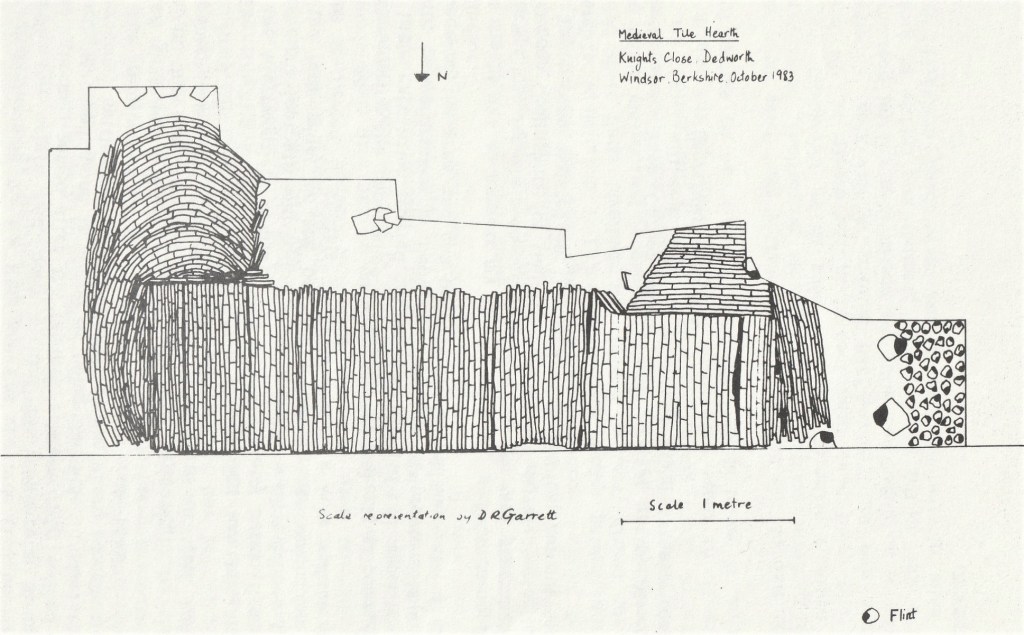
An excavation was launched and an area roughly five by two metres was uncovered, revealing an early medieval hearth measuring over four metres in length and varying in width. (See plan). The feature was manufactured of red roofing tiles placed on edge in parallel rows. An area of two and a half by one metre in the centre of the feature, being well worn, seemed to indicate the original hearth, after which four sets of cleaner tiles seem to have been added as extensions. The area to the north, which lies under a concrete path, may well have been destroyed.
The surface of the hearth showed signs of heavy burning and samples of the charcoal were taken for a possible Carbon 14 dating. The floor area surrounding the feature was made up of clay with chalk and charcoal which was possibly originally mixed with straw. The floor descended for a depth of 20cm onto what appeared to be a natural clay. To the west of the hearth was a surface of compacted flint with some larger flints. This proved too wide for a wall foundation but may well have supported something substantial.
The hearth was at a depth of 60cm from the surface which is abnormally deep for a feature of this period. This was explained when the upper layer was removed and found to contain modern materials to a depth of 58cm. Undoubtedly the area was disturbed and perhaps built up when the housing estate was developed. This disturbance of the layers above the hearth resulted in very few medieval small finds being made and consequently a lack of datable evidence. Fortunately three pieces of red pottery, representing a jar and a shallow dish with broad rims, and evidence of green glaze, could be dated to the period AD 1350 or thereabouts. As these were found on the surface of the hearth and the flint area, it would indicate that the features had an earlier foundation date.
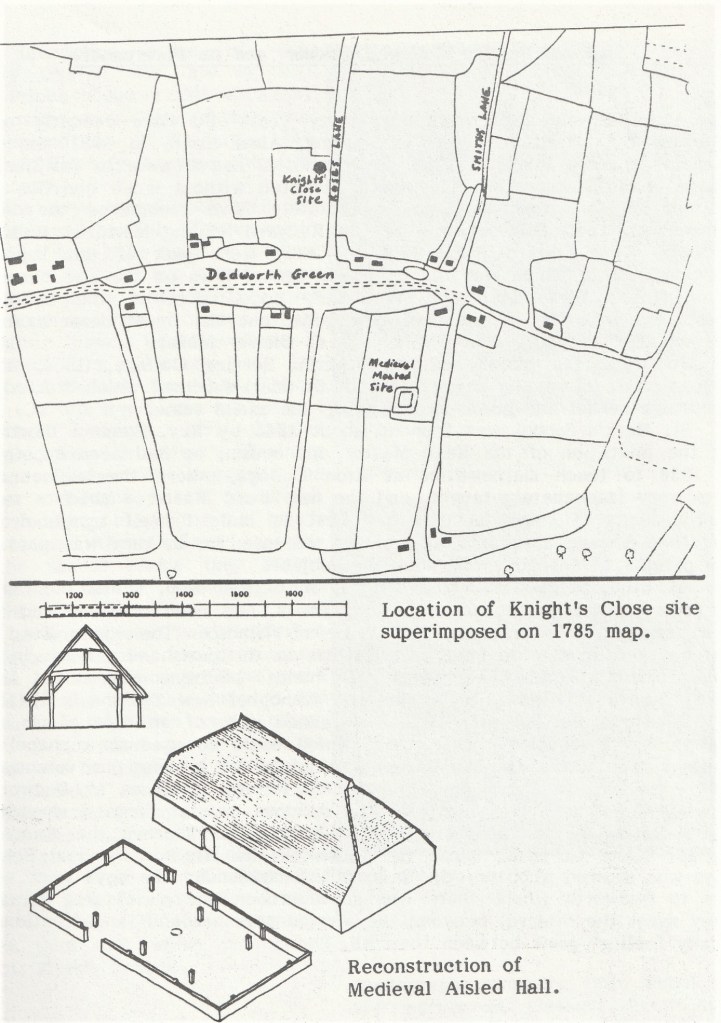
The size of the hearth indicates that it must have been connected with a medieval building of considerable proportions, possibly an early manor house. Hearths of this type were known throughout the medieval period and could have been located in the centre of the building or against a side wall. A pre-1350 building in this area is perhaps most likely to be an aisled hall with the hearth in a central position. In this case the size of the garden would preclude any chance of locating the outer walls of the hall, which may have been destroyed by modern
development.
Knight’s Close now lies within the parish of Clewer but research indicates that the site was at one time located in the Domesday manor of Dedworth. In 1086, the Manor, then known as Dideorde, was held by Albert of Lotheringia for the King and was one hide (120 acres) in size. By 1200, the estate had been divided into Dedworth Maunsell and Dedworth Loring, named after the families concerned. In a deed of 1204, Dedworth Maunsell alone is stated as being one hide in size, so perhaps the Domesday settlement was increased in area. Early documents do not show the relative locations of these manors but possibly they were situated north and south of Dedworth Green, this being the bounds of the forest. In this case the building in Knight’s Close might be the site of one manor house and the excavated moated site in Wolf Lane behind Forest Road, the site of the other.
The Knight’s Close building is on ground that has lain undisturbed until the mid twentieth century. The site is directly beside Roses Lane, a very ancient footpath and hollow way. There is some evidence to suggest that the lane might be the bed of an old stream which ran into the Thames at Clewer. If so, this would have been & very suitable siting for a large house.
Considering the importance of Windsor as a medieval town, there has been little excavation carried out in the area and this dig is perhaps the first to be undertaken in Dedworth. As such it provides important new evidence of the area and can be recorded as another part of the history of Windsor.
I should like to express my thanks to David and Christine Garrett of Knight’s Close for their co-operation and for the site plan; Judith Hunter and Gordon Cullingham for their encouragement and the basic map, and to John Tayler who assisted on the excavation and carried out some of the research.
Luke Over
 Windsor Local History Group