
Escheators and Felo de se in the fifteenth century
Published in Windlesora 32 (2016)
© WLHG 2016
An Escheator was a local official responsible for escheats. In broad terms, he was responsible for the maintenance and safeguarding of the rights of the feudal lord or king, as well as holding the majority of Inquisitions Post Mortem, although a few were conducted by appointed commissioners.
Even though it had long been condemned as a mortal sin by the Church, it was in the thirteenth century that Fe/o de se (felon of himself – an ancient legal term for suicide) became a crime under common law in England. In order to return a verdict of suicide it had to be proved that the person was sane before the event.
As the felon’s belongings were forfeit to the Crown or feudal lord, and the Escheator’s duty was to value and sell the forfeit goods, so
the suicide of an adult male could reduce his survivors to pauperism.*1
Sadly that ignominy was not the end for the families. For anyone declared a suicide, a Christian burial was denied them. Their bodies were taken at dead of night to a crossroads, buried without ceremony, ritual, prayers, or mourners, and their body pinioned to the ground with a wooden stake.
A horrifying end for a sad soul, during a period when religious belief was strong. As time passed, courts took a more kindly view and often declared the victim ‘insane. This ensured a decent burial and prevented the forfeiture of goods to the Crown.
William Fynchamsted of Eton hanged himself most likely on 23rd September 1419. We have no details as to why he did so, but as suicide was a felony at this time, William’s earthly possessions were forfeit. As we can see from the report following, his few possessions were sold and the proceeds paid into the Exchequer.
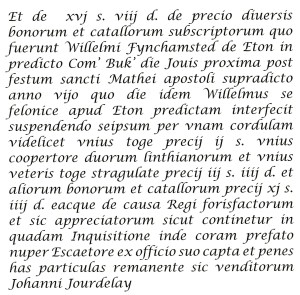
And 16s. 8d. from the value of divers goods and chattels below written which belonged to William Fynchamsted of Eton, in the aforesaid county of Buckinghamshire, on the Thursday after the feast of St Matthew the apostle in the abovesaid 7th year, on which day the same William feloniously killed himself at Eton aforesaid, hanging himself by a rope, that is a coat worth, 2s., a coverlet, two sheets and an old striped coat worth 3s. 4d. and other eoods and chattels worth 11s. 4d., and for that reason forfeited to the king and so valued, as contained in an inquest taken before the aforesaid former Escheator pursuant to his office and returned with these particulars, thus sold to John Jourdelay.
Elias Kupfermann and Carol Dixon-Smith
References
- Sleepless souls: Suicide in early modern England, Michael MacDonald and Terence R Murphy, Oxford University Press, 1990
 Windsor Local History Group